
Meta
Meta · AR / VR · Filed Mar 20, 2026 · USPTO published Oct 1, 2026 · Oct 1 release
Meta Patents a Headset System That Mutes Audio When Others Are Listening
Meta has filed a patent for a system that can detect when multiple people are tuned into the same audio stream and automatically mute the sensitive parts. It pairs that trick with a separate ultrasonic sensing method that could sharpen how wearables "feel" their environment.
- Publication number
- US 2026/0301726 A1(US20260301726A1)
- Applicant
- Meta Platforms Technologies, LLC
- Filed · Published
- Mar 20, 2026 · Oct 1, 2026
- Inventors
- Gengxi Lu, Francesco Marsili, Danielle Gelb, Ryan Alexander Chavez
- Status when we published
- Waiting for an examiner
- Document
- 2 claims
- US classification
- 381/71.1
- Parent application
- Claims priority from a provisional application 63781668 (filed Apr 1, 2025)
What Meta's listener-detection audio muting actually does
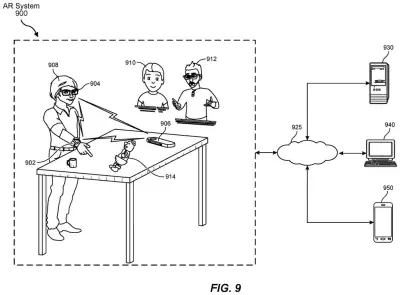
Imagine you're wearing a pair of AR glasses on a crowded train, listening to a private voice message. Someone nearby plugs into the same stream, or the device notices sound is leaking to another listener. Instead of playing on regardless, the device detects the situation and mutes the parts of the audio that shouldn't be shared.
That's one half of what Meta describes in this patent. A system spots when more than one person is receiving an audio stream at the same time, then automatically silences the portion that was meant to be private. The other listener hears a gap rather than your private content.
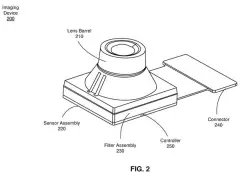
The same filing also covers a separate sensing technique. An array of tiny sensors fires a sound pulse, records the echo, reverses it in time, and fires it again. That process refines the echo into a cleaner signal, which could help a device map surfaces, detect motion, or sense what's around it with greater accuracy.
… a method for detecting, by a system, a plurality of users concurrently listening to an audio stream, muting, by the system, at least a portion of the audio stream, and transmitting the audio stream comprising the muted portion of the audio stream.
Translation: The system detects when multiple people are listening to the same audio and automatically mutes parts of it.
How the sensor array catches and reverses sound pulses
The patent covers two distinct methods bundled into a single filing.
Method one: listener detection and muting. A system monitors an audio stream for signs that multiple users are receiving it at the same time. When it detects concurrent listeners, it identifies a portion of the stream as private and mutes it before transmission continues. The muted audio is still sent as a placeholder, so the stream doesn't break, but the content is withheld.
Method two: time-reversed ultrasonic sensing. This is the more technically involved piece. An array of sensors fires a pitch-catch waveform (essentially a sound pulse sent from one point and caught at another). The system then:
- Records that waveform
- Reverses it in time (plays it backwards, a technique used in acoustics to focus signals)
- Emits the reversed version
- Records the echo that bounces back (pulse-echo measurement)
- Combines the echo with the reversed original to produce a cleaner final signal
Time-reversal in acoustics is a known way to sharpen a signal: imperfections in the original transmission tend to cancel out when the wave is played back in reverse and the echo is captured. The result is a more precise measurement of whatever the sound reflected off.
What this means for private audio on AR glasses and headsets
For anyone using Meta's Ray-Ban glasses or a future headset in public, automatic audio privacy detection would be a meaningful quality-of-life feature. Right now, if audio leaks or is intercepted, there's no automatic backstop. A device that can notice and react to that situation in real time addresses a real privacy gap.
The ultrasonic sensing method is harder to tie to a specific product today. Time-reversal signal processing is used in medical imaging and structural testing, but in a wearable context it could improve gesture detection, surface mapping, or proximity sensing. How far Meta is from fitting that hardware into a consumer device is the open question.
Meta's 70th filing we've tracked in the AR glasses race since May adds to a picture that includes shared AR objects fixed in place and lenses built into the frame.
Source: US 2026/0301726 A1 at the USPTO (PDF). Full patent text and figures are in the official publication.
Get our take in your Top Stories
Liked this breakdown? Add Patentlyze as a preferred source on Google, and our plain-English take shows up more often in your Top Stories the next time Meta patent news breaks.
Add Patentlyze on Google
One click.
There are more where this came from
We read every patent application Big Tech publishes and send you the ones worth knowing. Plain English, free, every week.
The drawings · 24 sheets
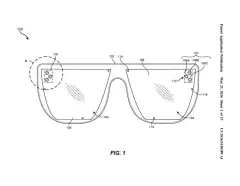
24 drawing sheets from US 2026/0301726 A1 · click any drawing to enlarge


Show the other 16 sheets


More from Meta
All 192 Meta patents →
More in AR / VR
All 713 AR / VR patents →
Meta
Meta Patent Reveals AR Glasses That Translate Text Before You Read It
Meta
Meta Patents AR and VR Devices That Learn to Read Hand and Eye Sequences
Meta
Meta Patents a Disambiguation System for Ray-Ban Glasses That Asks You to Clarify What You're Looking At
Meta
No comments yet