
Meta Patents a System That Keeps Shared AR Objects Fixed in Both Users' Rooms
Two people in different cities put on AR headsets and sit down to work on the same virtual project, but right now, the shared objects float in awkward places because their rooms are different shapes. Meta's new patent describes a way to fix that automatically.
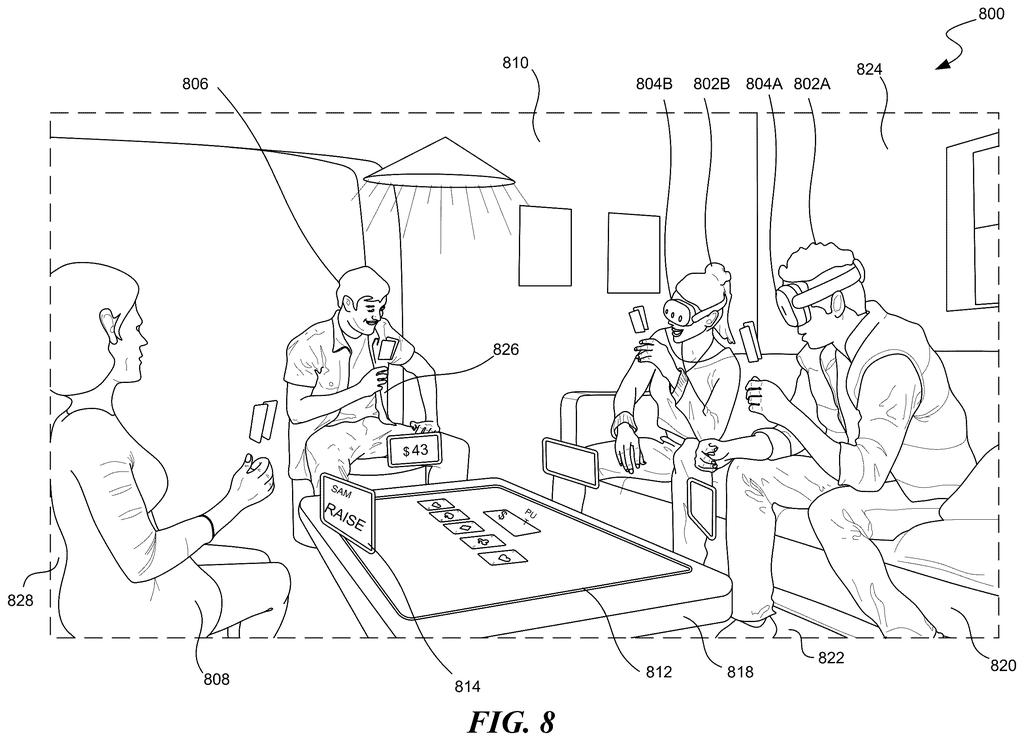
How Meta syncs virtual furniture across two different rooms
A friend in Tokyo and another in Toronto put on their AR headsets and try to share a virtual whiteboard. The board shows up perfectly for one of them but clips through a couch for the other, because the system never accounted for the fact that the two rooms are laid out completely differently.
Meta's patent targets exactly that problem. The system scans each person's physical space (the size, the furniture, the open floor area) and finds spots in each room that are roughly equivalent. Then it picks a shared "anchor point" in each room, so that a virtual object sitting at the anchor in Tokyo appears in a matching location at the anchor in Toronto. Same relative position, same orientation, in both places.
You would still be in your own room, but any shared virtual content would land where it actually makes sense given your physical space, not somewhere arbitrary. The system can also account for things like whether a virtual object needs a wall or a tabletop to sit on, and where other users' avatars are already standing.
… facilitating rendering of one or more virtual objects, in the extra reality environment, such that the position and orientation of each virtual object, relative to the first origin point on the first extra reality system, is the same position and orientation that the virtual object has relative to the second origin point when rendered on the second extra reality system.
Translation: It locks shared digital items into the exact same spot and angle for both users.
How the system scans, matches, and places shared origin points
The patent describes a multi-step process for placing shared virtual content in a way that works for everyone in a mixed-reality session, regardless of how different their physical rooms are.
First, the system collects scene data from each user's environment, essentially a spatial map of the room that includes things like room dimensions, furniture layout, and open floor space. It then analyzes both maps to find areas that are functionally comparable: for example, an open stretch of floor in Room A that resembles an open stretch of floor in Room B.
Once a matching area is found, the system picks an origin point for each user within that matching area. The origin point is like a pin on a map: every virtual object in the shared session is positioned relative to that pin. Because both origin points were chosen based on matching real-world geometry, a virtual table that sits one meter in front of User A's origin will also sit one meter in front of User B's origin, even though the two rooms are physically separate.
The system also applies constraints before finalizing the origin point. A virtual painting, for instance, needs a wall. A virtual board game needs a table. The patent says the system can filter candidate origin points to make sure the surrounding geometry actually supports what the virtual content requires. Existing avatars in the session and where they are already standing can also influence the choice.
… selects origin points, within real-world spaces, relative to which virtual content can be placed, that make shared activities more natural and intuitive, while keeping the relative positions for any shared virtual objects intact.
Translation: The software aligns two different rooms so shared digital objects stay right where they belong.
What this means for social AR and mixed-reality meetups
For social AR and mixed-reality collaboration to feel natural, shared virtual objects need to land in sensible places for everyone at once. Today, multi-user AR experiences often require all participants to manually align their spaces or accept that shared objects will appear awkwardly. A system that does this automatically, by reading each room and finding the best common anchor, removes one of the biggest sources of friction in shared headset sessions.
If this approach works in practice, it could make Meta's Quest platform significantly more useful for things like remote co-working, shared gaming, or social hangouts where participants expect objects to behave the same way for everyone. Meta's track record in copresence patents suggests this is an area the company is investing in seriously, not just filing defensively.
Meta's 69th filing we've tracked in the AR glasses race since May builds on ideas like lenses built into frames and typing on flat surfaces.
Claim 1 covers any method that scans two physical rooms, finds areas between them that are compatible, picks anchor points from that comparison, and then places shared virtual objects so both people see them in the same relative positions. The claim does not specify a particular device, a particular way of measuring rooms, or any precise definition of what makes two spaces compatible enough to match.
That scope is wide. Any system that makes two people feel present in the same virtual space, regardless of where they physically are, has to solve exactly those four steps in exactly that order. The claim describes the coordination problem itself, not one company's particular solution to it.
If granted, this would give Meta a foundational claim over the basic mechanics of social augmented reality, covering any shared AR experience before specific features or interfaces even enter the picture.
There are more where this came from
We read every patent application Big Tech publishes and send you the ones worth knowing. Plain English, free, every week.
The drawings
14 drawing sheets from US 2026/0303692 A1 · click any drawing to enlarge


Want this weekly breakdown for a company we don't cover? Patentlyze Pro →
Be the first to weigh in