
Amazon Patents a System That Translates Product Listing Images Without Breaking the Layout
Product listing images are full of text that almost never gets translated when sellers go global. Amazon is filing a patent that would change that automatically, without a human designer touching the file.
What Amazon's auto-translated product images actually do
Every time a seller lists a product on Amazon in one country, that same image, with its English callouts, arrows, and feature labels, shows up for shoppers in Germany, Japan, or Brazil. The text on the graphic stays in the original language because swapping it means a designer has to reopen the file, retype everything, and hope the translated words still fit.
Amazon's patent describes a system that handles this automatically. It scans a product image, figures out which text blocks should be translated (like a feature callout) and which ones should stay put (like a brand name or logo), erases the text that needs to go, translates what it removed, and then redraws the layout so the new words fit cleanly.
The end result is a localized image where the product photo looks the same but the words are in your language. No designer required, no awkward machine-translated text awkwardly jammed into a space built for English.
… classify a first portion of the text as text to be translated and a second portion of the text as text not to be translated; group the one or more lines of the text associated with the first portion of the text into one or more semantic groups; translate, each of the one or more semantic groups of the first portion of the text, from the first language to a second language; …
Translation: The system sorts the text to decide what needs translation and groups related phrases together before converting them.
How the system removes, translates, and rebuilds image text
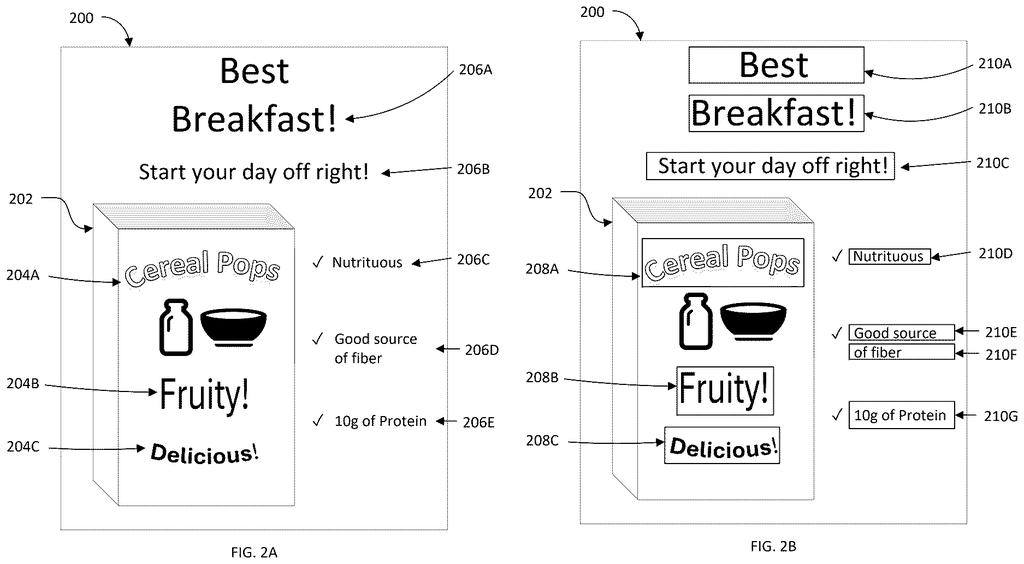
The system starts by detecting all text inside a product infographic and drawing invisible bounding boxes around each line. It then runs a classifier to sort the text into two buckets: text that should be translated (feature descriptions, usage instructions) and text that should stay in the original language (brand names, model numbers, logos).
The lines that need translating are grouped into semantic groups (meaning the system tries to keep related sentences together rather than translating line by line, which would produce choppy, out-of-context results). Each group is then passed through a translation engine.
With translations in hand, the system creates an empty image by scrubbing out only the translatable text, leaving the product photography, icons, and brand text untouched. It then recalculates the text layout, because translated text rarely takes up the same space as the source, and reflows the text boxes to fit. Finally, it composites the translated text back onto the cleaned image.
The claim is careful about what it calls a "localized image": the product looks identical to the original, just with the written copy swapped into the target language, with the layout adjusted so nothing overflows or looks squished.
The to-be-translated text is removed from the image to create and empty image. The to-be translated text is translated from a first language to a second language. The layout of the empty image is modified based on the translated text. The translated text is superimposed on the modified empty image.
Translation: It wipes out the original words, adjusts the background layout to fit the new language, and then pastes the translated text back on top.
What this means for global Amazon shoppers and sellers
For shoppers, this means product detail pages could one day show you infographics that actually explain features in your language, instead of a professionally lit photo with English text you have to squint at and guess. That matters most for technical or health-related products where the callouts carry real information.
For sellers, Amazon keeps filing around cross-border commerce automation, and this fits that pattern: the less manual work required to list a product in a new market, the lower the barrier for small sellers to go global. The system's ability to preserve brand names and logos while translating everything else is a practical detail that shows this was designed with real catalog constraints in mind, not just as a proof of concept.
Amazon's 82nd filing we've tracked since May in our Amazon coverage follows a robot car confusion warning and an AI that recalls old chats.
Amazon's path to shipping this is short. It's a software invention, meaning no new hardware has to be built or bought. The pieces that need to exist first, translation engines and the ability to read and edit images automatically, Amazon already operates at scale.
The hard part is the layout step, where translated text has to fit inside a fixed image without spilling over graphics or shrinking to the point of uselessness. Languages like German or Finnish can run 30 to 40 percent wordier than their English source, and product images are far less forgiving than a webpage that can just reflow around longer words.
If that layout problem is solved reliably, sellers who upload images in one language could reach foreign shoppers without redesigning anything themselves. That is useful infrastructure for a global marketplace, and shoppers would simply see cleaner product pages without knowing anything changed.
There are more where this came from
We read every patent application Big Tech publishes and send you the ones worth knowing. Plain English, free, every week.
The drawings
6 drawing sheets from US 2026/0301258 A1 · click any drawing to enlarge


Want this weekly breakdown for a company we don't cover? Patentlyze Pro →
Be the first to weigh in