
Amazon Patents an AI That Remembers Your Old Conversations Without Being Asked
You ask your smart speaker a question, and without you saying a word about it, the AI realizes you're picking up a conversation you had last Tuesday on your phone. That's exactly what Amazon is trying to build.
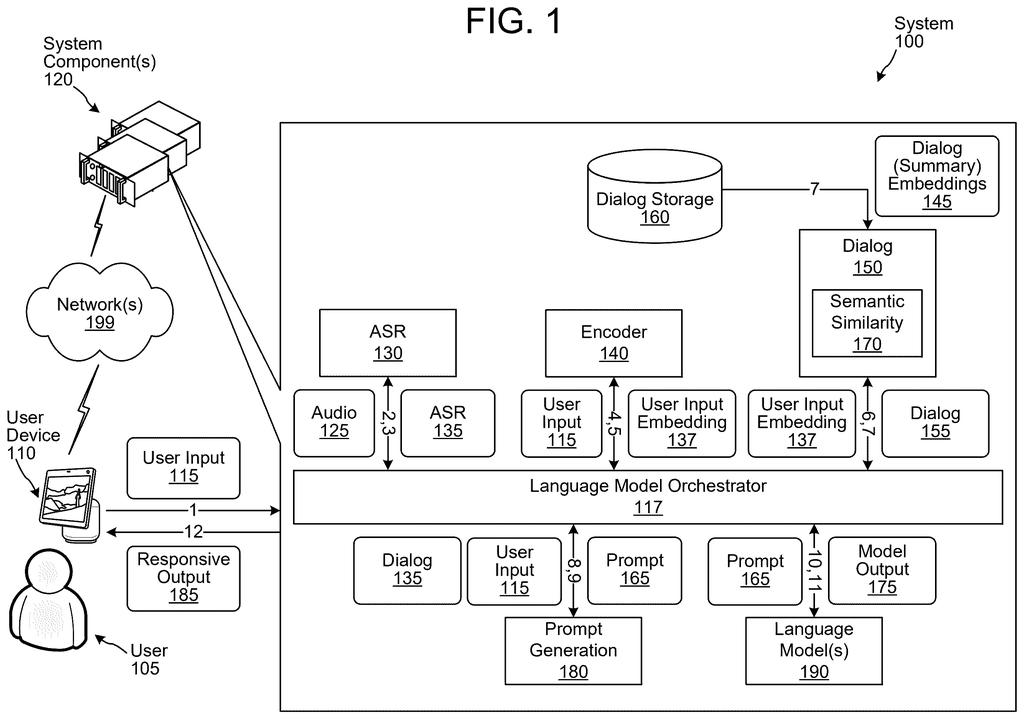
How Amazon's assistant recalls past conversations
Every time you ask an AI assistant something, it usually treats your question as if nothing came before it. You might be in the middle of planning a trip, switch devices, walk away, and when you come back, you have to re-explain everything from scratch.
Amazon's patent describes a system that compares your new question to a library of your previous conversations. If your new question is close enough in meaning to something you discussed before, the AI automatically pulls that old conversation in as background context, so it can give you a more useful answer.
If your new question matches more than one past conversation, the system politely asks which one you meant. And if nothing matches, it just answers normally. The whole process happens behind the scenes, and you never have to say "resume my previous conversation."
… determining second embedding data associated with the user identifier, wherein the second embedding data corresponds to a semantic representation of a summary of a user-system dialog that was performed using a second user device …
Translation: The system looks up past conversations linked to your user account from any of your devices.
How the system matches new questions to old chats
The patent describes a method that works in four main steps:
- Transcription: When you speak, the system converts your voice to text.
- Embedding generation: The text is turned into a kind of numeric fingerprint (called an "embedding") that captures the meaning of what you said, not just the exact words.
- Similarity check: That fingerprint is compared against stored fingerprints of summaries from your past conversations. If two fingerprints are close enough in meaning, the score crosses a threshold.
- Context injection: If there's a match, the old conversation is bundled into the prompt sent to the AI language model, so the model treats it as background when forming its answer.
A key detail: the system stores summaries of past conversations rather than full transcripts, which keeps storage manageable and protects some privacy. It also tracks which user is speaking via a user identifier, so conversations don't bleed between accounts.
The matching works across devices. You could start a conversation on your phone and the system can recognize the follow-up question you ask later on a smart speaker, without you making any connection explicit.
Techniques for enabling a user to resume a user-system dialog, without the user explicitly requesting resumption of the dialog, are described.
Translation: Methods are outlined that let you pick up an old conversation thread without having to ask the assistant to remember it.
What this means for Alexa and everyday AI assistants
For anyone who uses AI assistants regularly, re-explaining context is one of the most frustrating parts of the experience. You've been planning a vacation, asking about hotels and flights, then you close the app. The next day you ask "what about the weather there in June?" and the assistant has no idea what "there" means.
This patent targets that friction directly. If it works as described, the AI would understand that "there" refers to the destination you were researching yesterday, and answer accordingly. Whether this ends up in Alexa or Amazon's broader AI products isn't stated in the patent, but the mechanism is clearly aimed at making AI assistants feel less forgetful across long stretches of time and multiple devices.
Amazon files its fifth patent in the AI assistant and agent space we've tracked since May, adding to earlier work like turning requests into commands and compressing model weight tables.
The practical win here is simple: you can pick up a conversation where you left off without having to remember that you had it, or tell the assistant to go find it. If you asked for help planning a trip last Tuesday and come back with a follow-up question today, the system connects those two moments on its own.
The failure this prevents is the frustrating restart, where you explain your whole situation again because the assistant has no memory of you. Most people absorb that friction without naming it, but it shapes whether they trust the tool enough to use it again.
The real test is whether the matching works accurately enough to stay invisible. A wrong connection, where the assistant pulls in an old conversation that has nothing to do with your question, would feel stranger and more disorienting than starting fresh. That calibration is what determines whether users feel helped or confused.
There are more where this came from
We read every patent application Big Tech publishes and send you the ones worth knowing. Plain English, free, every week.
The drawings
11 drawing sheets from US 2026/0301737 A1 · click any drawing to enlarge


Want this weekly breakdown for a company we don't cover? Patentlyze Pro →
Be the first to weigh in