
Sony Patents a Container File Format That Blocks Unauthorized Copies of Out-of-Sync Media
Sony has filed a patent for a new kind of media container that embeds special instructions required to play back "asynchronous" content, making unauthorized copies much harder to reproduce correctly.
What Sony's asynchronous media lock actually does
Most video and audio files today are straightforward: copy the file, and you can play it anywhere. Sony's new patent targets a specific category of content where audio and video don't tick along in perfect lockstep, which the patent calls "asynchronous media," and describes a way to wrap that content in a file format that requires a special parsing step before playback can begin.
That parsing step reads a set of embedded instructions that describe how the out-of-sync media should be decoded and displayed. Without those instructions being read correctly, the file either won't play or won't play right. A raw copy of the encoded data, without the metadata telling a player how to handle it, becomes effectively useless.
The upshot: if you pull the encoded media out of the container without also extracting and honoring the asynchronous media information, you get a broken or unplayable result. It's a design that ties the content to its own rulebook.
an encoding unit which encodes media data of an asynchronous media to be reproduced asynchronously, to generate media encoded data; and a file generation unit which generates a container file and stores the media encoded data and asynchronous media information in the container file …
Translation: The system encodes out-of-sync media and packs it into a special file alongside metadata that labels it as asynchronous.
How the container file enforces the playback condition
The patent describes an information processing apparatus with two main jobs: encoding and file generation.
First, an encoding unit takes media data that is meant to play asynchronously (meaning its components don't share a common clock or timing reference) and compresses it into encoded data. Think of content where different streams, say a spatial audio track and a video layer, need to be coordinated at playback time rather than pre-synchronized at production time.
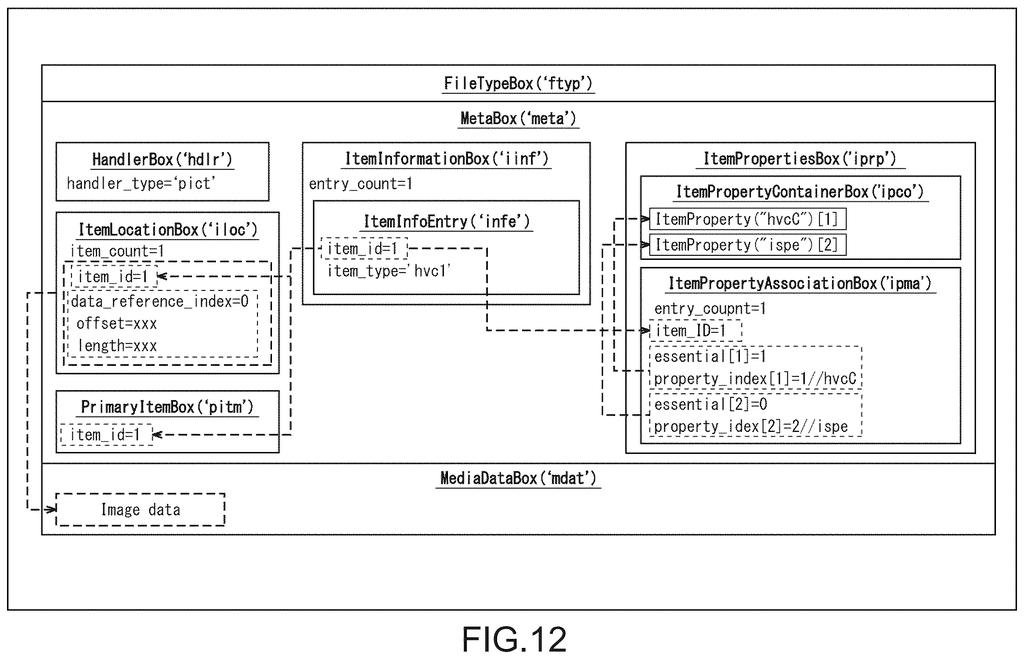
Second, a file generation unit wraps that encoded data inside a container file alongside a special metadata block called asynchronous media information. This metadata block does two things: it flags the content as asynchronous, and it carries the instructions a player must parse (read and interpret) before it can decode and render the media correctly.
On the playback side, a compliant device reads the container, parses those instructions, checks them against a reproduction condition (a set of allowed playback rules), and only then decodes and outputs the media. The chain looks like this:
- Container file is opened
- Asynchronous media information is parsed
- Decode happens according to the parsed rules and reproduction condition
- Rendered output is sent to a display or speaker
The key protection is that the encoded data and the parsing instructions are stored together but treated as inseparable: copying only the encoded data leaves you without the rulebook needed to play it.
… the asynchronous media information is parsed, the media encoded data of the asynchronous media is decoded in accordance with a result of the parsing and a reproduction condition, media data obtained by the decoding is rendered to generate output information …
Translation: The player reads this hidden metadata to decode and display the media correctly only if reproduction conditions are met.
What this means for copy-protected media formats
For Sony, which sells content through PlayStation, Sony Pictures, and its music labels, controlling how media files can be reproduced is a long-standing priority. A container format that bakes in playback conditions at the file-generation stage could give Sony a way to enforce copy restrictions at a lower level than traditional DRM overlays, which are often stripped out by widely available tools.
For everyday users, this is mostly invisible until it isn't: if you buy content in a Sony format and try to play it on an unsupported device or extract the file, the asynchronous media information layer is what would stop it from working. The practical effect is similar to existing copy protection schemes, but the mechanism is different enough that it may sidestep tools designed to crack older formats.
Sony's 554th filing in our Sony coverage since May continues a memory-saving video thread, following a compression overhead cut and a file-shrinking memory fix.
Locking the playback rules and the encoded content inside the same file is a clever way to make unauthorized copying harder, but it also makes the file harder to move between devices and services. Consumers have a long memory for formats that don't play where they expect them to.
The protection depends entirely on keeping the parsing step difficult to crack. That's a bet on sustained secrecy, which tends to erode over time as motivated people pick at it.
The focus on asynchronous media, content where timing shifts depending on how you experience it, like spatial audio or branching video, is where the real technical problem lives. Protecting that category matters. Whether a container-level lock is the right tool, or whether it just moves the vulnerability somewhere else, is the question this patent leaves open.
There are more where this came from
We read every patent application Big Tech publishes and send you the ones worth knowing. Plain English, free, every week.
The drawings
43 drawing sheets from US 2026/0303844 A1 · click any drawing to enlarge


Want this weekly breakdown for a company we don't cover? Patentlyze Pro →
Be the first to weigh in