
Samsung Patents Speakers That Retune Themselves as You Fold Your Phone
Every time you fold or half-fold your phone, the speakers end up in a completely different acoustic situation. Samsung has filed a patent for a system that notices this and adjusts each speaker's sound profile automatically.
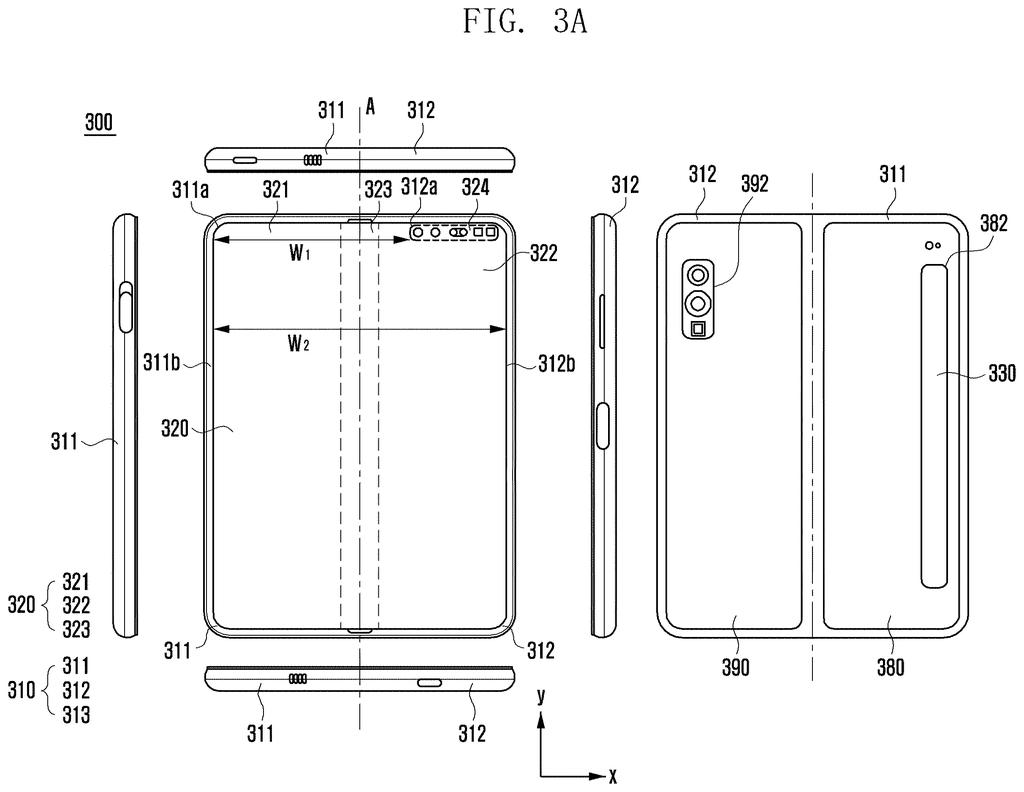
What Samsung's fold-aware speaker tuning actually does
A foldable phone lies flat on a table, both halves open, playing music through two speakers. Then someone picks it up and folds it shut, or props it halfway like a little tent. The speakers are now pointing in different directions, bouncing sound off different surfaces, and the audio that sounded balanced a moment ago can turn muddy or uneven.
Samsung's patent describes a system that tracks the phone's physical state and rebalances each speaker's audio profile on the fly. Open flat gets one set of sound settings. Folded closed gets another. And that middle position, the half-open tent stance many people use for video calls, gets its own logic too, where one speaker might keep its open-flat profile while the other switches to a different one.
The goal is that you shouldn't have to dig into audio settings every time you reposition your phone. The device handles it.
determine, based on sensing data from the at least one sensor, whether the electronic device is in a first state in which the first housing and the second housing are unfolded, a second state in which the first housing and the second housing are folded to face each other, or a third state intermediate between the first state and the second state …
Translation: Sensors detect whether the folding phone is completely open, closed shut, or somewhere in between.
How the device detects fold angle and adjusts each speaker
The patent covers a foldable device with a speaker in each housing half, a hinge connecting them, a flexible display that spans both, and at least one sensor that monitors the device's physical state.
The processor recognizes three distinct conditions:
- First state: fully unfolded (flat), where both speakers share the same sound frequency profile
- Second state: fully folded closed, where each speaker independently receives a different frequency profile (the patent calls these the second and third output characteristics)
- Third state: partially open, an intermediate angle where one speaker keeps the open-flat profile and the other is assigned either the closed-flat or the fully-folded profile depending on orientation
Sound frequency characteristics here means the EQ-style shaping of audio output, essentially which frequencies (bass, midrange, treble) each speaker emphasizes or pulls back. When the phone is closed, one speaker might be face-down or obstructed, so pushing certain frequencies harder or softer compensates for that physical constraint.
The sensor data driving all of this could come from a hall-effect sensor or accelerometer that tracks hinge angle, the same hardware most current foldables already carry for other purposes.
The electronic device controls sound frequency characteristics of the first and second speakers to have first sound frequency characteristics with the electronic device being in the first state.
Translation: The phone adjusts how the speakers sound depending on whether the device is currently opened flat.
What this means for audio on foldable phones
Foldable phones already ship with two speakers, but most treat audio tuning as a static setting. If you fold your Galaxy Z Fold mid-call or prop it up for a video, your audio experience degrades because the software doesn't know the physical situation has changed. A system like this one would close that gap without asking anything of you.
Samsung's long bet on foldable devices makes this kind of refinement a natural priority. The audio edge case isn't glamorous, but for a category where the whole pitch is versatility across multiple postures, getting sound right in each posture is part of delivering on that pitch.
Samsung's 80th filing we've tracked since May on foldable phones, following work on a slimmer sealed border and an antenna for closed phones, adds another piece to the picture.
Claim 1 covers any foldable device that senses whether it is fully open, fully closed, or at some middle angle, and then adjusts how each speaker sounds depending on which of those three positions the device is in. The claim says nothing about which sensors detect the angle or how the audio adjustments are calculated, so it wraps around the behavior itself, not any particular way of achieving it.
That breadth matters in practice because most people use foldable phones propped at an angle, and that middle position is explicitly covered here, not tucked away as a footnote. Any manufacturer shipping automatic speaker tuning across all three fold positions would land inside this claim.
If granted, this gives Samsung a broad hold over the basic logic of reading a fold and responding with speaker-level changes, which means the protection follows the feature wherever it appears on a foldable phone.
There are more where this came from
We read every patent application Big Tech publishes and send you the ones worth knowing. Plain English, free, every week.
The drawings
21 drawing sheets from US 2026/0304041 A1 · click any drawing to enlarge


Want this weekly breakdown for a company we don't cover? Patentlyze Pro →
Be the first to weigh in