
IBM's New Patent Teaches AI Chatbots to Respond Like Seasoned Specialists
Most AI chatbots sound the same no matter who you're talking to. IBM is patenting a way to make them mirror the communication style of actual subject-matter experts, in real time, without retraining the underlying model.
What IBM's expert-style AI chatbot actually does
Ever noticed how a doctor, a lawyer, and a customer-support rep all explain the same problem differently? That difference in tone and framing matters. A generic AI chatbot tends to flatten all of that into the same breezy, one-size-fits-all voice.
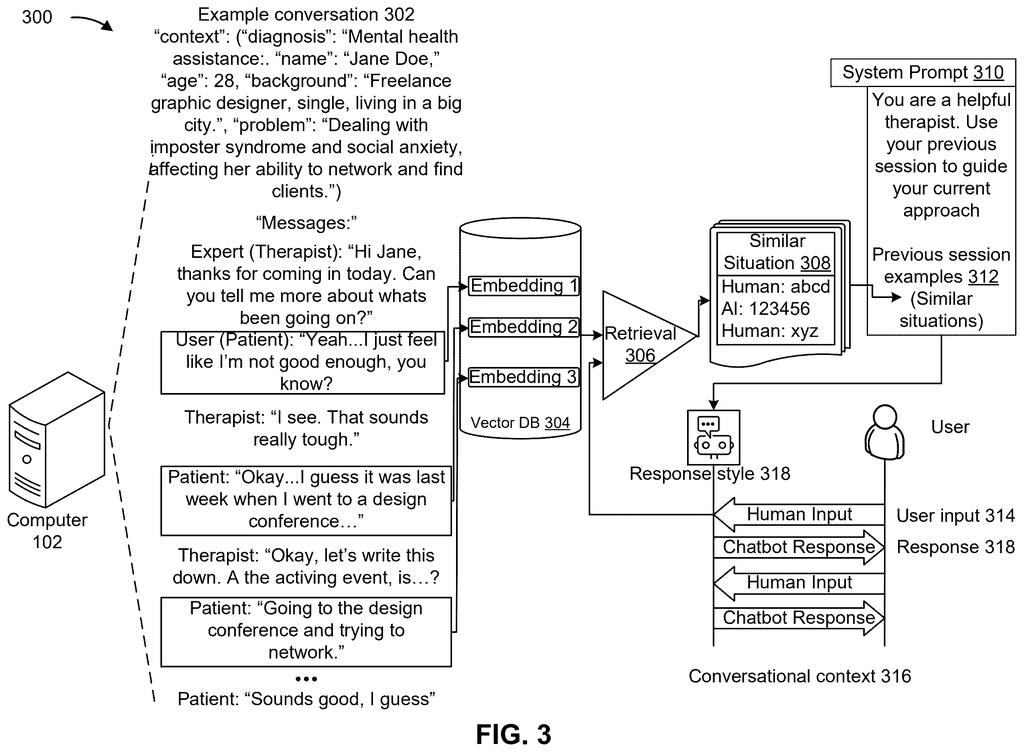
IBM's new patent describes a system that pulls from a library of real expert-to-user conversations whenever you ask a question. It finds the examples most similar to what you just said, then feeds those examples to the AI as a kind of style guide before it answers. The result is a response shaped to match how a real expert in that field would actually talk.
Critically, this happens without changing the AI model itself. No retraining, no fine-tuning. The style borrowing happens live, every time you send a message. Think of it as giving the AI a quick briefing before each answer instead of sending it back to school.
… constructing a system prompt associated with the user input by inserting the set of relevant example conversations into the system prompt as few-shot examples that teach a large language model (LLM) a response style; …
Translation: It builds a custom prompt filled with expert examples to train the AI on how specialists talk.
How the system borrows expert tone without retraining
The system starts with a vector database (a special index that stores conversations as mathematical fingerprints so they can be searched by meaning rather than keywords). When a user sends a message, the system finds stored example conversations between human experts and users that are semantically similar to what was just asked.
Those retrieved examples are slotted into a system prompt, which is the behind-the-scenes instruction set the AI reads before composing its reply. The examples function as few-shot demonstrations, a technique where you show an AI a handful of examples of the behavior you want rather than rewriting its core code. The AI reads those examples and infers the desired tone, vocabulary level, and explanation style.
The actual response is then generated using in-context learning, meaning the style adaptation lives entirely inside the prompt, not inside the model's parameters. The underlying large language model is never modified.
The key claim is that this works at inference time, the moment a user asks something, rather than during an expensive training or fine-tuning phase. That makes the approach significantly cheaper and faster to deploy than traditional style-customization methods.
The computer system may search a vector database for relevant example conversations between experts and users based on semantic similarity between the user input and indexed user utterances in the vector database.
Translation: The system hunts through past chats to find ones that match the meaning of what the user just asked.
What this means for AI tools in specialized fields
For anyone using AI tools in a specialized field, such as healthcare, legal, or financial services, tone and framing aren't cosmetic. A response that sounds like a knowledgeable colleague lands very differently than one that reads like a Wikipedia summary. IBM's track record in enterprise AI patents suggests this is aimed squarely at that kind of professional deployment, where generic assistant behavior is often a dealbreaker.
For end users, the practical upside is an AI that feels calibrated to the context rather than identical across every conversation. For businesses deploying AI tools, the appeal is style customization without the cost and complexity of retraining a model every time you want it to sound different.
IBM's 35th filing we've tracked in AI assistant and agent patents since May adds to a run that includes one on meeting-running agents and one on layered fact-checking.
From a shipping standpoint, this idea requires no new hardware and no rebuilt AI. The whole approach rests on a searchable library of example conversations and a step that pulls the right examples before the AI replies, both of which software teams already know how to build.
The library is the real prerequisite. A system that learns tone from expert conversations can only be as good as those conversations, and collecting a well-organized set of them for any specialized field is hard work that has to happen before development even begins.
Once that library exists, the path to a working product is short. The idea solves a familiar frustration, that AI assistants sound the same whether they're advising a tax lawyer or a first-time homebuyer, and fixing that through examples rather than rebuilding the underlying AI is a practical and economical approach.
There are more where this came from
We read every patent application Big Tech publishes and send you the ones worth knowing. Plain English, free, every week.
The drawings
7 drawing sheets from US 2026/0300373 A1 · click any drawing to enlarge


Want this weekly breakdown for a company we don't cover? Patentlyze Pro →
Be the first to weigh in