
Microsoft Patents a System That Gives Each Meeting Attendee Their Own Role-Specific AI Assistant
Instead of one AI notetaker for the whole meeting, Microsoft is patenting a system that reads the room, figures out who should be doing what, and assigns each person their own specialized AI assistant tuned to their role.
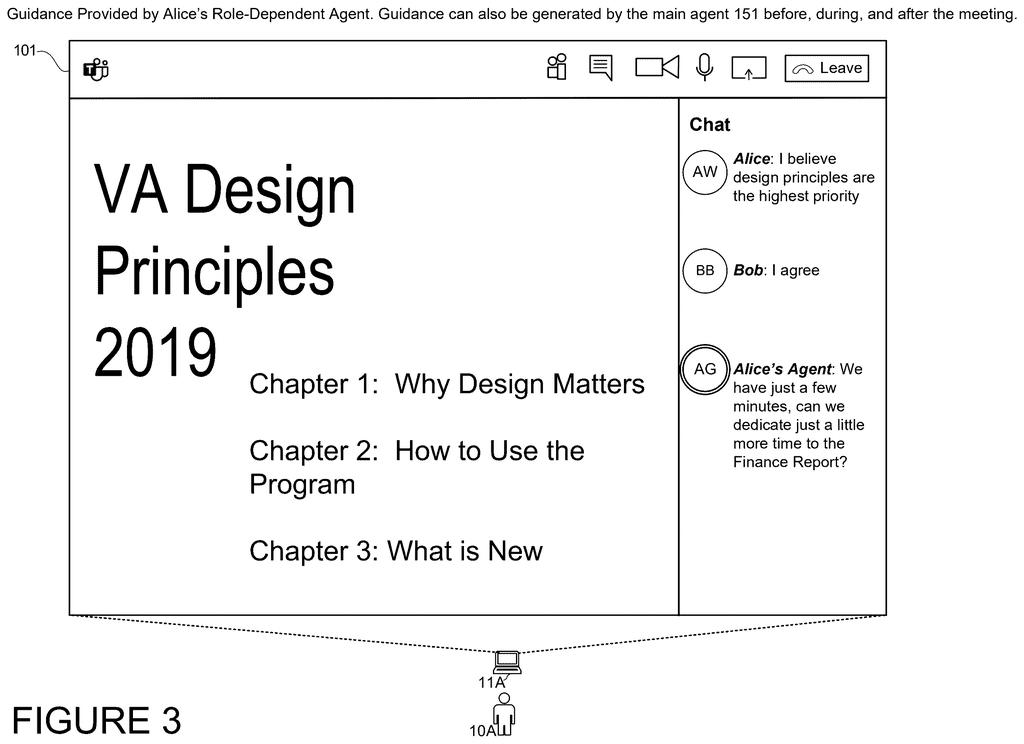
What Microsoft's per-person meeting AI actually does
Imagine you're in a product review meeting with your manager, a designer, and someone from legal. Right now, if your video call app has an AI assistant, everyone gets the same one doing the same things. Microsoft's patent describes something different: an AI system that figures out what the meeting is actually for, then assigns each person a role and gives them their own assistant built around that role.
The system pulls from the meeting agenda, prior chat messages, and even what people are saying live to decide who should be doing what. If you're the decision-maker in the room, your AI might track open questions and push you toward a conclusion. If you're presenting, yours might coach you through the material. The idea is that each AI only does the job relevant to that person's role, and stays out of what everyone else's assistant is handling.
It's a direct response to one of the real frustrations with AI in meetings: a one-size-fits-all assistant often helps nobody very well. This approach tries to make the AI feel less like a shared tool and more like a personal coach sitting next to you.
… according to each assigned individual role, deploying an individual agent for each of the individual participants of the subset of participants, wherein the individual agent is configured to perform a first set of functions that map to the individual role of the individual participant …
Translation: The system launches a custom AI assistant tailored to each person based on what job they need to do.
How the system matches roles to people and deploys agents
The patent describes a multi-step process that runs before and during a meeting to assign individualized AI agents to participants.
First, the system analyzes context from several sources: the calendar invite and agenda, any Slack-style messages sent before or alongside the meeting, and the live spoken conversation itself. From that, it identifies what tasks the meeting needs to accomplish.
Next, it maps those tasks to individual roles (think facilitator, presenter, decision-maker, action-item owner) and then matches those roles to specific participants. The matching isn't random: the system looks at each person's profile attributes and their observed activity, including how much they're speaking, what they've written in related threads, and the content of the live discussion, to decide who fits each role best.
Once roles are assigned, the system deploys a separate AI agent for each participant who has a role. Critically, each agent is isolated: the agent assigned to the facilitator performs one set of functions and operates independently from the agent assigned to the presenter. A participant who isn't assigned a role gets no agent at all. The patent specifically claims these agents are "separate and operate independently" from each other, which suggests the architecture is designed to prevent agents from interfering with or duplicating each other's work.
The techniques disclosed herein provide a dynamic streaming decision hierarchy for multiple artificial intelligence (AI) agent assistants in meeting systems.
Translation: Microsoft patented a system that manages a team of different AI helpers during a single conference call.
What this means for people who sit through a lot of meetings
For anyone who has tried AI meeting tools and found them generically useful at best, this patent describes the gap those tools leave open. A single AI that summarizes the whole meeting is helpful in a shallow way; an AI that knows you're the one supposed to make a decision by the end of the call, and coaches you toward that, is something different.
Microsoft's track record in AI-for-meetings patents suggests this fits into a broader effort to make tools like Teams feel less like productivity software and more like active participants. Whether this ever ships in a recognizable form is another question, but the underlying problem it's solving is real: most meeting AI today helps everyone equally, which often means it helps no one particularly well.
Microsoft's 32nd filing we've tracked since May on AI models working in teams adds to a pattern that includes a three-AI security system and an AI with a self-checking critic.
Meeting software today gives everyone the same AI summary after the call ends. This idea changes when the help arrives and who it's aimed at: during the meeting, the person running the agenda gets one assistant, the decision-maker gets another, and the note-taker gets a third, each nudging them toward their specific job in real time.
The moment you'd feel the difference is when you're drifting outside your lane and something pulls you back, or when you're supposed to own a decision and the AI keeps surfacing the right information instead of burying you in everyone else's context.
The real risk for users is that the system has to figure out your role automatically, from agenda text and how much you've been talking. If it reads the room wrong, it spends the whole meeting coaching you toward someone else's responsibilities, which is more disorienting than no help at all.
There are more where this came from
We read every patent application Big Tech publishes and send you the ones worth knowing. Plain English, free, every week.
The drawings
13 drawing sheets from US 2026/0303390 A1 · click any drawing to enlarge


Want this weekly breakdown for a company we don't cover? Patentlyze Pro →
Be the first to weigh in