
Microsoft Patents an AI That Decides Faster Whether Your Voice Is Real
Voice authentication systems usually need to hear you out before deciding if you're really you. Microsoft's new patent trains AI to make that call much earlier in the process, cutting wait times while keeping imposters out.
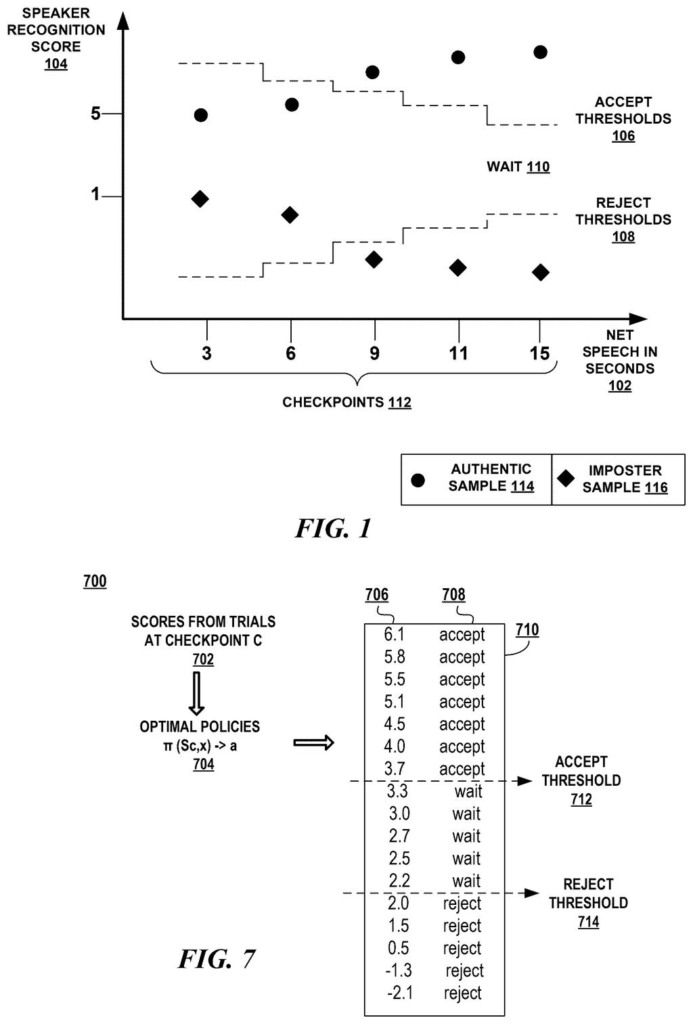
How Microsoft cuts the waiting in voice ID checks
Ever tried to unlock something with your voice and felt like it was taking forever to confirm who you are? That pause happens because the system is comparing your voice against a stored profile, and it typically waits until it has processed everything before it makes a judgment call.
Microsoft's patent describes a way to pre-compute what it calls "decision thresholds," essentially confidence levels that tell the system, "you've already heard enough to be sure, make the call now." Instead of always waiting until the very end, the system can stop early when the evidence is already clear, either to say "yes, that's them" or "no, that's not."
The key is that these early stopping points are calculated in advance using thousands of real voice tests, both from the real user and from imposters trying to get in. The system learns which early checkpoints carry enough information to be trustworthy, so it isn't just guessing. You get a faster response, and the security bar doesn't drop.
… generate, through reinforcement learning, an optimal policy for each state of the MDP that achieves a maximum cumulative reward …
Translation: It uses trial and error learning to find the best strategy for deciding quickly.
How the system learns when it has heard enough
The system generates a set of decision thresholds for a voice authentication process by running thousands of test recordings through a pipeline before deployment. Each recording is an "imposter" sample or a genuine user sample, and the system scores each one at multiple points during playback.
At every checkpoint, it measures two error rates: the false acceptance rate (FAR) (how often an imposter gets let in) and the false rejection rate (FRR) (how often the real user gets locked out). These rates are then used to build a Markov Decision Process (MDP), a mathematical model that maps out every possible situation the system might encounter and assigns a value to acting early versus waiting longer.
A reinforcement learning algorithm (similar in concept to how game-playing AI learns which moves pay off) then finds the optimal policy for that model, determining at each checkpoint whether to accept, reject, or keep listening. Rewards inside the model are structured to favor stopping earlier without allowing accuracy to slip below acceptable limits.
The output is a lookup table of accept and reject thresholds for every checkpoint. When the system is live, it simply checks the current score against those thresholds at each step and stops the moment a threshold is crossed, skipping any unnecessary processing.
… used in real-time for the system to make a decision to accept or reject a voice input at an earlier checkpoint with minimal accuracy loss …
Translation: It lets the system judge your voice sooner without sacrificing accuracy.
What faster voice checks mean for people using voice login
For you as a user, the practical payoff is a voice login that feels snappier. If the system is already 99% certain after hearing two seconds of your voice, it doesn't need to wait for the full five-second clip to finish. That might sound small, but in a world where voice authentication gates everything from smart speakers to call-center accounts, shaving off those seconds adds up across millions of interactions and reduces compute costs.
Microsoft's long bet on voice and identity shows up here in a meaningful way. The design also has a security angle worth noting: because the thresholds are calibrated against real imposter samples before the system ever goes live, the early-exit shortcuts are not guesses. The system should not be meaningfully easier to fool just because it makes faster decisions.
Microsoft's 465th filing in our Microsoft coverage since May adds to a privacy thread that includes scrubbing medical audio and isolating a single voice on calls.
Someone calling their bank clears the voice check faster, sometimes halfway through what the system used to need to hear, and the call just moves on. That moment of friction, already annoying when you are on hold, gets shorter without any noticeable drop in accuracy.
The system does its heavy thinking before the call ever happens, using thousands of recorded samples to decide in advance how much of your voice it actually needs to hear. By the time you are speaking, the answer is already mostly worked out.
The real risk is that those pre-built cutoffs are only as reliable as the recordings behind them. If those samples lean toward certain accents or speaking styles, some callers will wait longer or get rejected incorrectly, and they will have no idea why.
There are more where this came from
We read every patent application Big Tech publishes and send you the ones worth knowing. Plain English, free, every week.
The drawings
6 drawing sheets from US 2026/0301746 A1 · click any drawing to enlarge


Want this weekly breakdown for a company we don't cover? Patentlyze Pro →
Be the first to weigh in