
Microsoft
Microsoft · AI / ML · Filed Jun 8, 2026 · USPTO published Oct 1, 2026 · Oct 1 release
Microsoft Patents an Image Search That Looks for Meaning, Not Just Pixels
Most image search tools look for visually similar pictures, matching colors, shapes, and textures. Microsoft's new patent describes a system that skips all that and asks a different question: do these two images mean the same thing?
- Publication number
- US 2026/0300384 A1(US20260300384A1)
- Applicant
- Microsoft Technology Licensing, LLC
- Filed · Published
- Jun 8, 2026 · Oct 1, 2026
- Inventors
- Manish GUPTA, Niraj Nrisinvha BHILEGAONKAR, Avishek MAZUMDER, Akash KATARE
- Status when we published
- Waiting for an examiner
- Document
- 20 claims
- US classification
- 707/741
- Parent application
- Continuation of 18/970,647 (filed Dec 5, 2024)(18970647)
What Microsoft's meaning-first image search actually does
Imagine you take a photo of a busy street intersection with a traffic light on the left and pedestrians crossing on the right. You want to find other images that capture that same scene setup, not images that look identical, but images where the relationships between things are the same. A standard search engine would struggle with that. Microsoft's patent describes a system that can do exactly this.
Instead of comparing raw pixels or colors, the system analyzes what elements are in an image and how they relate to each other. It encodes that relational structure into a compact form, stores it in a database, and when you drop in a query image, it finds stored images that share the same underlying structure of meaning.
The result is a search tool that can recognize, say, that a photo of a dog sitting next to a child is meaningfully similar to a cartoon drawing of the same setup, even if the two images look nothing alike at first glance.
… extracting, using one or more machine-learned models, semantic structure information from the query image, the semantic structure information representing relationships among elements depicted in the query image …
Translation: AI is used to figure out how the different objects in your photo relate to one another.
How the system extracts and compares image meaning
The core of the patent is what Microsoft calls semantic structure information: a machine-generated description of the relationships between objects in an image, not just a list of what's there, but a map of how things connect.
Here's how the process works:
- A machine-learned model (an AI trained to understand image content) scans each image and pulls out its structural meaning. Think of it as generating a relational blueprint rather than a pixel fingerprint.
- Those blueprints are stored in an index (a fast-lookup database optimized for search).
- When you submit a query image, the same extraction process runs on it, and the system compares your image's blueprint against the stored ones.
- Images whose relational structure closely matches yours are returned as results.
The claim is specifically about relationships among elements, not just element detection. Two images could contain dogs and children but arrange them differently, and the system would treat them as distinct. Two images could look very different but share the same spatial and semantic relationships, and the system would flag them as similar.
The patent does not specify a single model architecture, leaving room for various approaches, which suggests the inventors are staking out the broader method rather than one specific implementation.
… an image search is performed based on a query image where the result includes images with semantic information that matches the query image …
Translation: The system finds other pictures that share the same underlying meaning and context as your search image.
What this means for finding images in search and at work
For everyday users, this kind of search could make tools like Microsoft's Bing Image Search or OneDrive photo organization far more useful. Right now, searching images by meaning requires typing text descriptions. With a system like this, you could drop in an image and find conceptually equivalent photos across huge libraries, without having to describe what you're looking for.
For businesses, the implications go further. Design teams, stock photo platforms, legal discovery, and media archives all deal with the problem of finding images that capture a specific situation rather than a specific look. Microsoft's run of AI-powered search filings points to a company building out the infrastructure to make this kind of contextual retrieval a standard capability, not a specialty tool.
Microsoft filed its 71st application in Language AI we've tracked since May, adding to work like one grouping cloud alerts and one flagging document gaps.
Source: US 2026/0300384 A1 at the USPTO (PDF). Full patent text and figures are in the official publication.
Get our take in your Top Stories
Liked this breakdown? Add Patentlyze as a preferred source on Google, and our plain-English take shows up more often in your Top Stories the next time Microsoft patent news breaks.
Add Patentlyze on Google
One click.
There are more where this came from
We read every patent application Big Tech publishes and send you the ones worth knowing. Plain English, free, every week.
The drawings · 12 sheets
12 drawing sheets from US 2026/0300384 A1 · click any drawing to enlarge


Show the other 4 sheets


More from Microsoft
All 681 Microsoft patents →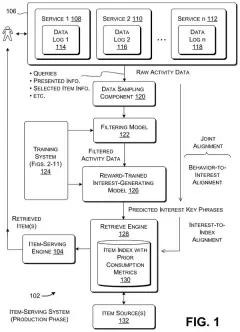
More in AI / ML
All 2,738 AI / ML patents →
Google
Google Patents an AI That Stops Thinking About Words It Already Understands
Google
Google Patents an AI That Decorates Your Documents Around What You Type
Google
Google Patents a Search System That Splits Your Query into Tasks and Learns From Your Clicks
Google
No comments yet