
Microsoft Patents a Touchscreen That Knows When Water Is Fooling It
Water on a touchscreen has always looked a lot like a finger to the device. Microsoft's new patent describes a system that learns the difference, and acts on it.
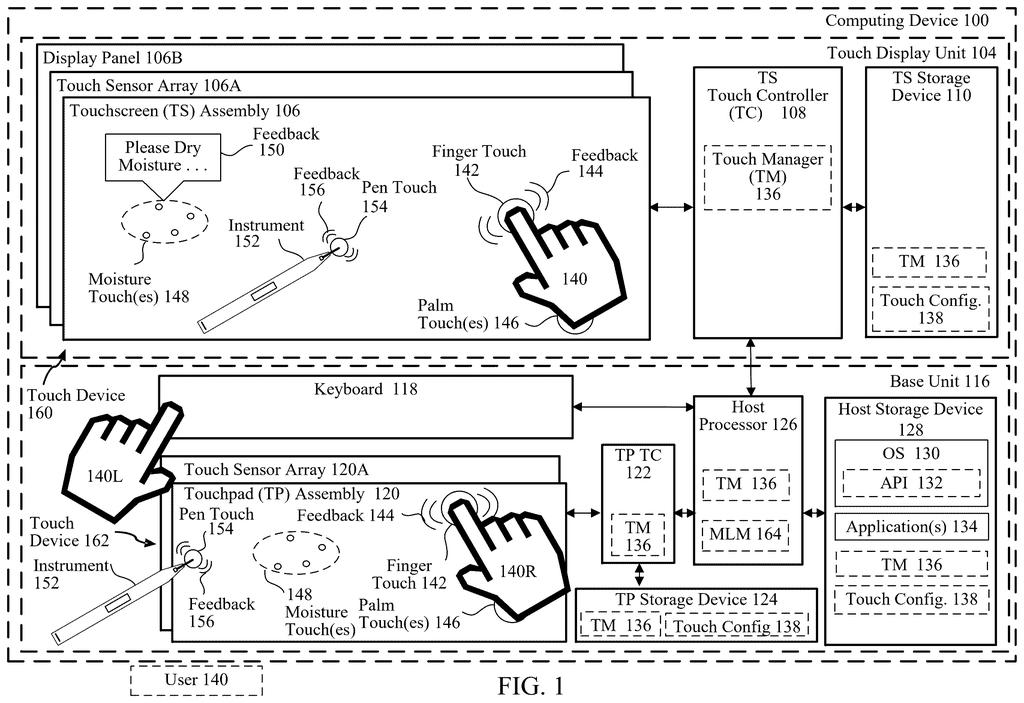
How Microsoft's touch classifier tells fingers from raindrops
You're out in the rain, trying to tap directions into your phone, and the screen keeps firing off random inputs from the water drops hitting the glass. Or you've rested your palm on a laptop trackpad and watched the cursor jump halfway across the screen. These are old problems that touchscreens have never fully solved.
Microsoft's patent describes a system that studies each touch event in detail before deciding what to do with it. Instead of treating every contact as a finger, it looks at the shape of the touch, how that shape changes over time, how strong the electrical signal is, and whether the contact moves in a pattern that makes sense for a human hand. Based on all of that, it sorts the touch into a category: finger, stylus, palm, or moisture.
If it decides a touch is a water droplet, it can ignore it, warn you, or tell the operating system to compensate. The device stops reacting to things that aren't actually your input, which means fewer accidental taps and fewer corrections.
… classify the touch events as a class in a set of classifications comprising at least finger touch and moisture touch based on a touch profile indicated by the touch features; and respond to the classified touch events.
Translation: The system sorts what touches the screen into categories like fingers or water, then reacts accordingly.
How the system profiles shape, size, and signal strength
The system works by collecting a detailed dataset for every touch event and running it through a classification engine. The key inputs are what the patent calls touch features, which include:
- Shape and shape change: a fingertip leaves a roughly oval print that shifts slightly as you press; a water droplet spreads irregularly and may split or merge
- Capacitance intensity: fingers conduct electricity in a consistent, strong way; moisture produces a weaker and less stable electrical signal
- Contact dynamics: how fast the contact grows, shrinks, or moves, and whether that motion fits human behavior
- Clustering: multiple nearby contacts that behave in a coordinated way suggest a palm resting on the surface
Each combination of features points to a touch profile, and the system maps profiles to classifications. The claim specifically requires the system to track shape change over time, not just the static shape at first contact, which is the detail that separates a moving finger from a spreading puddle.
Once a touch is classified, the device responds accordingly. Finger and stylus touches trigger normal input. Palm touches are rejected or flagged. Moisture touches can produce a user-facing warning, and the operating system can be told to apply a correction layer so the wet screen stops misfiring.
Resources are conserved by avoiding reporting, processing, actions and reversals for non-input touch events.
Translation: The device saves battery by ignoring accidental water drops instead of trying to process them.
What smarter touch rejection means for everyday devices
Moisture rejection is one of those problems that sounds simple until you try to build it. Current devices use blunt rules, like ignoring contacts above a certain size, which helps with palms but fails badly with rain, sweat, or wet hands. A classification system that watches how a contact behaves over time is a much more accurate approach, and it could make touchscreens genuinely more reliable in outdoor and high-activity settings.
For you as a user, the payoff is mundane but real: fewer phantom taps in the rain, fewer accidental scrolls from a resting palm, and a device that can tell you when its screen needs to be dried rather than silently misbehaving. That matters most on tablets, large-format touchscreens, and laptops with touch-enabled displays, where palm rejection is already a constant frustration.
Microsoft's 17th filing in our Display topic coverage since May follows earlier work like one sharpening via edge blur and one speeding video chip memory, showing a broad push across how screens process and render visuals.
Claim 1 is broad enough to cover any computing device with a touch surface that collects shape-change data and sorts touches into at least a finger category and a moisture category. That's a wide net. The claim doesn't lock down a specific algorithm, a specific sensor type, or a specific threshold, which means it could apply to most capacitive touchscreens on the market if granted as written.
In practice, that breadth is the interesting thing to watch. Moisture handling on touch devices is an unsolved annoyance across the whole industry, and a claim this wide, covering the act of classifying moisture by touch behavior rather than any specific method, could be meaningful IP if the patent office doesn't narrow it during examination.
The engineering described is real and useful. Shape-change tracking over time is a genuinely better signal than static size or capacitance alone. Whether this specific filing covers enough novel ground to survive prior-art review is a separate question, but the underlying approach is sound.
There are more where this came from
We read every patent application Big Tech publishes and send you the ones worth knowing. Plain English, free, every week.
The drawings
6 drawing sheets from US 2026/0299724 A1 · click any drawing to enlarge


Want this weekly breakdown for a company we don't cover? Patentlyze Pro →
Be the first to weigh in