
Google Patents an AI That Maps 3D Objects by Tracing How Light Rays Miss Them
Instead of storing a 3D object as millions of tiny cubes or triangles, Google's new patent trains an AI to reconstruct its shape by asking a simpler question: does this imaginary light ray hit the object, and if not, how close does it get?
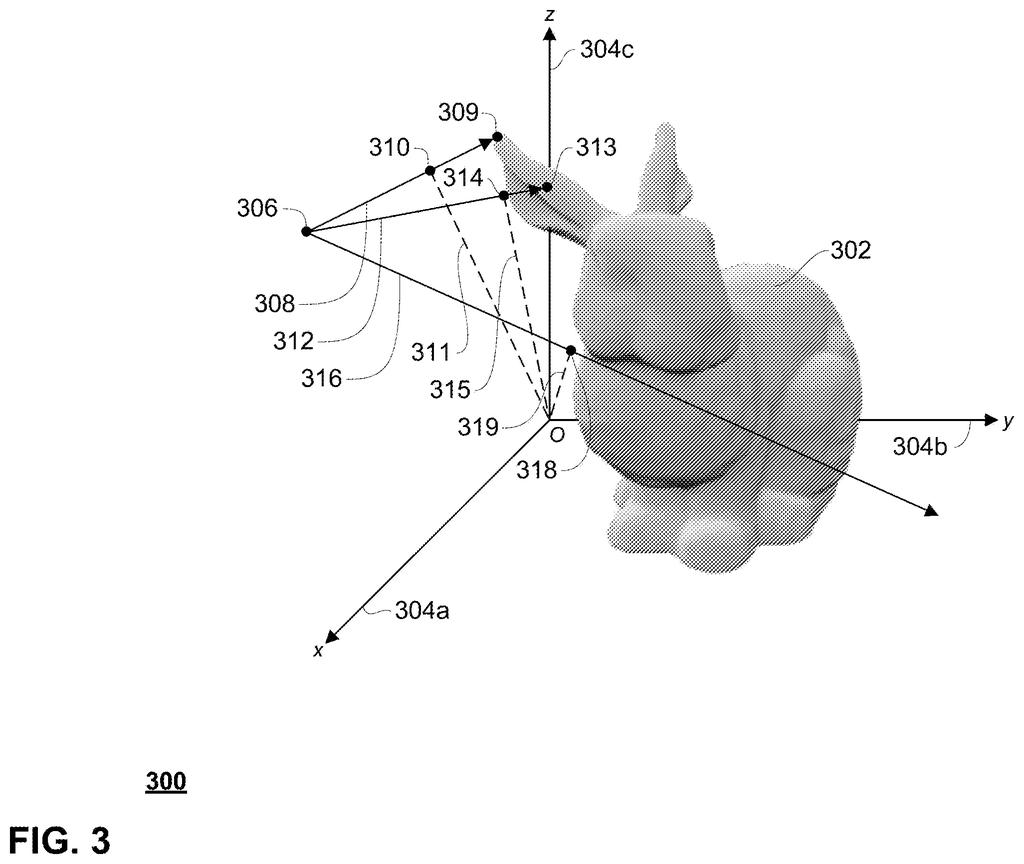
How Google teaches an AI to 'feel' a 3D shape
Imagine you're trying to describe the shape of a sculpture to someone blindfolded. You could fire thousands of thin laser pointers at it from different angles and report back: did the beam hit, and if it barely missed, how far off was it? Over enough tries, those answers together paint a surprisingly complete picture of the object.
That's essentially what Google's patent automates. A neural network (a type of AI modeled loosely on how brains learn) is trained on huge numbers of these ray-and-answer pairs. After enough training, it can predict the shape of an object it's never seen rendered as a traditional 3D model.
The result is a compact, math-based description of a 3D object rather than a heavyweight mesh or voxel grid. You get the shape without storing all those individual points, which could mean faster loading, lower storage costs, and cleaner rendering on devices like phones or AR headsets.
… an intersection indicator indicating whether the ray will intersect with the object, and a distance indicator indicating a shortest distance along the ray between the perpendicular foot and a surface of the object …
Translation: Data tracks whether light misses the shape and how close it passes to the surface.
How rays, feet, and distances train the neural network
The system creates what researchers call an implicit neural representation (a way of storing a 3D shape as a trained AI's weights rather than a list of geometry coordinates) of a physical object.
For each training example, the network receives three inputs:
- A reference point: a fixed anchor in 3D space near the object.
- A ray: an imaginary straight line fired from or through that space.
- The ray's perpendicular foot: the closest point on the ray to the reference point (think of it as the ray's nearest pass to your anchor).
Given those inputs, the network makes two predictions simultaneously: first, an intersection prediction (will this ray actually hit the object's surface?), and second, a distance prediction (if not, what is the shortest gap between the ray's closest pass and the surface?). Both predictions are compared to ground-truth answers, generating error values called loss values, which are used to adjust the network's internal settings until its guesses get consistently accurate.
Once trained, the network effectively is the 3D object in compressed form. You can query it with any new ray and get a fast, geometry-consistent answer about the object's surface, without unpacking a traditional mesh file.
Systems and methods for generating and using primary-ray based implicit neural representations of three-dimensional objects.
Translation: This technology creates 3D computer models by analyzing lines of sight.
What this means for 3D scanning and rendering apps
For everyday users, the payoff would show up in apps that display 3D objects: product previews in shopping apps, AR furniture placement, or 3D scanning tools. A compact AI-based shape description could load faster and look cleaner than traditional polygon models, especially on lower-powered devices where big mesh files choke the renderer.
Google keeps filing on neural 3D-representation techniques, and this approach is specifically built around primary rays, the same mathematical construct used in real-time ray-tracing graphics engines. That alignment suggests the method could plug into existing rendering pipelines rather than requiring an entirely new graphics stack, which would lower the barrier for developers to actually use it.
Google files its 19th patent in the AI simulation filings we've tracked since May, building on work like one on crisp scene edges and one on camera-free 3D models.
If you've ever tapped on a 3D product in a shopping app and watched it take forever to load, or seen an AR object jitter and glitch as you move your phone, this patent is working on exactly that moment. The idea is to replace the heavy geometry files that describe a 3D shape with a compact, trainable system that can answer questions about the shape on demand.
What makes it smarter than simple compression is that it learns the empty space around the object, not just its surface. That means it handles tricky spots like thin edges or curved hollows more accurately, which is where most visual errors tend to show up.
The real question for users is speed: a system like this only feels like an improvement if it answers fast enough during actual use, and that depends on hardware that is still catching up. So the benefit is real but conditional, closer to a solved design problem than a finished product experience.
There are more where this came from
We read every patent application Big Tech publishes and send you the ones worth knowing. Plain English, free, every week.
The drawings
9 drawing sheets from US 2026/0301304 A1 · click any drawing to enlarge


Want this weekly breakdown for a company we don't cover? Patentlyze Pro →
Be the first to weigh in