
Microsoft's New Patent Protects an AI System That Maps Cause and Effect in Limited Farm Data
Farmers and climate scientists often have too little data to trust their models. Microsoft's new patent describes a way to fill those gaps by teaching AI to combine real-world measurements with computer simulations and then trace what actually causes what.
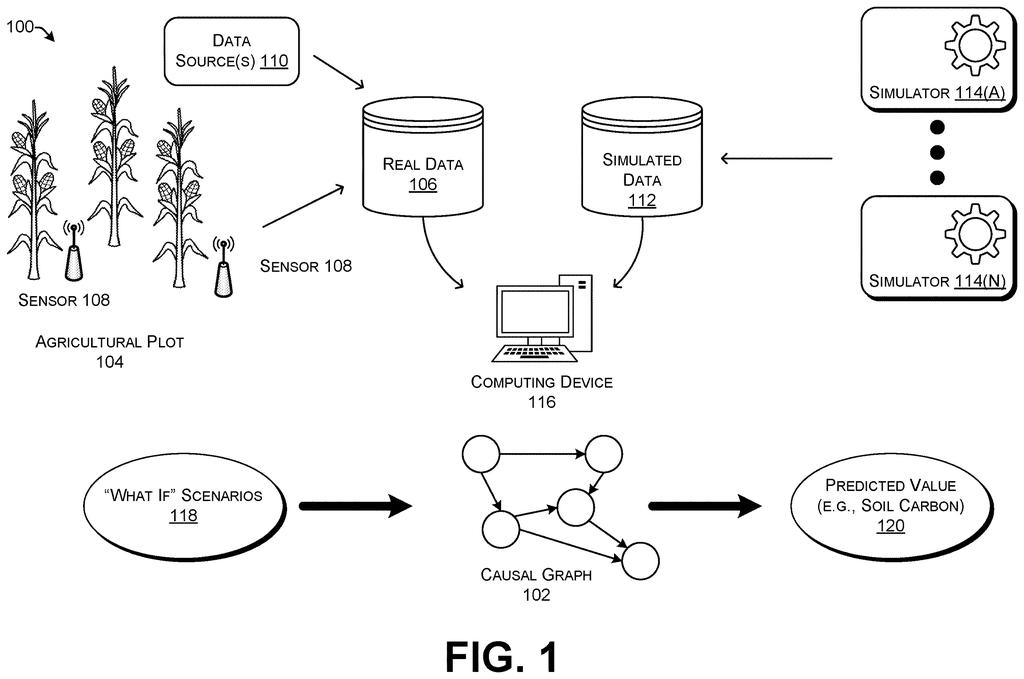
What Microsoft's soil carbon AI actually does
Scientists studying soil carbon, a key factor in both farm productivity and climate, often have a frustrating problem: they don't have enough measurements. Fields are wide, instruments are sparse, and running long experiments is expensive. Microsoft's system wants to work around that by mixing the limited real data you do have with data generated by physics-based simulators, the kind that can estimate what soil carbon should look like under different conditions.
The result is a causal graph, a kind of map that shows which factors actually drive which outcomes, not just which factors tend to move together. That's a meaningful difference: knowing that rainfall and tilling cause carbon changes, rather than just correlate with them, is what lets a farmer or agronomist make a confident decision about what to change.
The patent describes using that graph to answer "what-if" questions, like what happens to soil carbon if a farm shifts from conventional tilling to no-till farming over the next five years. It's the kind of forward-looking analysis that usually requires either enormous datasets or expensive field trials.
… iteratively revising the first hidden embedding, the second hidden embedding, and a causal graph, wherein the iteratively revising comprises passing the first hidden embedding learned from the first neural network to the causal graph and the second hidden embedding learned from the second neural network to the causal graph; …
Translation: The system constantly updates its understanding by feeding real and simulated data into a shared cause and effect map.
How the system fuses real data with simulation
The system works in three broad phases.
Phase one: dual learning. Two separate neural networks process two separate streams of data. The first network reads real measurements, actual sensor readings, lab samples, satellite observations, and so on. The second reads simulated data produced by process-based models (physics and chemistry simulators that encode what scientists already know about how soil works). Each network compresses its data into a compact representation called a hidden embedding, essentially a distilled numerical fingerprint of the patterns in that data.
Phase two: causal graph construction. Both embeddings are fed into a causal graph, a directed network where each arrow says "this variable influences that variable." The graph is built iteratively: the system repeatedly revises its guesses about which arrows belong where, each time checking whether the updated graph better explains both the real and simulated data together.
Phase three: what-if analysis. Once the causal graph is trained, you can query it with hypothetical scenarios that fall outside the original data, what researchers call out-of-distribution settings. Ask it what soil carbon will look like in 2030 under a new tilling schedule, and it can give a reasoned answer because it understands cause and effect, not just pattern-matching.
The soil carbon use case is the main example in the filing, but the architecture is general enough to apply to any domain where real data is sparse and simulators exist.
This technique can learn a causal graph from heterogenous data sources by combining embeddings from real data and embeddings from simulated data generated by process-based models.
Translation: It figures out cause and effect by mixing actual measurements with data generated by computer models.
What this means for AI-driven farm decision-making
The practical gap this addresses is real. Causal AI is considerably harder to build than predictive AI. Most machine learning models are trained to say "when X happens, Y tends to follow," which works fine for recommendations or spam filters. For decisions with real consequences, like whether to change a farming practice across thousands of acres, you need to know why, not just that. This patent is Microsoft's attempt at an automated pipeline for that harder task.
For farmers and agricultural scientists, a working version of this could make soil carbon forecasting accessible without requiring years of on-site data collection. For Microsoft, it extends the company's several Microsoft filings on AI for agriculture and environmental science this year into a territory that has direct relevance to carbon credit markets, climate modeling, and precision agriculture platforms.
Microsoft has filed its tenth patent in the AI simulation work we've tracked since May, a group that includes running robots in sim first and rebuilding a body from one photo.
Getting this to a real product is a software problem, which is the good news. The harder news is that the method depends on two things that have to exist first: trustworthy computer simulations of the natural system in question, and enough real-world measurements to check those simulations against reality.
For soil science, some of that groundwork already exists, which makes agriculture the obvious starting point. A tool built specifically for farming researchers or farm-management platforms, where the data and simulations are already reasonably mature, is the shortest path to something shippable.
The document does not address how a farmer would actually read and act on a map of cause-and-effect relationships, and translating that output into a clear recommendation is a product-design problem in its own right. Solving that gap is what would separate a research prototype from something people rely on.
There are more where this came from
We read every patent application Big Tech publishes and send you the ones worth knowing. Plain English, free, every week.
The drawings
6 drawing sheets from US 2026/0289241 A1 · click any drawing to enlarge


Want this weekly breakdown for a company we don't cover? Patentlyze Pro →
Be the first to weigh in