
Qualcomm Patents a Fix for the Tiny Errors Shrinking Audio Files Leaves Behind
Every time audio gets compressed and sent to a speaker or headset, tiny rounding errors creep in. Qualcomm's new patent describes a way to measure those errors at the source and ship a small correction code alongside the audio so the receiving device can undo the damage.
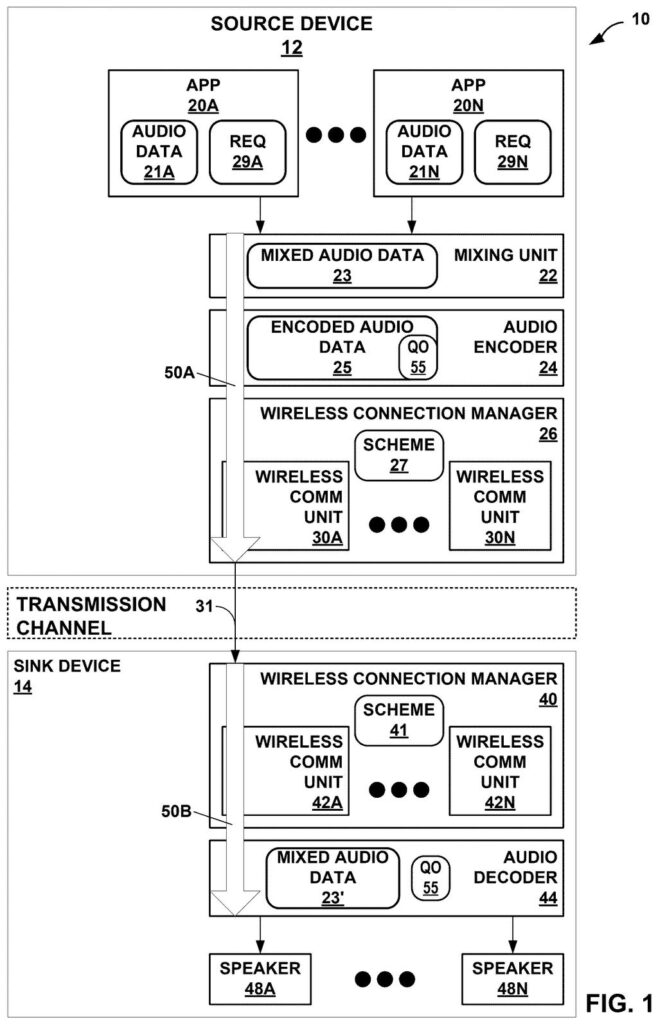
What Qualcomm's audio correction offset actually does
You're wearing wireless earbuds during a phone call, and somewhere between your caller's microphone and your ears, the audio gets squeezed into a smaller file to travel faster. That squeezing process (called compression) introduces small errors, and what you hear is a slightly imperfect copy of what was originally recorded.
Qualcomm's patent tackles this at the decoding end. When the device unpacks the compressed audio, it also reads a small correction value baked into the file. That value tells the device exactly how far the decompressed sound has drifted from the original, and the device nudges it back. The result is audio that better matches what was sent in the first place.
The correction travels inside the same audio file, so there's no extra wireless traffic or processing delay for you to notice. The fix happens automatically, before the audio reaches your speakers.
… obtain, from the encoded audio bitstream, a quantization offset; apply the quantization offset to the decoded audio data to obtain corrected audio data, wherein the quantization offset corrects for any bit differences between original audio data that was encoded to obtain the encoded audio bitstream and the decoded audio data; …
Translation: The device extracts a math correction from the file and applies it to fix rounding errors made during compression.
How the quantization offset patches decoded audio data
Audio compression works by rounding off tiny details in a sound signal to save space. The problem is that rounding always introduces small differences between the original signal and the unpacked version. Over time, or across multiple processing steps, those differences add up.
Qualcomm's system adds a quantization offset (a pre-calculated correction number) to the encoded audio file at the point of encoding. Think of it as a note left for the decoder that says: "Here's exactly how much rounding error we introduced; please subtract it."
On the decoding side, the processing chip:
- Unpacks the compressed audio as normal
- Reads the embedded correction value from the bitstream (the digital audio file)
- Applies the offset to the decoded signal to produce corrected audio
- Renders the corrected audio into speaker feeds for playback
The correction is embedded inside the standard audio bitstream, which means it works within existing transmission pipelines without requiring a separate channel or extra bandwidth.
What this means for wireless audio and hearing devices
For most casual listening, compression errors are inaudible. But in applications where precision counts, such as hearing aids, professional audio monitors, or spatial audio headsets where tiny channel imbalances affect perceived direction, even small rounding errors can degrade the experience. A built-in correction mechanism means the device doesn't have to guess or average its way to accuracy.
Qualcomm supplies audio chips to a wide range of headset, hearing device, and mobile manufacturers. A correction technique embedded at the codec level could improve quality across all of them without any change to the hardware. You probably wouldn't notice a dramatic shift, but the worst-case audio scenarios (already-compressed source material re-encoded for wireless transmission) would hold up better.
Qualcomm's fifth filing in the wearable tech patents we've tracked since July builds on ideas like GPS-locked spatial audio and wireless earbud noise control.
For most people streaming music or making calls, this fix will never announce itself. The rounding errors it corrects are too small for casual listening to catch.
The gap closes when accurate sound reproduction stops being a preference and starts being a need. A hearing aid that slightly misrepresents a frequency is doing its job less accurately, and the person wearing it pays that cost in real time. Qualcomm's correction travels inside the audio file itself, so the device compensates automatically, with no setup required from the user.
Small adjustments to signal accuracy add up for someone who depends on a device to hear clearly. That is the person who notices, and that is the person this protects.
There are more where this came from
We read every patent application Big Tech publishes and send you the ones worth knowing. Plain English, free, every week.
The drawings
9 drawing sheets from US 2026/0301752 A1 · click any drawing to enlarge


Want this weekly breakdown for a company we don't cover? Patentlyze Pro →
Be the first to weigh in