
Microsoft Patents a System That Reads Your Document and Suggests What's Missing
Microsoft has filed a patent for a system that lets productivity apps automatically analyze what you're working on and suggest additional content, pulling in an AI language model to do the heavy lifting without you having to ask.
What Microsoft's AI content-suggestion system actually does
Ever stared at a half-finished document and thought, "what am I even missing here?" Microsoft is patenting a system that answers that question for you, automatically.
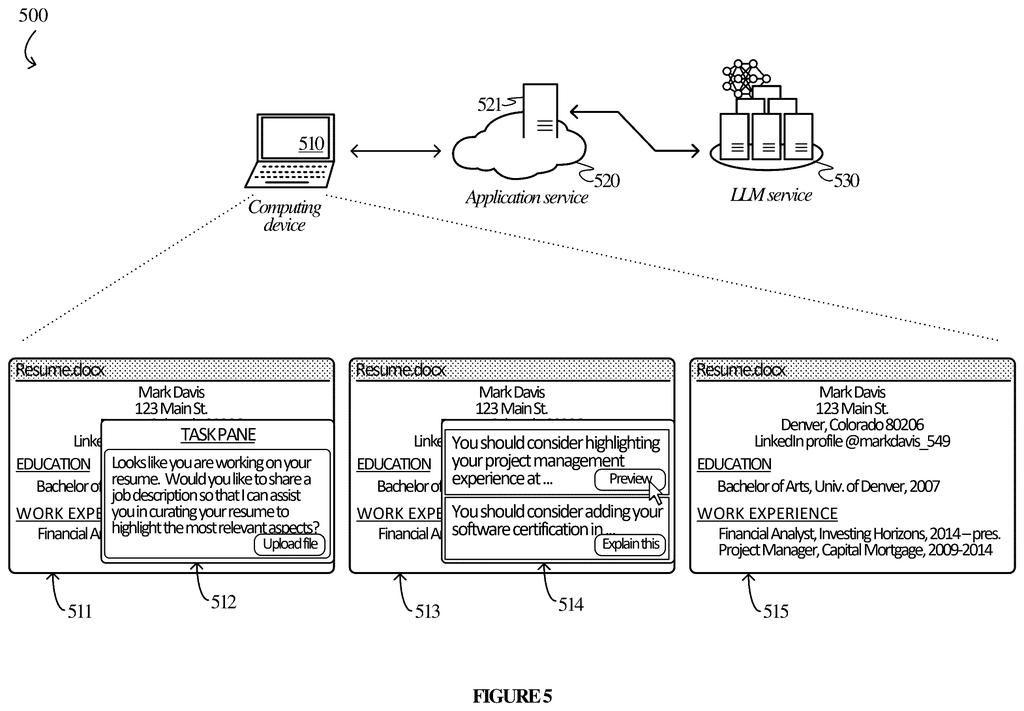
The idea is that an app like Word or PowerPoint watches the content you're working on, figures out the surrounding context (what kind of document it is, what you seem to be doing), and then sends both pieces of information to an AI language model. The AI reads everything and sends back a suggestion for content you might want to add.
You'd see that suggestion pop up right inside the app, as a recommendation. No switching tabs, no typing a separate prompt into a chat box. The app handles the back-and-forth with the AI on your behalf.
The application identifies a context relating to the content, wherein the context comprises contextual information by which to evaluate the content. The application generates a prompt for an LLM service which includes the content and the context.
Translation: The software figures out what your document is about and asks an AI to review it in that specific setting.
How the app builds a prompt and gets a suggestion back
The patent describes a pipeline with three main moving parts: the app, a prompt it constructs, and an external LLM service (a large language model, meaning an AI system like the kind that powers ChatGPT or Microsoft Copilot).
First, the app identifies both the content (what you've written or built so far) and the context (metadata about what the content is and how it should be evaluated). Context might include the document type, the section you're in, or rules about what good content looks like in that situation.
The app then assembles a prompt, a structured instruction sent to the LLM service, that asks the AI to evaluate the content and recommend what supplemental material would improve or complete it.
- The prompt is submitted to the LLM service automatically, without the user initiating a separate AI session.
- The LLM returns a suggestion for supplemental content.
- The app displays a recommendation based on that suggestion inside its own user interface.
The patent is broad about what "supplemental content" means, leaving room for text additions, data, images, or other app-specific material, depending on where this is deployed.
What this means for AI assistants in Office and beyond
The problem this addresses is real: people routinely produce incomplete documents, reports, or presentations not because they're careless but because they don't know what they're missing. A system that flags gaps in context, rather than just running a spell-check or a generic AI chat, is a different kind of tool.
For Microsoft, this fits squarely into Microsoft keeps filing on AI-assisted productivity tools in its Office suite. If this makes it into production, the practical effect is that Copilot-style suggestions become more automatic and context-aware rather than something you have to deliberately invoke. Whether that feels helpful or intrusive to users depends entirely on how well the context-detection works.
Microsoft's 16th filing we've tracked since June in our AI assistants that remember you watch builds on earlier work on predicting typed form inputs and keeping chat memory intact.
The problem this patent is attacking, people not knowing what their own documents are missing, is genuinely common and costs real time in professional settings. A presentation without key supporting data or a report missing a section summary are everyday failures that happen not from laziness but from not having a second reader.
The approach here, embedding AI analysis directly into the app rather than routing users to a separate chat interface, is the right instinct. The friction of switching to an AI assistant is high enough that most people skip it; building the analysis into the document workflow removes that barrier entirely.
What the patent doesn't resolve is whether the context the app gathers is actually good enough to make useful suggestions. Knowing the document type helps, but knowing what good looks like for a specific organization's internal report is a much harder problem. The patent describes the plumbing; the quality of the water is a separate question.
There are more where this came from
We read every patent application Big Tech publishes and send you the ones worth knowing. Plain English, free, every week.
The drawings
8 drawing sheets from US 2026/0300643 A1 · click any drawing to enlarge


Want this weekly breakdown for a company we don't cover? Patentlyze Pro →
Be the first to weigh in