
Samsung Patents a Camera Cover That Physically Locks an LED Flash in Place
Getting a camera and a flash to stay perfectly aligned inside a folding phone is harder than it looks. Samsung's new patent describes a camera cover shaped to physically cradle the LED, keeping both parts locked together without extra fasteners.
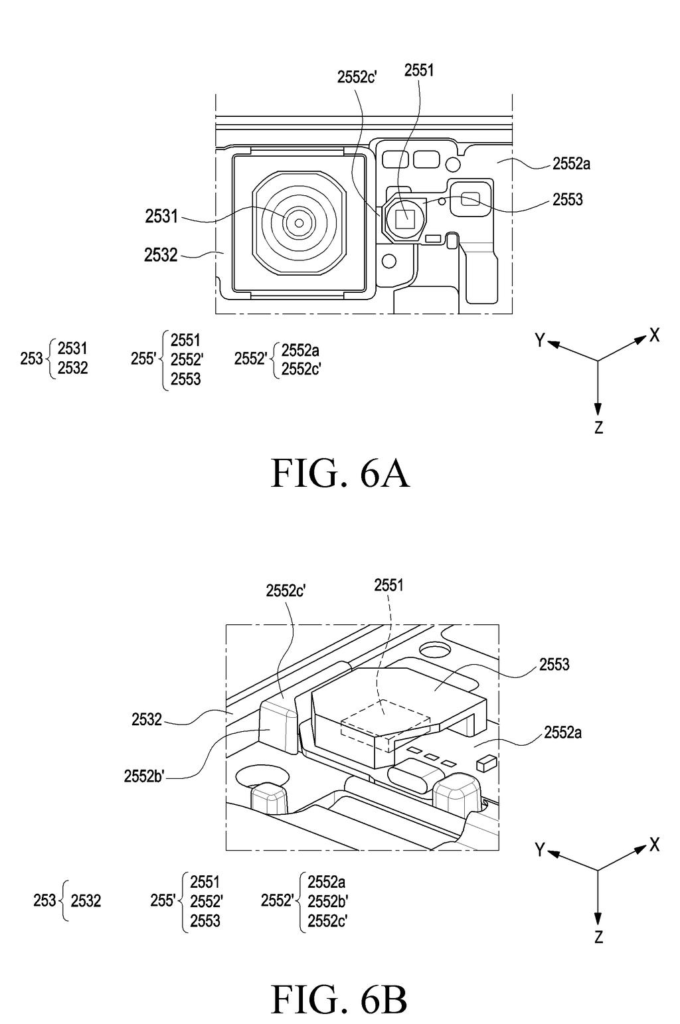
What Samsung's interlocking camera-and-flash design does
The flash LED on your phone sits right next to the camera lens, and that close placement matters: if the two drift even slightly out of alignment, photos look unevenly lit. Inside a foldable phone, where the body bends thousands of times, keeping those parts in exactly the right spot is genuinely tricky.
Samsung's patent describes a camera cover with two protrusions pointing in opposite directions. One pokes outward through the phone's outer surface, forming the visible camera bump. The other pokes inward, into the device, and wraps partway around the LED flash module. That inward prong acts like a cradle, holding the LED in place without needing a separate bracket or adhesive.
The result is a single camera-cover part that does two jobs at once: it protects the lens from the outside and secures the flash from the inside. For a device that flexes with every open-and-close, that kind of mechanical simplicity could mean fewer parts that can loosen over time.
… wherein the camera cover comprises a first protrusion, protruding in a first direction perpendicular to one surface of the housing and exposed to the outside through an opening formed in the one surface of the housing, and a second protrusion spaced apart from the first protrusion and protruding in a second direction opposite to the first direction …
Translation: The camera cover has two distinct bumps pointing in opposite directions to secure its position.
How the two-pronged cover grips the LED module
The patent covers a three-part system: a camera bracket (which holds the lens), a camera cover (the protective cap over that bracket), and a light-emitting module (the LED flash and its own bracket) sitting nearby.
The clever part is the camera cover's geometry. It has two protrusions:
- First protrusion: extends outward, perpendicular to the phone's surface, and pokes through an opening in the housing. This is the part you see from the outside, forming the camera bump.
- Second protrusion: extends in the exact opposite direction, inward into the phone, and partially wraps around the LED. The claim specifies it "at least partially surrounds" the LED, meaning the cover forms a partial collar around the flash diode.
The design means the camera cover physically constrains the LED's position without requiring a dedicated retention feature on the LED module itself. The two parts interlock through the cover's own geometry.
In a foldable device, the hinge mechanism creates repeated stress on internal components. A cover that simultaneously anchors two adjacent modules reduces the number of independent parts that could work loose over a product's lifetime, which is the engineering problem this patent is aimed at.
What this means for foldable phone camera reliability
For foldable phones specifically, component count and part complexity are real concerns. Every separate bracket, clip, or adhesive pad is a potential failure point across tens of thousands of open-and-close cycles. A camera cover that doubles as an LED retainer removes at least one of those variables.
For you as a buyer, this kind of design is invisible until it isn't: you notice it only if the flash starts throwing uneven light or rattling inside the housing. If Samsung's approach keeps the LED from shifting over time, it's the sort of quiet engineering that makes a foldable phone hold up better after a year or two of daily use rather than feeling slightly worse.
Samsung's 82nd filing we've tracked since May in our foldable phone patents follows work like wiring for expanding screens and self-retuning speakers.
Claim 1 draws a tight circle around one specific physical arrangement: a camera cover with one lip that pokes outward through the phone's surface and a second lip that curves back inward and partially wraps around the flash LED. Every element of that geometry has to be present for the claim to apply.
That narrowness has real consequences. A competing phone that holds its flash LED in place with a separate clip, a different bracket, or any other method that does not involve the camera cover itself physically embracing the LED would sit outside this claim entirely.
What Samsung is protecting here is a precise assembly decision, one where a single molded cover does double duty by both framing the lens and cradling the light beside it. The patent matters because it locks down that exact interlocking solution, not a broader category of camera-and-flash arrangements.
There are more where this came from
We read every patent application Big Tech publishes and send you the ones worth knowing. Plain English, free, every week.
The drawings
17 drawing sheets from US 2026/0299396 A1 · click any drawing to enlarge


Want this weekly breakdown for a company we don't cover? Patentlyze Pro →
Be the first to weigh in