
Sony Patents an AI That Delivers Game Graphics Based on What You're Actually Doing
When you're sprinting through a cutscene versus carefully studying a map, you're using the same game asset in completely different ways. Sony wants its cloud gaming servers to notice that difference and adjust what gets sent to your screen accordingly.
How Sony's AI tailors streamed game content to your play style
Right now, cloud game streaming tends to treat every asset the same way: a tree is a tree, a menu is a menu, and the server sends you the same version regardless of what you're actually doing with it. Sony's patent describes a different approach, where an AI watches both your controller inputs and what's happening in the game to figure out your intent before deciding how to render and deliver each piece of content.
Say you're in a fast-paced firefight. The AI infers you probably don't need ultra-high-detail background textures right now, so it can adjust those assets accordingly. But if you pause to examine an item or a map, the context shifts, and the system can deliver higher-fidelity details where they'll actually count.
The whole system runs on Sony's servers, not your device. Your console or TV just displays what it receives. The AI makes the call in real time, based on a continuous read of your inputs and the game's state.
Systems and methods for dynamically delivering an asset based on a determined end use are provided.
Translation: This technology sends custom game graphics to your device depending on your actions.
How the AI reads context and picks the right asset parameters
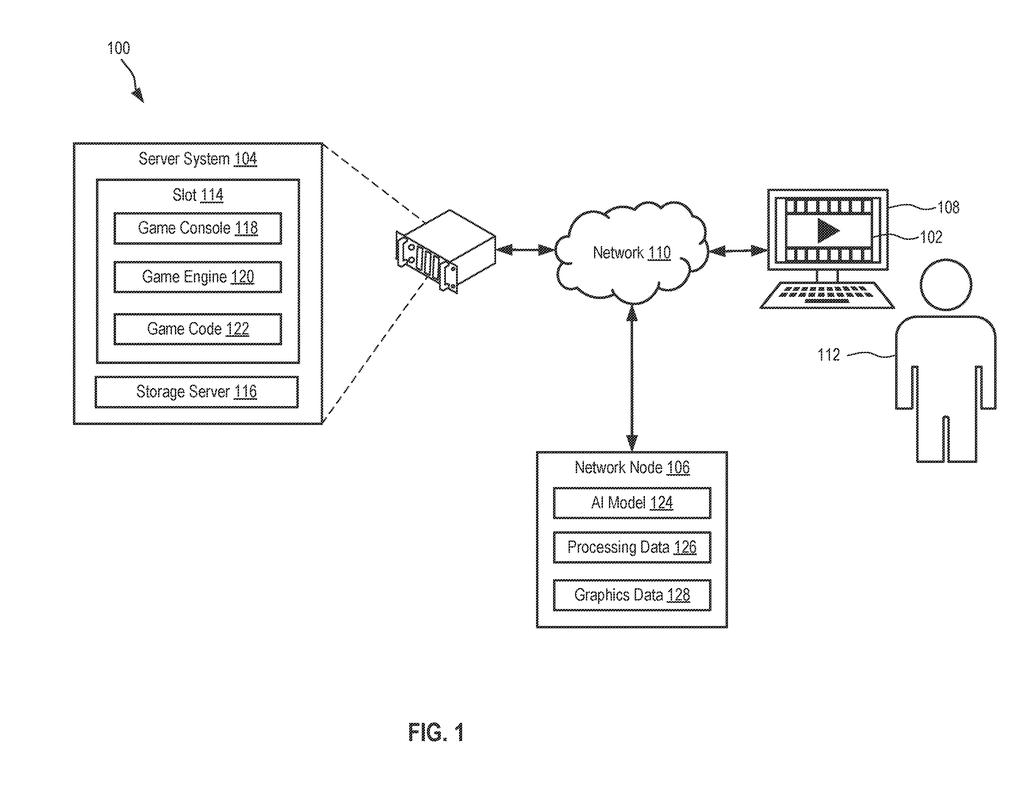
The patent describes a server-side pipeline for cloud-streamed games. A central computing system receives two streams of data: a user input signal (the buttons you press, the camera angles you choose) and a video game signal (the game's current state, scene, and progression).
An AI model ingests both streams and does something specific: it determines context. Context here means the inferred reason you're interacting with a particular asset at that moment. Are you in combat, where speed matters? Watching a cutscene, where visual fidelity matters? Navigating a menu, where clarity matters? The AI labels the situation.
From that context label, the AI outputs a parameter for the asset. A parameter could be resolution, level of detail, texture quality, or some other rendering variable. The server then renders the asset to that specification and transmits the result to your device.
- Inputs: player controls plus live game state
- Processing: AI context classification on the server
- Output: a rendering parameter sent to the rendering pipeline
- Result: the finished asset streamed to the user's screen
This all happens remotely, meaning the user's device is essentially a display terminal. The intelligence stays in the cloud.
What this means for cloud gaming and PlayStation streaming
Cloud gaming has always carried a bandwidth and latency problem: pushing high-quality assets to every user, all the time, is expensive and slow. If a server can confidently predict that a player won't notice reduced detail on a background object during a fast action sequence, it can save resources without you ever registering a dip in quality. That tradeoff, made automatically and per-player, is the core pitch here.
For PlayStation's cloud streaming ambitions, this kind of system could help Sony deliver a better experience on lower-bandwidth connections, or serve more simultaneous users from the same hardware. It's a back-end efficiency play with a real user-facing benefit: the game looks as good as it needs to, exactly when it needs to, without your connection straining to carry more than necessary.
Sony's 20th filing we've tracked in AI simulation since May adds to a pattern that includes one on reading player taste and one on rewriting enemy behavior.
The problem this addresses is real and measurable. Bandwidth costs money, latency ruins games, and dumb asset pipelines that ignore context waste both. Any system that can intelligently match delivery quality to actual player need is solving something concrete, not hypothetical.
The approach is sensible in principle, but the hard part isn't the idea. Classifying player context accurately, in real time, without lag that compounds the latency cloud gaming already fights, is genuinely difficult engineering. The patent describes the what clearly but leaves the how of the AI model mostly open, which is where the interesting problems live.
For casual players, if this works as described, the benefit is invisible in the best possible way: fewer moments where the stream quality noticeably drops. That's a reasonable bar to clear, and Sony has both the cloud infrastructure and the player-behavior data from PlayStation Network to make a context model credible.
There are more where this came from
We read every patent application Big Tech publishes and send you the ones worth knowing. Plain English, free, every week.
The drawings
8 drawing sheets from US 2026/0295401 A1 · click any drawing to enlarge


Want this weekly breakdown for a company we don't cover? Patentlyze Pro →
Be the first to weigh in