
Google's Health Arm Patents a Layered Brain Implant That Holds Its Own Layers Together
Implants that talk to your brain are only as useful as their ability to stay intact for years inside a living body. This Verily patent focuses on a surprisingly unglamorous problem: keeping a paper-thin electrode assembly from falling apart at the seams.
What Verily's brain-electrode bonding method actually does
What holds a postage-stamp-thin brain implant together when it's been sitting inside someone's skull for a decade? That's the quiet engineering problem at the center of this filing.
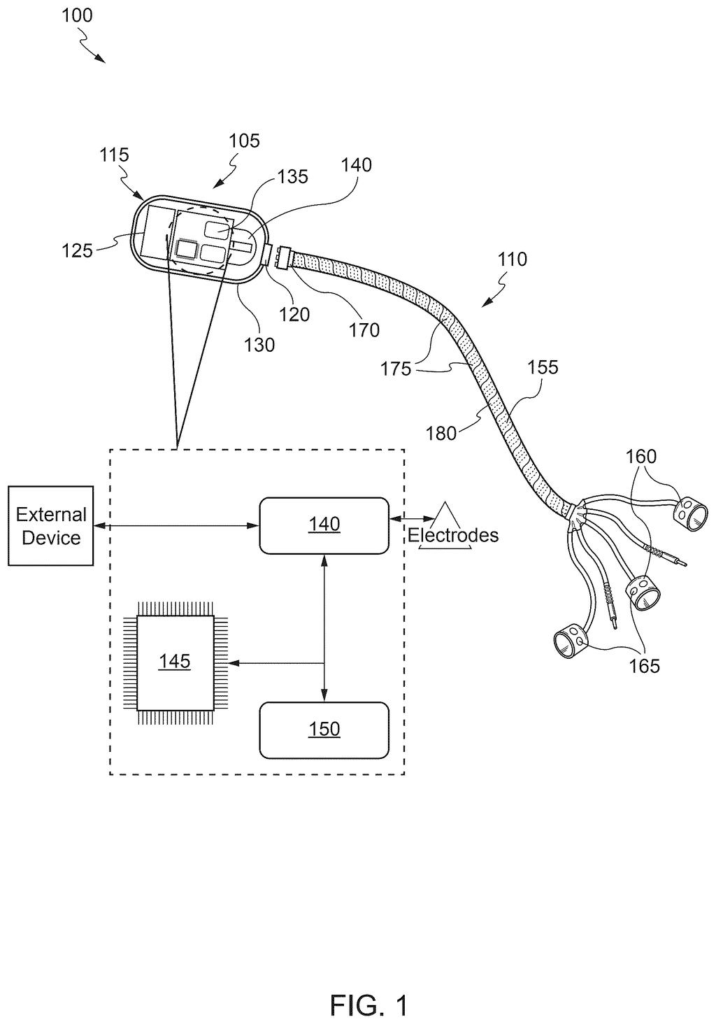
Verily (Google's life-sciences arm) describes a neural interface, basically a flexible strip studded with tiny electrodes that can read or send electrical signals to nerve tissue. The strip has three main parts: a structural middle layer, metal wiring traces printed on top of it, and a backing bonded to the underside. The trick here is that the middle layer has physical features, think of tiny anchors or interlocking shapes, built right into it to grip the backing layer mechanically rather than relying on glue chemistry alone.
The goal is a more durable bond between layers in a device that flexes, bends, and sits in a warm wet environment for years. For patients who need long-term neural monitoring or stimulation, that durability is everything.
… a backing formed on a back side of the supporting structure, wherein the backing is comprised of a medical grade polymer material, and the supporting structure includes one or more features for mechanical adhesion with the backing; …
Translation: A medical plastic layer is mechanically locked onto the back of the device structure.
How the supporting structure locks onto its backing layer
The patent describes a thin-film neural interface, a microfabricated device built using the same photolithography techniques used to make computer chips, scaled down to fit on and around nerve tissue.
The device runs from a proximal end (near the body surface, where it connects to external hardware) to a distal end (the tip that contacts neural tissue). Along its length, conductive traces (essentially printed metal wires, thinner than a human hair) carry signals between the electrodes at the tip and the connector at the base.
The core invention focuses on the backing layer, a material applied to the underside of the structural layer. Instead of bonding solely through adhesive chemistry, the structural layer is patterned with mechanical adhesion features (physical interlocking shapes, undercuts, or surface textures) that grip the backing. This is analogous to how Velcro works versus how tape works: one relies on physics, the other on chemistry, and physics tends to hold up longer under repeated stress.
Key components include:
- A supporting structure spanning the full length of the device
- Electrodes on the front side, electrically connected to the conductive traces
- A backing on the rear side, anchored by those mechanical features
… a supporting structure that extends from the proximal end to the distal end, one or more of conductive traces formed on a portion of the supporting structure, one or more electrodes formed on the front side of the supporting structure in electrical connection with the one or more conductive traces, and a backing formed on the back side of the supporting structure.
Translation: The implant runs from end to end with built-in wires, front-side electrodes, and a protective rear backing.
What this means for long-term brain implant reliability
For neural implants, delamination (layers peeling apart) is one of the most common failure modes over time. If the backing separates from the structural layer, the device can shift, short-circuit, or lose signal quality, none of which is acceptable in something implanted in a human brain or spinal cord.
By engineering mechanical grip directly into the structure rather than depending entirely on adhesive chemistry, Verily is betting on a more predictable, testable failure mode. Whether this specific approach delivers meaningfully better longevity than existing methods is the real question, and the patent itself doesn't answer it. But for anyone watching the space of long-duration neural implants for conditions like epilepsy, Parkinson's, or paralysis, durability at the material-bonding level is exactly where the hard problems live.
Google's 826th filing we've tracked since May adds to a run of Waymo work that includes a car GPS fix at pickup and a next-event prediction system, all part of our Google coverage.
Every engineering choice in an implant is a tradeoff between what you gain and what you give up. Mechanical interlocking features add grip, but they also add geometric complexity to a device that is already built at near-microscopic scale. Patterning those features into the structural layer means tighter manufacturing tolerances and more chances for a defect to appear during fabrication.
The trade reads as worth attempting. Chemical adhesion alone has a track record of degrading in biological environments, where moisture, heat, and mechanical flex slowly unpick molecular bonds. Backing that claim with physical geometry is a reasonable hedge. The cost is manufacturing difficulty; the benefit is a device that might stay whole for ten years instead of five.
That said, the canceled first claim is a flag worth noting. When the broadest claim of a patent is canceled during prosecution, it often means the examiner pushed back hard on novelty, and the applicant narrowed the scope. What survives may be more specific than the abstract suggests. For a general reader, this is a competent materials-engineering filing on a real problem, not a headline moment.
There are more where this came from
We read every patent application Big Tech publishes and send you the ones worth knowing. Plain English, free, every week.
The drawings
14 drawing sheets from US 2026/0294347 A1 · click any drawing to enlarge


Want this weekly breakdown for a company we don't cover? Patentlyze Pro →
Be the first to weigh in