
Waymo (Google)
Waymo (Google) · Automotive · Filed Mar 30, 2026 · USPTO published Oct 1, 2026 · Oct 1 release
Waymo Patents a Prediction System That Shows Self-Driving Cars What Comes Next
Waymo is teaching a single neural network to absorb every sensor a self-driving car has, all at once, and then predict what the road will look like moments from now. That internal crystal ball is what lets the car plan moves before events fully unfold.
- Publication number
- US 2026/0296454 A1(US20260296454A1)
- Applicant
- Waymo LLC
- Filed · Published
- Mar 30, 2026 · Oct 1, 2026
- Inventors
- Chiyu Jiang, Harish Chandran
- Status when we published
- Waiting for an examiner
- Document
- 20 claims
- US classification
- 701/48
- Parent application
- Claims priority from a provisional application 63780046 (filed Mar 28, 2025)
What Waymo's sensor-fusion world model actually does
Ever wondered how a self-driving car decides what to do half a second before something happens? It has to predict the future, not just react to the present.
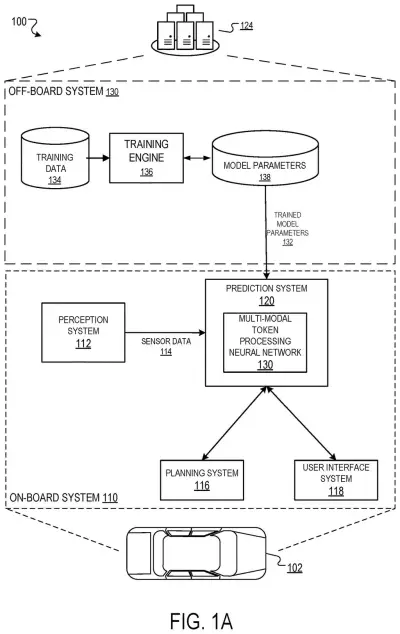
Waymo's patent describes a system that takes data from all of a car's sensors at once, cameras, radar, lidar, and more, and feeds it into a single neural network as a stream of timed snapshots. The network has been trained on huge numbers of real driving situations, so it learns to guess what comes next: where other cars are heading, whether a pedestrian is about to step off the curb, how the scene will look a few moments from now.
The output is a prediction the car can act on. Instead of treating each sensor as its own separate problem, the system sees everything together, which gives it a more complete picture of the world around it.
obtaining an input sequence of tokens characterizing a driving environment for a vehicle, wherein the input sequence of tokens comprises, for each of one or more time steps, a respective set of tokens for each of a plurality of modalities of data from a set of multiple modalities of data …
Translation: The system collects different types of environmental data over time to understand what is happening around the car.
How the network turns sensor feeds into future predictions
The patent describes what engineers call a world model: a neural network trained not just to classify what it sees, but to forecast how a scene will evolve over time.
Input arrives as a sequence of tokens (think of tokens as compact numerical summaries of a moment in time) drawn from multiple modalities (different sensor types: camera images, lidar point clouds, radar returns). For each time step in recent history, the network receives one set of tokens per sensor type, all stitched together into a single ordered list.
The network then processes that entire list to generate an output token sequence that represents a predicted future state. That prediction can serve several downstream tasks:
- Estimating where nearby vehicles and pedestrians will be in the next few seconds
- Validating the car's planned path against likely futures
- Flagging scenarios where the environment is about to change rapidly
Critically, the network is trained end-to-end on example driving environments, meaning it learns the relationships between sensor types implicitly, without engineers hand-coding rules about how camera data should interact with lidar data. The architecture is described as multi-modal token processing, a design borrowed from large language models but applied to physical sensor streams instead of text.
the multi-modal token processing neural network has been trained to process input token sequences characterizing current states of example driving environments to generate output token sequences characterizing predicted future states of the example driving environments …
Translation: The artificial intelligence learns from past driving situations to forecast what will happen next on the road.
What this means for self-driving car reliability
For passengers and pedestrians, a car that anticipates the near future is meaningfully safer than one that only reacts to the present. Reaction-only systems have to wait for an event to fully register across sensors before they can respond. A world model that forecasts what is about to happen gives the car a small but real head start.
For Waymo's engineering team, fusing all sensor types through a single trained network also reduces the number of hand-tuned rules that have to be maintained as hardware changes. If a new sensor type is added, it becomes another modality in the token stream rather than a separate processing pipeline. That kind of architectural flexibility matters when you are running a commercial robotaxi fleet and updating software continuously.
Google's 63rd filing we've tracked since May in the self-driving sensing race adds to a run that includes one grading its own decisions and one predicting road users' paths.
Source: US 2026/0296454 A1 at the USPTO (PDF). Full patent text and figures are in the official publication.
Get our take in your Top Stories
Liked this breakdown? Add Patentlyze as a preferred source on Google, and our plain-English take shows up more often in your Top Stories the next time Google patent news breaks.
Add Patentlyze on Google
One click.
There are more where this came from
We read the new patents from Big Tech, carmakers and more and send you the ones worth knowing. Plain English, free, every week.
The drawings · 11 sheets
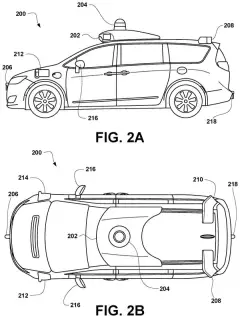
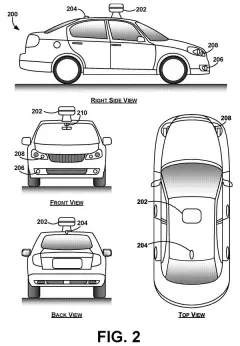
11 drawing sheets from US 2026/0296454 A1 · click any drawing to enlarge


Show the other 3 sheets


More from Google
All 1,127 Google patents →
More in Automotive
All 432 Automotive patents →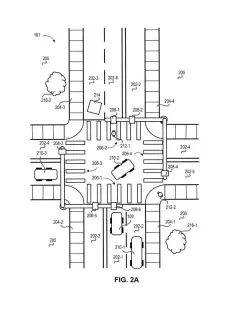
Waymo (Google)
Waymo Patents an AI That Predicts Collisions by Mapping Every Object's Next Move
Waymo (Google)
Google Patent Uses Laser Reflections to Help Self-Driving Cars Detect Weather
Waymo (Google)
Waymo Files Patent for Autonomous Cars That Navigate Around Sensor Blind Spots
Waymo (Google)
No comments yet