
Samsung Patents a Neural Network Supersampling Method for 3D Rendering
Samsung is patenting its own take on AI-driven supersampling — the same category of technology that powers Nvidia's DLSS and AMD's FSR — using a neural network pipeline that leans on motion vectors and a clever jitter-correction step to reconstruct high-resolution frames from low-res inputs.
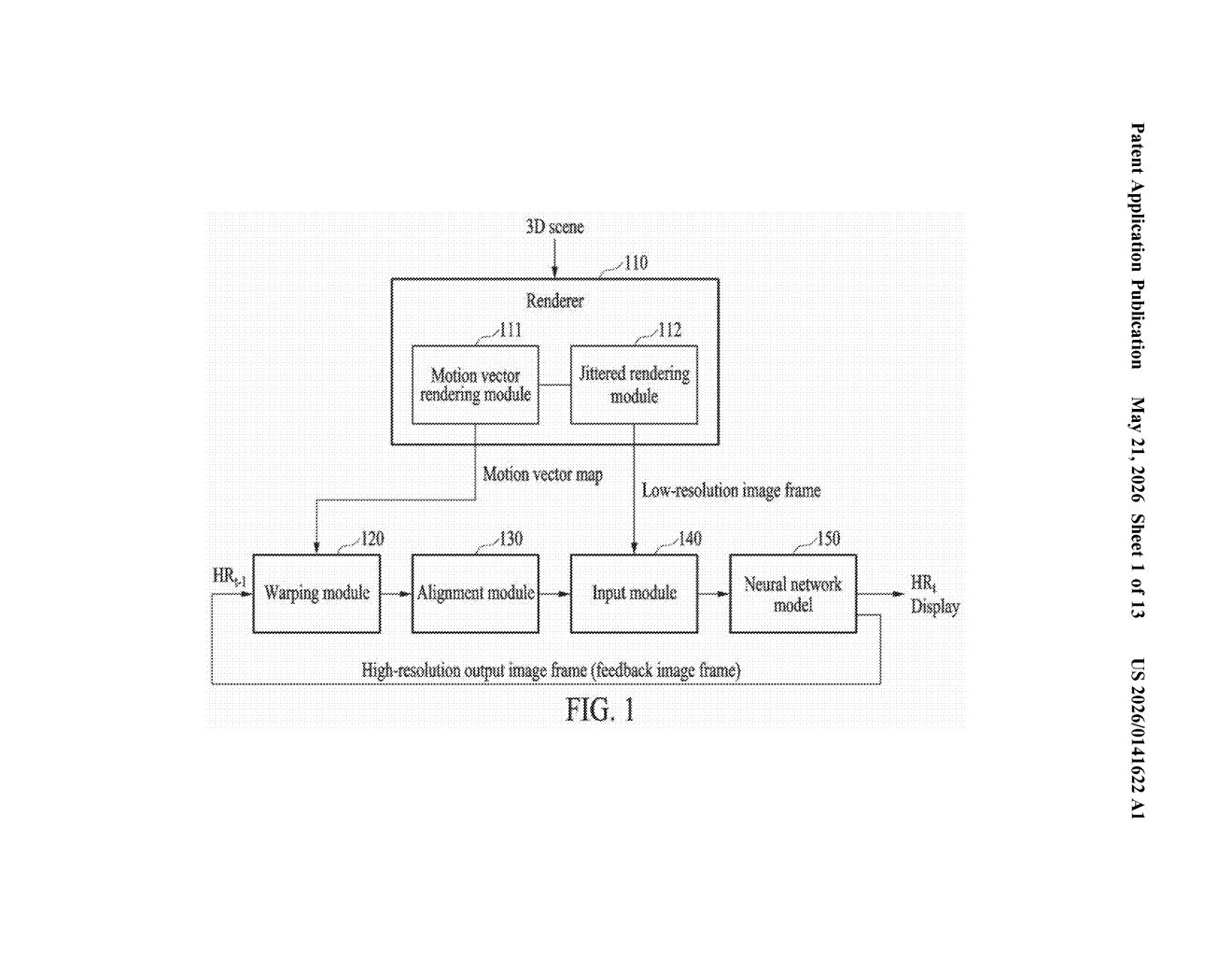
What Samsung's jitter-and-upscale rendering trick actually does
Imagine your phone or GPU is rendering a 3D game scene. Rendering every pixel at full 4K resolution is expensive — it eats power and time. So instead, the system renders at a lower resolution and then uses software to reconstruct the missing pixels. That's supersampling, and it's the engine behind technologies like Nvidia's DLSS.
Samsung's patent describes its own version of this pipeline. The key twist is something called jittered sampling — each frame is rendered with the pixel grid shifted slightly in a different direction. This sounds counterintuitive, but it means successive frames collectively cover more of the scene, giving the AI more raw information to work with.
Before the neural network does its upscaling job, Samsung's method also corrects for the position shift introduced by that jitter, so the AI model receives a clean, aligned input rather than a slightly offset one. The result is a high-resolution output frame assembled from both the current low-res render and a warped version of the previous high-res frame.
How jittered sampling feeds Samsung's neural upscaler
The patent outlines a four-step pipeline for generating a high-resolution output frame from a low-resolution rendered input:
- Jittered sampling: The current frame is rendered at a low "first resolution" but with a deliberately sub-pixel-shifted grid — each frame's grid is offset slightly differently, a technique that spreads sample coverage across frames over time.
- Motion-vector warping: A "feedback" image (the previous output frame, already at high resolution) is warped using a motion vector — essentially a map of how each pixel moved between frames. This produces a warped image frame at the higher target resolution, aligning past high-quality data with the current camera/scene position.
- Jitter correction: Because the current frame was rendered with a shifted pixel grid, the warped high-res frame needs a corresponding positional adjustment before the two can be meaningfully compared or combined. This position-adjusted warped image step is the patent's notable contribution — it explicitly accounts for the sampling offset before the neural network sees the data.
- Neural network fusion: A neural network model takes both the low-res current frame and the position-adjusted warped frame and produces the final high-resolution output, which in turn feeds back as the "feedback image" for the next frame.
The feedback loop is what makes this a temporal supersampling approach (similar in concept to DLSS 2/3 or Intel XeSS) — quality accumulates over multiple frames rather than being reconstructed entirely from a single frame.
What this means for Samsung GPUs and mobile gaming
Technologies like Nvidia's DLSS and AMD's FSR have largely been defined by PC and console GPU vendors. Samsung, as a major GPU IP holder through its Xclipse mobile GPU line (based on AMD RDNA) and its own Exynos chip ambitions, has clear incentive to develop a proprietary AI upscaling pipeline it controls end-to-end. A native supersampling method tuned for Samsung silicon could improve gaming performance on Galaxy devices without licensing constraints.
For you as a gamer or developer, this kind of technology is what lets a device run visually comparable graphics at a fraction of the rendering cost — meaning better frame rates, lower power draw, or both. The explicit jitter-correction step before the neural network ingests data is a tidy engineering detail that could reduce ghosting and temporal artifacts, which are the most common complaints about existing AI upscalers.
This is Samsung staking out IP in a space dominated by Nvidia and AMD — temporal, neural-network-based supersampling is rapidly becoming table stakes for any serious GPU platform. The jitter-position-correction step is a real engineering contribution, not just a patent-filing formality. Whether Samsung ships this in a consumer product or uses it defensively, it signals the company is serious about owning its own rendering stack.
There are more where this came from
We read every patent application Big Tech publishes and send you the ones worth knowing. Plain English, free, every week.
Want this weekly breakdown for a company we don't cover? Patentlyze Pro →