
Zoox Patents a Spinning Window That Flings Rain Off Its Self-Driving Car Sensors
Zoox wants to keep its driverless car's cameras clear by putting a glass disc in front of each one and spinning it fast enough to fling off rain, mud and bugs.
What Zoox's spinning sensor window actually does
A camera on a driverless car stares down the road as a rainstorm rolls in. Within seconds, water drops cling to the glass in front of it, and the view turns into a blurry smear.
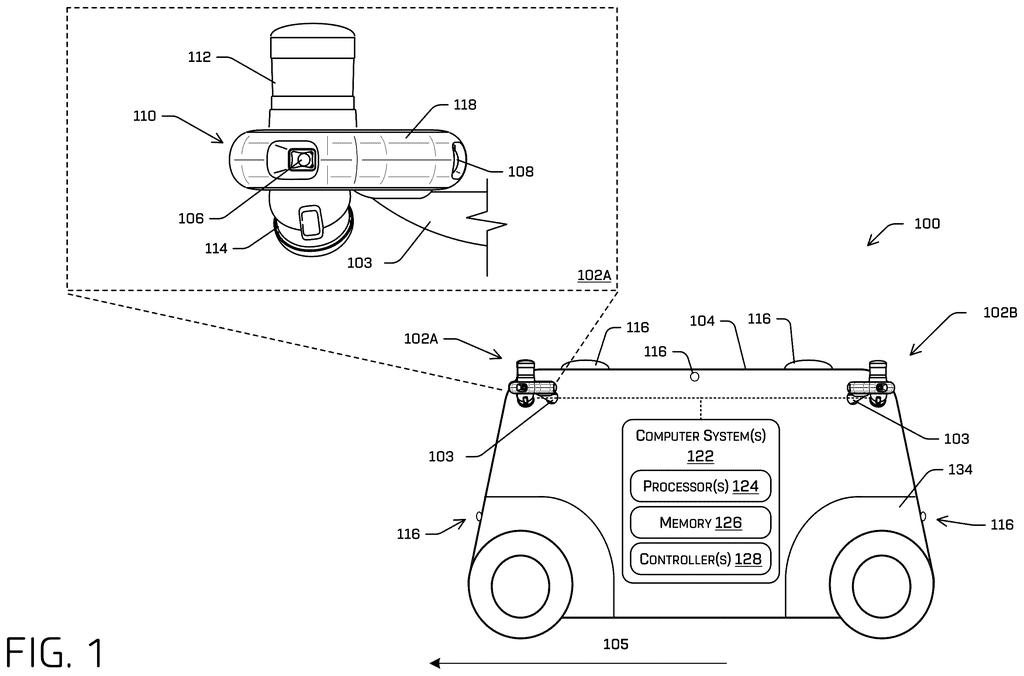
If you ride in one of these cars, you want it to see clearly, and there's no human around to wipe a lens. Zoox's filing puts a clear glass disc in front of the camera and spins it. Rain, mud and bugs that land on the disc get flung outward by centrifugal force, the same effect that dries lettuce in a salad spinner.
A small motor does the spinning, and the filing says it can switch on when the car senses something on the window. The camera itself stays still and looks through the turning glass.
… an actuator configured to rotate the sensor window relative to the sensor, wherein the sensor window is configured to rotate about a rotational axis that extends into the field of view of the sensor.
Translation: A tiny motor spins the glass right in front of the camera lens to keep the view clear.
How the motor spins rain off the glass
The core of the filing is a sensor window: a transparent disc mounted in front of a camera, lidar (a laser-based distance sensor) or similar sensor. An actuator (a small motor) spins the disc around an axis that points into what the sensor sees. The description gives example speeds of about 4,000 to 6,000 RPM.
The disc is fixed inside a cylindrical housing that wraps around the sensor, rides on a bearing, and is turned by a belt running in a groove on its outer surface. The filing also describes gears or a direct drive as options. Small fins inside the housing block stray light that could bounce into the lens.
The patent also covers ways to know when to spin:
- Electrical traces: two thin conductive coatings on the glass form a circuit. A water droplet touching both changes the circuit's readings (current or resistance), and the controller starts the motor.
- Motor strain: the controller commands a speed and compares it with the measured speed. If the motor lags, something heavy is probably stuck on the glass, and it can command a higher speed.
- Vehicle speed: the filing also says the spin speed can be based on how fast the vehicle is moving.
Optional extras include a wiper blade that touches the part of the disc outside the sensor's view, and a spray nozzle.
The sensor window is rotated relative to the sensor to cause obstructions on the sensor window, like water or debris, to disperse.
Translation: Spinning the glass flings away rain and dirt so the autonomous car can see properly.
Why clear sensors matter for driverless cars
A driverless car that can't see is a car that can't safely drive, and nobody inside is available to wipe a lens. Rain, road spray and bugs are everyday problems, so a fix that works without a person or heavy software could make these cars more dependable in bad weather.
The filing frames this as a hardware answer, in contrast to software that tries to guess what's behind a smudged image. For you as a rider, the practical hope is fewer moments when the car slows down or pulls over because its sensors are blinded. The description ties the idea to sensor pods mounted around a vehicle, so it points toward a design built into the car's body.
Amazon's 31st filing we've tracked since May in the self-driving sensing race continues Zoox's work on weighing every driving decision and dual-track route steering.
Claim 1 is short and wide. It asks for a sensor, a window in front of it, and a motor that spins the window around an axis pointing into what the sensor sees. The words car, camera, rain and belt never appear in it.
That breadth means the claim, if granted, would reach any spinning window in front of any sensor, however it is driven. The belt, the bearing, the heated coating and the wiper show up only in later claims, which narrow the idea. Claims 11 and 16 cover separate bundles: one adds the housing and bearing, and the other adds the motor-speed check that spots a blocked window.
The filing itself separates its window from a spinning sleeve that wraps around a sensor, so that design would sit outside the claim's wording. Overall this is a clear, practical hardware idea with a broad opening claim, and the speed check is the cleverest detail.
Get our take in your Top Stories
Liked this breakdown? Add Patentlyze as a preferred source on Google, and our plain-English take shows up more often in your Top Stories the next time Amazon patent news breaks.
There are more where this came from
We read every patent application Big Tech publishes and send you the ones worth knowing. Plain English, free, every week.
The drawings
9 drawing sheets from US 2026/0313243 A1 · click any drawing to enlarge


Want this weekly breakdown for a company we don't cover? Patentlyze Pro →
Be the first to weigh in