
Disney Patents AI That Turns Flat Movie Scenes Into 3D, Down to Strands of Hair
Turning a regular movie into 3D usually goes wrong at the edges: hair, smoke and see-through objects. Disney's patent application has an AI split those fuzzy pixels into separate layers so the 3D version holds up.
What Disney's 2D-to-3D layering patent does
You're watching a movie that was converted to 3D after filming, and the hero's wispy hair looks like it was cut out with scissors and pasted in front of the background. That halo happens because the computer has to decide, pixel by pixel, whether each dot belongs to the person or to the scene behind them.
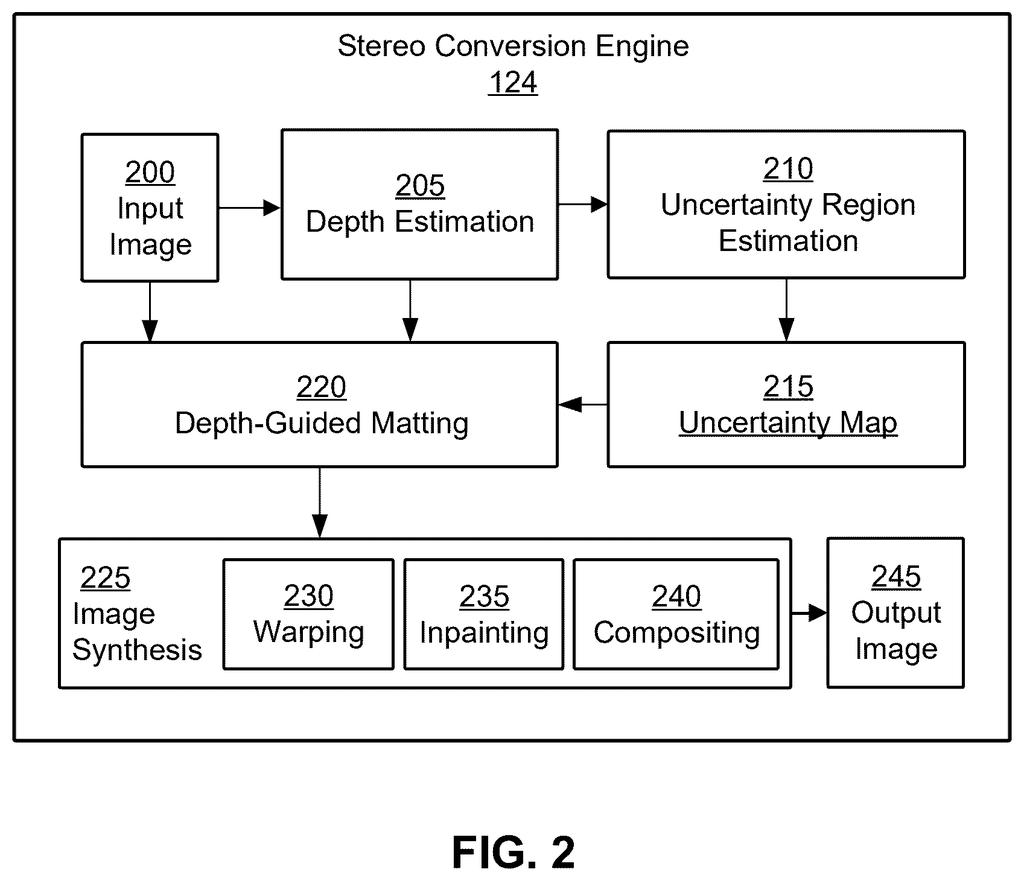
Disney's patent application goes after that problem. An AI first guesses how far away everything in a frame is. Then it flags the uncertain spots, mostly edges, where a single pixel is really a mix of two things, like a hair strand and the sky behind it. A second AI pulls each of those pixels apart into a foreground piece and a background piece.
With the layers separated, the system shifts them by different amounts to build a second image. Viewed together, the original and the new picture give your eyes the sense of depth. Gaps that open up behind moved objects get filled in using only the background.
… determining one or more uncertainty regions associated with the depth map, wherein each uncertainty region identifies a different area of the input image having one or more pixels that can be in multiple depth layers on the input image; …
Translation: The system finds tricky spots in the image where objects might overlap or blur together in 3D space.
How the AI splits blurry edge pixels apart
The filing describes a pipeline built on two sets of machine learning models. The first estimates a depth map: for every pixel, how far that part of the scene is from the camera. The patent says it can work with inverse depth (one divided by the distance) because things like the sky sit at nearly infinite distance.
Next, the system marks uncertainty regions, areas where a pixel could belong to more than one depth layer, usually along object edges. These can be a simple on/off mask, or a number at each pixel saying how many pieces it must be split into. The second set of models is described as a UNet-like network (a common image-processing neural network) with transformer blocks (a layer type that weighs relationships across the whole image). For each uncertain pixel it outputs:
- A foreground color and depth
- A background color and depth
- An opacity value, called alpha, that says how see-through the foreground is
Finally, the output image comes from three steps: warping (shifting each layer by its own amount), inpainting (filling holes where background is newly revealed), and compositing (stacking the layers back together). The result forms a stereo pair with the original image. The training data described includes computer-generated images and existing 3D movies.
… processing, using a second set of machine learning models, the depth map and the one or more uncertainty regions to determine, for each pixel in one of the one or more uncertainty regions, a foreground context and a background context for that pixel based on the depth map …
Translation: A second AI analyzes those tricky spots to figure out what belongs in the front and what belongs in the back.
Why hair and smoke matter for Disney's old films
If you've ever seen a 3D re-release where the edges shimmer or people look like paper cutouts, this is the problem being targeted. The filing says conversion in post-production is costly and often manual, and that older automated tools assign one depth per pixel, which fails on hair, reflections, partly transparent objects and smoke. Handling those cases automatically could mean cleaner 3D versions of films that were never shot in 3D, including a studio's older catalog.
The filing's title points to artistic control, though the text mostly describes the automatic pipeline. It also says the approach reuses what pretrained models already know, which it presents as cheaper than methods that optimize every scene from scratch. Whether any of this reaches theaters or streaming is not something the filing says.
Disney's third patent we've tracked in our AI photo editing race since September builds on their earlier work cutting actors from footage and pinning masks to objects.
The design gives up some simplicity to buy quality. By guessing depth first and splitting only the fuzzy edge pixels afterward, it avoids the heavy scene-by-scene calculation the filing criticizes in older methods. The price is that every later step trusts that first depth guess, so a wrong guess can carry a mistake straight into the final picture.
The two-layer default is the other bargain. The filing says two layers explain the vast majority of scenes, while fire and smoke may need the costlier option of splitting a pixel into more pieces. That is a sensible place to spend effort, since most shots are fine with two. Cheap for the common case, more expensive for the rare hard one: I'd take that trade.
Get our take in your Top Stories
Liked this breakdown? Add Patentlyze as a preferred source on Google, and our plain-English take shows up more often in your Top Stories the next time Disney patent news breaks.
There are more where this came from
We read every patent application Big Tech publishes and send you the ones worth knowing. Plain English, free, every week.
The drawings
4 drawing sheets from US 2026/0311353 A1 · click any drawing to enlarge


Want this weekly breakdown for a company we don't cover? Patentlyze Pro →
Be the first to weigh in