
Qualcomm Files Patent for Cross-Checking Phone Locations Against Camera Footage
A device's reported location can be faked, and so can what a security camera sees. Qualcomm's patent application has each source check the other.
What Qualcomm's camera-checked location patent does
Every time a warehouse tracker, a phone, or a delivery robot reports where it is, a computer somewhere has to believe it. That belief rests on radio signals, and radio signals can be faked or tampered with by someone with the right equipment.
Qualcomm's patent application adds a second witness. A location server compares what the radio data says about a device's surroundings with what nearby cameras actually see. If a device claims to be standing next to a particular cell tower but the footage disagrees, the server flags the radio data as compromised.
It works the other way around too. Cameras can be fooled with a fake wall or a blinding light, so trusted radio devices help check that what the cameras report is true.
… determining whether the RF-based information is compromised based on a comparison of a first set of values of a set of characteristics of an environment of the target network node determined based on the RF-based information to a second set of values of the set of characteristics of the environment of the target network node determined based on the vCSI.
Translation: Checking if phone location data is fake by comparing it against what security cameras see in the area.
How the server compares radio data to camera views
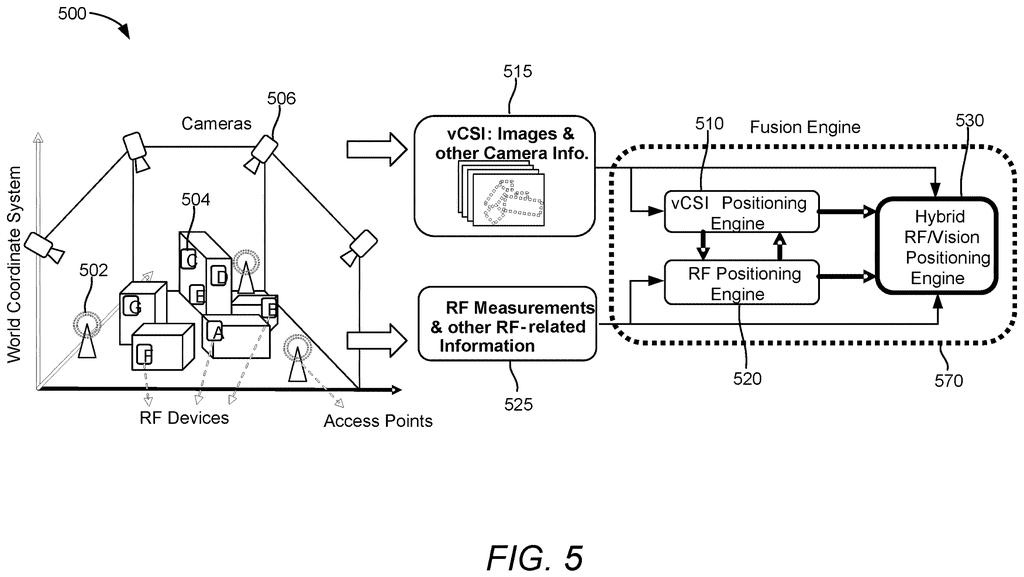
The patent describes a hybrid positioning system that combines two kinds of data. One is radio frequency (RF) information, such as signal strength readings, distance measurements, and satellite position estimates. The other is visual channel state information (vCSI), which is camera images, camera calibration data, and object detection results. A location server, the computer that works out where devices are, combines the two.
In the first framework, the server gets RF data from a target device and asks nearby cameras for vCSI. It then compares characteristics of the environment as seen by each source:
- Which anchor nodes (fixed reference points such as base stations or Wi-Fi access points) are present
- The device's distance and angle from those anchors
- The type of place, such as indoors, outdoors, a warehouse, or a home
If the two sets of values differ by more than an allowed margin, the RF data is flagged. The server can throw out just the bad portion, work out the location from what remains, and ask the cameras for more images as a double check.
The second framework reverses the roles. Camera data is checked against RF data from trusted devices, which can reveal that a line of sight was blocked, that a field of view does not match, or that objects have moved or been cloned. The filing also mentions a statistical method called random sample consensus (RANSAC) to spot outliers.
Why trusting a location signal is risky
If you rely on location data to find a package, guide a robot, or track equipment, the practical risk is that someone feeds the system a false position. The filing says that when camera data is added to radio-based tracking, an attack on one side can spread to the other and jeopardize the whole system.
The patent names asset trackers, smartphones, and industrial devices as the kinds of things being located, and warehouses, grocery stores, and homes as example settings. The idea is simple: no single source gets trusted on its own. The filing also notes the method could be used to spot odd readings in non-security settings.
Qualcomm's 492nd filing in our Qualcomm coverage since May adds to a body of work that includes saving battery during device search and AI that grades robot moves.
The problem here is real, and it grows with every system that acts on a location without a human checking it. A robot sent to the wrong shelf or an inventory tracker fed a false position costs money and time, and the filing says the risks of mixing cameras with radio tracking are still poorly understood.
The fix is proportionate to that problem. Instead of building a new security layer, it asks two independent sources whether they agree about the surroundings, and it throws out only the data that fails the test. That is easy to explain and easy to reason about.
The catch is that it only works where cameras can see the devices being tracked. Sending images to a server also raises privacy questions, though the description mentions a version where cameras send only outlines of detected objects. As a defense for camera-equipped sites like warehouses and factories, the approach fits the size of the problem.
Get our take in your Top Stories
Liked this breakdown? Add Patentlyze as a preferred source on Google, and our plain-English take shows up more often in your Top Stories the next time Qualcomm patent news breaks.
There are more where this came from
We read every patent application Big Tech publishes and send you the ones worth knowing. Plain English, free, every week.
The drawings
13 drawing sheets from US 2026/0313590 A1 · click any drawing to enlarge


Want this weekly breakdown for a company we don't cover? Patentlyze Pro →
Be the first to weigh in