
Adobe Files Patent for AI That Stages Product Bundle Photos Without a Shoot
Adobe describes a system where an AI paints a throwaway picture of a product bundle, then real catalog photos get fitted into it, so nobody has to stage a shoot.
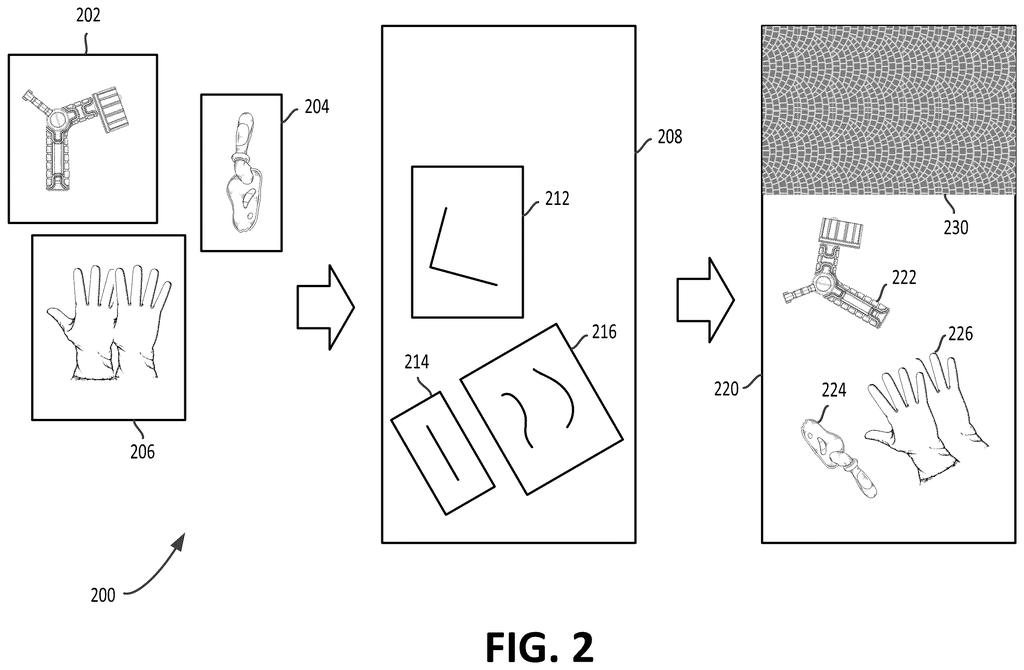
What Adobe's bundle-photo generator actually does
A gardening retailer has three separate product photos on file: a watering nozzle, a trowel, and a pair of gloves. Now it wants one image selling them as a bundle. Today that means staging a physical photo shoot or fiddling with editing software, layer by layer.
Adobe's patent application describes a shortcut. An AI first paints a stand-in picture: a made-up garden scene with look-alike tools placed in sensible spots. The system then measures how each look-alike is tilted, sized and angled, and drops the retailer's real product photos into those same spots with the same tilt and size. Any small gaps get filled in automatically.
If you shop online, you have probably seen bundle photos like this. The idea is to make them without anyone owning the products or opening a photo editor.
… applying a text generative model to the image and the image metadata to generate a text-based, contextually relevant prompt for a trained generative image model configured to provide contextual relevance for a use case corresponding to the presentation context …
Translation: It uses text AI to build a detailed prompt based on the product images and tags.
How a fake AI photo guides the real product shots
The system starts with a stored catalog. Each item is an image plus metadata (a text record with details like the product name and description). From the images, it works out a presentation context, meaning the setting the products suggest, such as outdoors near a patio rather than a subway station.
Next, a text generative model (a language AI) reads the images and metadata and writes a prompt, which is a written instruction for an image-generating AI. The filing also describes tuning that prompt by sampling an embedding space (a kind of map where similar meanings sit close together) around a vector (a list of numbers) that stands for the context. The image AI then produces a representative image: a placeholder scene with look-alike objects.
From there, the pipeline runs in steps:
- Cut out the look-alike objects from the placeholder (segmentation).
- Infer the disposition of each one, meaning its pose, scale, perspective and rotation.
- Transform each real catalog photo to match, and overlay it where the look-alike sat.
- Inpaint (fill in) any gaps left by small mismatches.
The finished composite can be displayed, stored, or sent out for use in an online catalog, flyers or messaging.
… segmenting the generated objects from the representative image to extract the generated objects from the representative image …
Translation: The system cuts out the objects generated in the draft image to figure out where they should go.
Why catalog teams could skip the photo shoot
For anyone selling things online, bundle photos are a chore. The filing points out that samples may sit in far-off warehouses or ship straight from a manufacturer, so staging a shoot is not always possible. A system like this would let a merchandiser pick three items from the catalog and get a finished scene.
The detail that matters for shoppers is that the final image uses the real product photos, with only the surrounding scene and layout invented. That keeps the product on screen close to the product in the box. It also describes a version where several candidate images are shown and a person accepts or rejects them, so a human still makes the final call.
Adobe's 27th filing we've tracked on our controllable AI image watchlist since May builds on earlier applications like cheaper AI image training and copying objects into photos.
The smartest choice here is also the one that costs the most. Adobe keeps the retailer's real product photos and uses the AI image only as a blueprint, so the trowel in the final picture is the actual trowel. The price is that a flat photo shot from one angle has to be tilted and resized to fit a scene it was never taken in.
That is where this could break. A photo can only be turned so far before it looks pasted on, and the filing leans on gap-filling to patch the seams. It also says nothing about matching lighting or shadows between the real photo and the invented scene.
For catalog work, the trade reads as worth it. Shoppers care that the product looks like what arrives, and a slightly flat bundle shot beats a polished picture of a trowel that does not exist.
Get our take in your Top Stories
Liked this breakdown? Add Patentlyze as a preferred source on Google, and our plain-English take shows up more often in your Top Stories the next time Adobe patent news breaks.
There are more where this came from
We read every patent application Big Tech publishes and send you the ones worth knowing. Plain English, free, every week.
The drawings
6 drawing sheets from US 2026/0311407 A1 · click any drawing to enlarge


Want this weekly breakdown for a company we don't cover? Patentlyze Pro →
Be the first to weigh in