
Sony Patents a Tool That Spots Glitches in AI-Sharpened Game Footage
When a game uses AI to sharpen its picture, glitches like ghostly afterimages can slip in, and today a human has to spot them. Sony's patent application has software do the spotting instead.
What Sony's glitch checker does for game video
Right now, if a game uses AI to sharpen its picture, the only way to catch glitches is to have a person watch the footage and spot them by eye. That takes a lot of human labor, and tired eyes miss things. Sony's patent application describes software that does the looking for you.
The idea: the game draws a rough frame, an AI model upscales it into a sharper one, and then the checker lays that sharper frame next to a reference version. If a patch of the picture looks very different from where it should, the software marks it as a possible flaw. Ghosting, where a faint afterimage of a moving character lingers on screen, is one of the problems the filing describes.
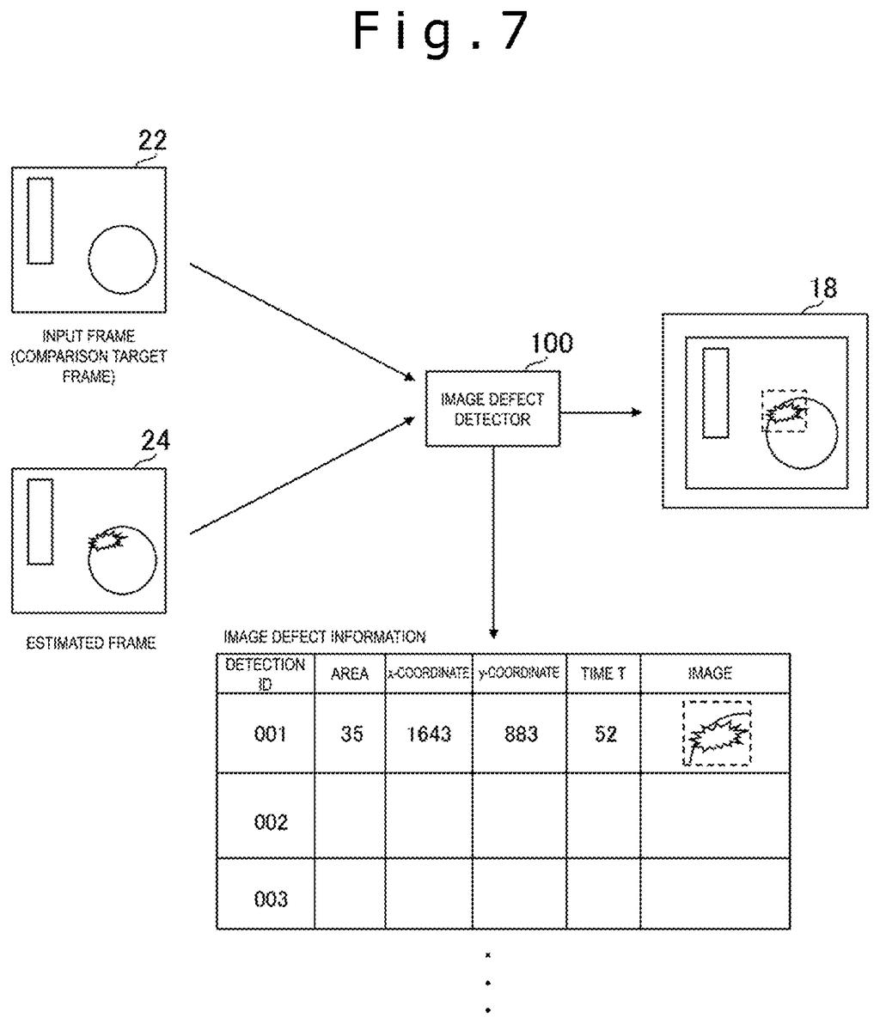
When the checker finds something, it logs where the flaw is, how big it is and which frame it showed up in. It can also draw a dashed outline around the spot for a human reviewer.
… acquire an n-th estimated frame output from a machine learning model, the n-th estimated frame being generated by the machine learning model by inputting an n-th input frame and (n−1)-th auxiliary information related to features of first to (n−1)-th input frames into the machine learning model …
Translation: The system grabs an AI-enhanced video frame that was built using data from several previous frames.
How the checker finds a bad patch of pixels
Sony's setup has two parts. First, a game console renders a frame at lower quality (the filing's example is 1080p) and an AI model boosts it to 4K. That model is recursive, meaning it also receives a summary of earlier frames. The extra history adds detail but can leave ghost-like afterimages when things move.
The second part is the inspector. For every AI-made frame after the first, it takes a reference frame and measures the differences. The reference can be the original input frame, the previous AI frame shifted to account for motion, or the frame the model was trained to produce.
- It scores how alike the two images are using SSIM (structural similarity, a standard measure of how similar two pictures look in brightness, contrast and structure), both for the whole screen and pixel by pixel.
- If the whole screen changed, it assumes a scene cut and skips the frame.
- Otherwise it marks regions that differ sharply as suspects and counts their pixels.
- A suspect becomes a flagged defect when its pixel count passes a threshold. The threshold drops in areas with fine detail (high spatial frequency, measured with a fast Fourier transform, a math tool that gauges how much detail a patch holds).
Flagged defects are logged with their size, coordinates, frame number and an image crop, and can be outlined on screen for a reviewer.
… detects a difference related to pixel information of the n-th estimated frame ( 24 ) with respect to the comparison target frame, based on the n-th estimated frame ( 24 ) and the comparison target frame; and acquires image defect information of the n-th estimated frame ( 24 ), based on the difference related to the pixel information.
Translation: It finds visual glitches by comparing the AI output frame against a reference frame.
Why AI-upscaled games need an automatic proofreader
If you play games on a console, the AI-boosted picture is only as good as the testing behind it. Checking every frame by eye does not scale, and the filing itself says human review can cause oversights. An automatic checker lets a studio scan long stretches of gameplay and jump straight to the frames that look wrong.
The filing describes the inspector as a program on a computer used to build games, so it looks like a tool for the people making them. Still, the result you would notice is fewer ghosting smears and visual oddities. The example jump from 1080p to 4K shows why it matters: the AI is inventing a lot of pixels, and some of them will be wrong.
Sony's 14th filing we've tracked in AI vision since May follows earlier applications like one that reads emotions and one cutting subjects from photos.
Claim 1 is wide on the checking side and narrow on the AI side. It asks for four steps: get a frame from an AI model, get a reference frame, measure the pixel differences, and report defect information. The claim never mentions games, a scoring method, a size cutoff or an on-screen box. Those details appear only in the later dependent claims.
The narrow part is the model. The claim covers only AI that is fed the current frame plus a summary of earlier frames, and the frame must be the second or later in a sequence. A checker built for an AI that sharpens single photos with no memory of past frames would fall outside that wording.
Any reference frame counts as long as it is 'predetermined,' so the claim reaches many ways of testing such a model. The filing reads as routine quality-control tooling: useful to Sony's own developers, with little direct effect on what you see on screen.
Get our take in your Top Stories
Liked this breakdown? Add Patentlyze as a preferred source on Google, and our plain-English take shows up more often in your Top Stories the next time Sony patent news breaks.
There are more where this came from
We read every patent application Big Tech publishes and send you the ones worth knowing. Plain English, free, every week.
The drawings
11 drawing sheets from US 2026/0311314 A1 · click any drawing to enlarge


Want this weekly breakdown for a company we don't cover? Patentlyze Pro →
Be the first to weigh in