
A New Disney Patent Rewrites Dubbed Dialogue to Match the Original Actor's Pauses
Disney's patent application goes after a dubbing flaw most viewers notice without being able to name: new dialogue that runs long, ends early, or ignores the original pauses. Its fix starts with rewriting the script so the words fit the original timing.
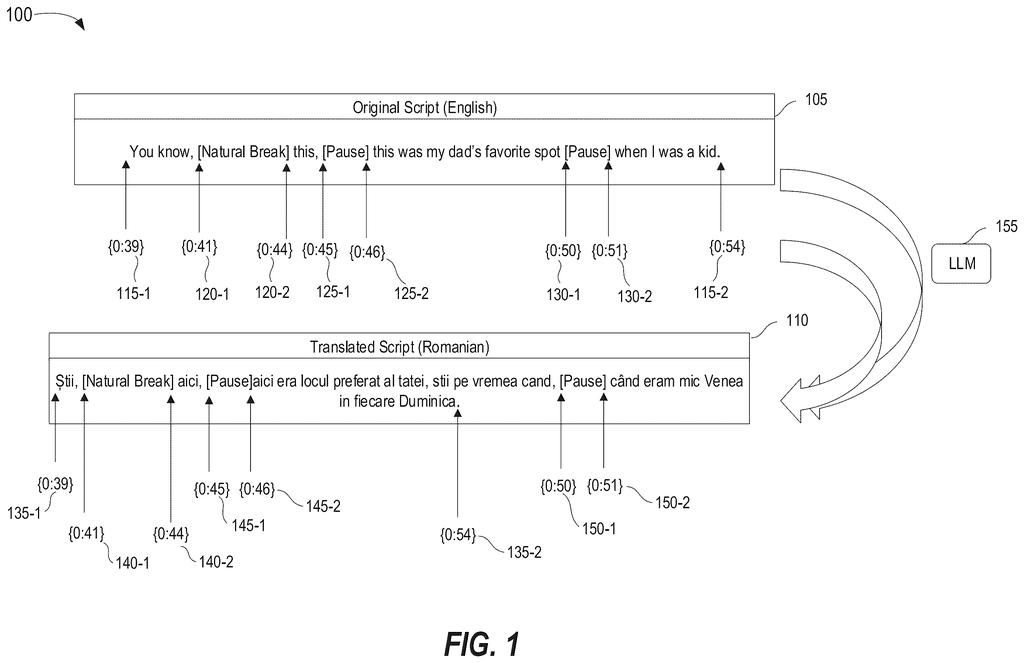
What Disney's dubbing patent actually does
Today, when a video gets a new voice track, most of the effort goes into making the speaker's lips match. The audio itself often gets overlooked, so the new dialogue can run long, finish early, or sound flat, with none of the pauses a real person takes.
Disney's patent application goes after that timing problem first. The system listens to the original scene and notes where the speaker pauses and how long each line lasts. Then an AI writing tool rewrites the new script (a translation, say) so it fits those same gaps, adding small words like well or you know where needed. A voice generator reads the result aloud, using the original recording as a guide for rhythm and loudness.
The new audio replaces the old track, so you get a dub that already lines up before any lip editing begins.
transcribing audio extracted from a video file to generate an original script; extracting pause and timing information from the audio, wherein the pause and timing information comprises at least one of pauses, natural gaps, or a duration of a speech segment in the audio; …
Translation: The system listens to the original video to map out exactly when the actor pauses and how long they speak.
How the script gets reshaped to fit the pauses
The claims cover a straightforward chain of steps. First, the system pulls the audio out of a video and converts it to text with a speech-to-text model (software that transcribes speech). It also records timing: where pauses and natural gaps fall and how long each speech segment lasts.
Next, a language model (the kind of AI behind modern chatbots) writes a new script built to fit that timing. For a translation, it makes a literal first pass, then adjusts it by inserting conjunctions, transitional phrases or filler words so the breaks land where the original speaker paused. The new script can also be entirely new content, such as updated narration, rephrased to match the original length.
Finally, a text-to-speech model turns the script into audio. In a narrower claim, the system also feeds in a mel spectrogram, a picture of the original sound showing timing, pitch and loudness over time. The description says the voice generator refines its waveform step by step using a math method called ODE-based inversion (a gradual, repeated adjustment), with 32 steps given as a default.
The description also outlines an optional check loop:
- Make a quick draft of the audio.
- Compare its timing with the original, for example within a 20-millisecond delay or 5% pause variance.
- Send the script back for another rewrite if it misses.
A new script is generated from the original script using a language model, where the new script is structured to align with the pause and timing information of the audio.
Translation: An AI rewrites the translated lines so they fit into the exact same breath patterns as the original performance.
Why this matters for dubbed video you watch
For you, the payoff would be dubbed video that sounds like a person talking at the right moments, instead of speech that rushes through a scene or trails off after the actor's mouth has stopped. The filing names translation, updated educational and marketing videos, and regional adaptation as uses.
The company also argues this saves effort. Because the audio already fits the original timing, the video needs only light fine-tuning of lip movements and not heavy pixel-level editing. That could make dubbing cheaper and faster for anyone who has to produce one video in many languages.
Disney's fifth filing in the Language AI patents we cover since July follows a mug design checker and a question-splitting search tool.
Nothing here needs new hardware. Every step is software that already exists: a transcription tool, a chatbot-style AI and a voice generator. The description even names real examples, including WhisperX and GPT-based systems.
The shortest route to a product is a dubbing tool that rewrites lines, checks them against the original timing, and loops until they fit. That loop is the clever part, and it is simple enough to build today. The harder piece is voice quality. The final step copies the original rhythm and loudness with a math-heavy method, and the filing offers no results showing how the finished audio sounds.
Until someone plays a sample, it stays a sensible plan with no proof attached. If it works, expect it to show up inside dubbing and editing software long before you ever see it as a button.
Get our take in your Top Stories
Liked this breakdown? Add Patentlyze as a preferred source on Google, and our plain-English take shows up more often in your Top Stories the next time Disney patent news breaks.
There are more where this came from
We read every patent application Big Tech publishes and send you the ones worth knowing. Plain English, free, every week.
The drawings
7 drawing sheets from US 2026/0310723 A1 · click any drawing to enlarge


Want this weekly breakdown for a company we don't cover? Patentlyze Pro →
Be the first to weigh in