
IBM Patents a Seizure Detector That Works With Any Number of Brain Sensors
Brain implants are laid out differently for every epilepsy patient, so seizure-spotting AI usually starts over for each person. IBM's new patent describes a version that learns just one number per sensor to fit a new layout.
What IBM's brain-sensor seizure detector does
Imagine you have epilepsy, and doctors place a custom set of sensors on your brain, in a layout chosen just for you. Yours would look different from the next patient's. Most AI seizure detectors expect the same number of sensors every time, so each patient's model has to be trained from scratch.
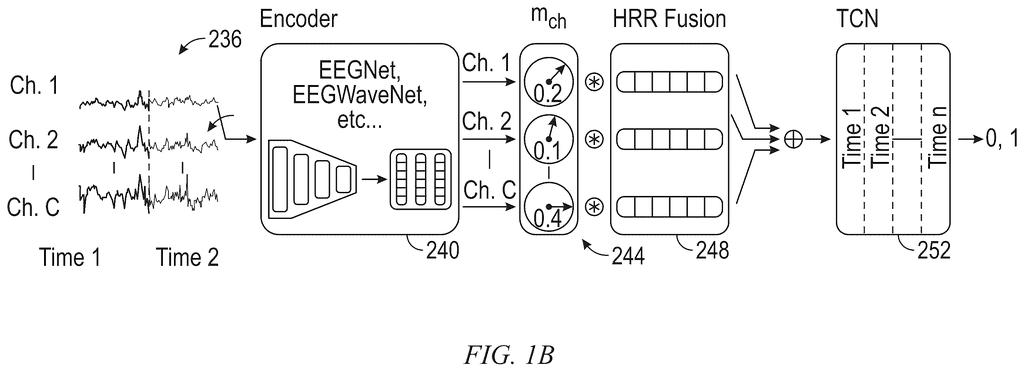
IBM's patent describes a way around that. The system first reads each sensor's signal on its own, in short snippets of a few seconds. Then it blends those readings into one summary, using just one learned number per sensor to remember how the sensors relate to each other. A second stage looks across a run of snippets, about 105 seconds in the main example, a bit like a neurologist reviewing minutes of recording before calling a seizure.
The idea is to train once on many patients, then fine-tune on a single seizure from you.
encoding a plurality of channels to provide short-term feature extraction from multi-channel timeseries data for each of a plurality of short-term windows to generate channel-by-channel feature vectors and provide a structured latent space representation of the plurality of channels; …
Translation: The system breaks down brain wave data from multiple sensors into small, short time pieces for analysis.
How one number per sensor blends the signals
The method starts by chopping a recording into short windows, each a few seconds long (7.5 seconds in the main example). Every channel (one electrode's stream of readings) goes through its own small neural network, called an encoder, independently and in parallel. Each one outputs a feature vector, a list of numbers summarizing what that channel just did.
Next comes fusion, built on holographic reduced representations (HRR), a technique from the vector symbolic family, where information is stored as very long lists of numbers that can be combined and later pulled apart. Each channel gets one learned value that rotates a shared base vector, so channels that behave alike get similar tags. Adding the tagged vectors gives one summary per window, whatever the channel count, with channel relationships kept as angles.
A second tier stacks a run of those summaries (14 in the example) and passes them to a temporal convolutional network, a model that scans a sequence for patterns over time without slow step-by-step looping. A final classifier then labels the stretch, such as seizure or no seizure.
Training has two stages:
- Pre-train on many patients with different sensor layouts.
- Fine-tune on a new patient, mostly to learn their per-channel values, in about five times fewer training passes.
One dependent claim adds detecting a medical condition from biometric data and automatically delivering a drug or neurostimulation.
The channel-by-channel feature vectors are fused to incorporate an original spatial structure of the plurality of channels into a single short-term representation for each of the plurality of short-term windows.
Translation: It combines the data from all sensors together to maintain the physical layout of the brain activity.
What this means for hospital seizure monitoring
If you or someone you know has epilepsy, the practical bottleneck here is setup. Implant layouts differ for every patient, so today's models get rebuilt for each person. IBM's design reuses most of one pre-trained model and adjusts it with a single recorded seizure, which could shorten the wait between implanting sensors and having a working detector. The filing says a personalized model can be deployed within minutes to hours.
The numbers come from public hospital recordings. In the filing's tests, median scores reached 0.79 versus 0.74 for one baseline, with a model of about 1.7 million parameters (adjustable settings), far smaller than the billion-parameter transformers (a heavier class of AI model) it is compared with. The filing also says the approach could handle weather, equipment fault and financial data. It is a patent application describing research results, and no product is named.
IBM's 23rd filing we've tracked in our AI vision coverage since May follows work like one on fixing IT outages and one on comparing duplicate entries.
The price of this design is compression. Squeezing dozens of sensors into one combined summary means some sensor-by-sensor detail has to blur. The company's own tests show how much rides on that step: with a plain average of the channels instead of the learned blend, the score fell from 0.78 to 0.45.
A second cost shows up in the results. On the shorter dataset, the filing says specificity dropped, meaning more false alarms, because the model had seen more data. For a seizure alert, a false alarm means a frightened patient and a missed seizure means something worse, so where that balance gets set matters more than a small bump in the median score.
The trade still reads as worth making. Giving up a little precision to skip building a new model for every patient, using about a fifth of the training passes, fits the daily reality of clinics with one-off sensor layouts. The gains are modest (0.79 versus 0.74), so I would call it a sensible efficiency win that still needs proof on live patients.
Get our take in your Top Stories
Liked this breakdown? Add Patentlyze as a preferred source on Google, and our plain-English take shows up more often in your Top Stories the next time IBM patent news breaks.
There are more where this came from
We read every patent application Big Tech publishes and send you the ones worth knowing. Plain English, free, every week.
The drawings
13 drawing sheets from US 2026/0310949 A1 · click any drawing to enlarge


Want this weekly breakdown for a company we don't cover? Patentlyze Pro →
Be the first to weigh in