
Apple Files Patent for Phones That Predict the Best 5G Signal Without Testing It
Your phone could skip most of its signal testing and let AI guess where the strongest 5G beam is. Apple's filing describes a phone that picks beams the tower never offered up for testing.
What Apple's AI beam-guessing phone does
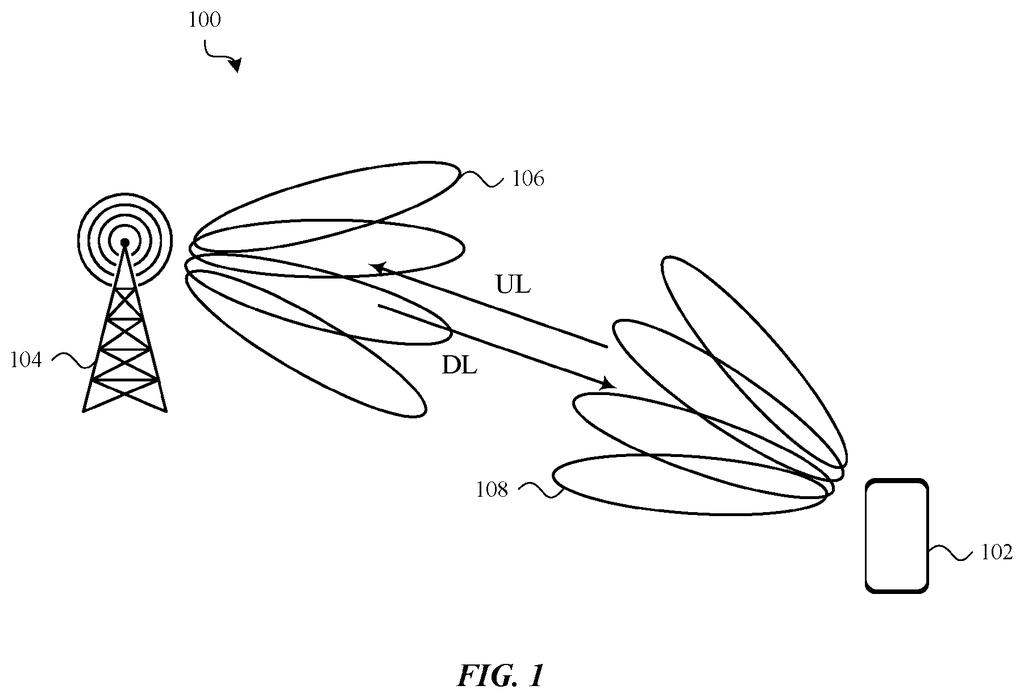
Today, when your phone talks to a 5G tower, the tower only lets it test a short list of signal beams (narrow, focused streams of radio waves). Testing every possible beam would burn time, battery and network capacity, so the phone checks a small sample and hopes the best option is on the list.
Apple's filing describes a phone that uses AI to fill in the gaps. It measures a handful of beams, then predicts which beam would reach it best, even if the tower never told it to test that one. The phone then sends the tower a report giving the predicted beam's angles, left to right and up and down.
From there, the tower can send a quick test signal on the predicted beam to confirm the guess before it switches over. The result is a short check of the AI's pick instead of a full sweep of every option.
… determine, at least partly based on the set of measurements and using artificial intelligence (AI), a set of predicted Tx beams that is best received by the UE, the set of predicted Tx beams including one or more Tx beams outside the set of Tx beams …
Translation: The device uses artificial intelligence to forecast the strongest signals without needing to test them all first.
How the phone predicts beams it never tested
The phone first receives a list of the tower's transmit beams. The filing's example has a full set of 56 beams (called Set A) and a smaller test set of 16 (Set B), on which the tower sends reference signals (known test transmissions the phone can measure).
The phone measures how strong and how clean the signal is on those 16 beams (the readings are called RSRP and SINR) and feeds the numbers into an AI model. The model returns the beams it expects to be received best. These can include narrower beams, or beams whose angles are interpolated or extrapolated (estimated between or beyond the measured ones) from the beams the phone actually heard.
Because a predicted beam may have no official ID, the phone's report identifies it by a horizontal angle and a vertical angle, and can pair each one with the phone's own receive beam. The tower may then send a second round of test signals on the predicted beams and tell the phone which one to use for data or control messages.
One detail is quasi-co-location (QCL), the set of assumptions, such as Doppler shift and signal delay, that tell the phone how to tune its radio for a given beam. A predicted beam has none defined, so the filing lets the phone work them out from neighboring beams, using a formula from the standards or one the phone maker writes. A separate claim covers the tower side of the exchange.
… generate a set of measurements based on a set of reference signals. The set of reference signals is received via the transceiver and from the network device on at least one beam of the set of Tx beams.
Translation: The phone analyzes standard signals it already receives to gather initial data for its predictions.
Why better beam guesses matter for your phone
If this works, the practical payoff is a faster, cheaper way for your phone and the tower to lock onto a good connection. Less time spent testing beams means less battery used on housekeeping and less network capacity spent on test signals, which matters most when you are moving and the best beam keeps changing.
The filing also covers the paperwork that makes AI guesses usable: how the phone reports a beam without an ID, how the tower confirms it is using the phone's pick, and how the phone sets up its radio for a beam nobody has defined. That reads as groundwork for phone makers and network gear makers to agree on shared rules, since both sides need to speak the same language.
Apple's 523rd filing in our Apple coverage since May follows applications like the AI labeling one and the angled avatar one.
The design trades certainty for speed. The phone skips most of its measurements and bets on an AI guess, so a bad guess wastes a round of test signals and delays the connection. The filing hedges this by having the tower confirm the predicted beam before committing, which keeps the cost of a wrong guess small.
The bigger price is coordination. The tower has to understand reports about beams it never labeled, and the phone's radio setup for those beams may come from a formula the phone maker writes, so two phones could behave differently on the same tower. That is a lot of new rules for the industry to agree on.
Still, the trade looks worth it. Checking a prediction costs far less than testing every beam, and the pain it targets, overhead and wasted battery, is real. Whether it ships depends on standards bodies, not on how clever the AI is.
Get our take in your Top Stories
Liked this breakdown? Add Patentlyze as a preferred source on Google, and our plain-English take shows up more often in your Top Stories the next time Apple patent news breaks.
There are more where this came from
We read every patent application Big Tech publishes and send you the ones worth knowing. Plain English, free, every week.
The drawings
10 drawing sheets from US 2026/0312745 A1 · click any drawing to enlarge


Show the other 2 sheets


Want this weekly breakdown for a company we don't cover? Patentlyze Pro →
Be the first to weigh in