
A New Samsung Patent Folds a Smart Ring's Antenna Down Over Its Radio Chip
Samsung's answer to a cramped smart ring is to fold part of the circuit board over on itself, like closing a flap, so the antenna sits on top of the radio chip it serves.
What Samsung's folded ring antenna actually does
One common way to wire an antenna inside a ring is a small metal spring clip. The trouble is that a ring's antenna has to curve with the band, and a curved surface can make a sloppy connection with the clip. The clip also adds height and takes up space on the circuit board that other parts could use.
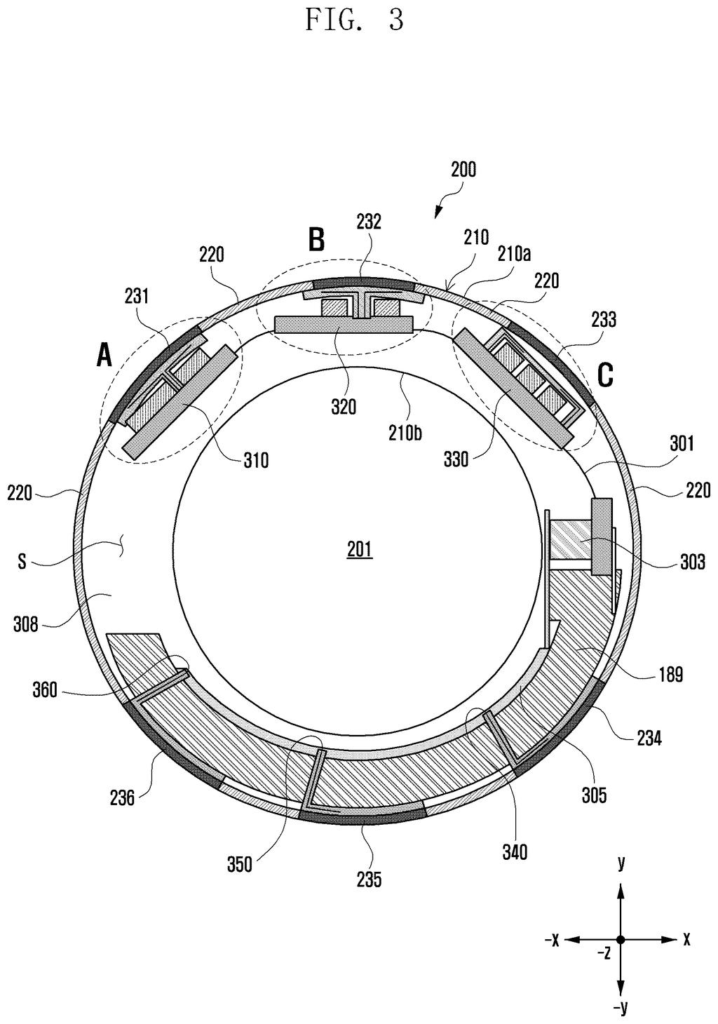
Samsung's filing skips the clip. Part of the circuit board is rigid and holds the wireless chip. A bendable strip extends from it with the antenna built in, and that strip folds back over the chip like closing a flap. A wire built into the strip carries the signal, so no extra connector is needed.
According to the filing, the result is a better connection and a thinner ring. The antenna sends and receives its signal through a non-metal window on the ring's outer surface.
… a third flexible portion disposed between the first rigid portion and the second flexible portion, the third flexible portion including a conductive line electrically connected with the first rigid portion and the antenna pattern …
Translation: A bendable connector links the circuit board to the antenna.
How the flexible strip folds over the radio chip
The claims describe a ring-shaped housing with an outer surface and an inner surface, and a printed circuit board (the board that carries a device's chips and wiring) sandwiched between them. The board mixes stiff and bendable sections: several rigid portions joined by a flexible one, plus two more flexible pieces.
One flexible piece has the antenna pattern formed in it (a thin conductive trace that sends and receives radio signals). A second flexible piece, carrying a conductive line (a wire built into the board), links that antenna piece to a rigid portion. This linking piece bends so the antenna section lies directly over the rigid portion and the wireless chip mounted there. Dependent claims name Bluetooth Low Energy (a low-power version of Bluetooth) as the signal type.
The filing also describes these details:
- A non-metal window, such as a polymer, on the ring's outer surface lets the antenna's signal pass through.
- A shielding plate over the radio chip absorbs electrical noise, bonded with adhesive layers about 0.03 to 0.07 mm thick.
- The same fold-over layout can hold touch-sensing patterns and an optical sensor for heart rate, stress and blood oxygen. A long press could dim your lights through a paired phone, and a swipe could trigger a transit-card payment.
The connecting portion is bent such that the second portion is disposed on the wireless communication circuit.
Translation: The antenna folds directly on top of the radio chip to save space inside the ring.
Why a thinner ring antenna matters on your finger
If you wear a smart ring, you notice every bit of thickness. Building the antenna into a folded strip frees up height and board space, which the filing says can make the ring thinner and improve the antenna's contact with the board. Both matter for a device you wear all day, through workouts and sleep.
The filing describes the same fold-over layout for touch strips and heart-rate sensors too, so one compact layout could hold an antenna, a swipe pad and a health sensor in a very small band. The filing names no product, and it is a design for how the parts are arranged, not a new feature you would see in an app.
One more thing to know: the patent office has already approved this application. Once Samsung pays the final fee, it should be issued as a granted patent, and the final claims may read a little differently from the version described here.
Samsung's 388th filing in the Display patents we cover since May follows work like a fix for jagged 3D lines and a nanostructure light-splitting lens.
A ring leaves almost no spare room. Every part has to fit in a band you wear on a finger all day, so a clip that adds height and takes up board space is a real cost, and a flaky connection on a curved antenna is a real annoyance.
Folding a flexible strip over the chip is a proportionate answer. It removes the troublesome part and uses the board's own material to make the connection.
The filing gives no figures for how much thinner the ring gets or how much the signal improves, so the size of the win stays unknown. Treat it as sound, routine hardware plumbing: useful to wearers if it reaches a product, and unlikely to change how anyone thinks about smart rings.
Get our take in your Top Stories
Liked this breakdown? Add Patentlyze as a preferred source on Google, and our plain-English take shows up more often in your Top Stories the next time Samsung patent news breaks.
There are more where this came from
We read every patent application Big Tech publishes and send you the ones worth knowing. Plain English, free, every week.
The drawings
11 drawing sheets from US 2026/0312274 A1 · click any drawing to enlarge


Want this weekly breakdown for a company we don't cover? Patentlyze Pro →
Be the first to weigh in