
Meta Files Patent for Glasses That Shine a Laser on Your Nose to Hear You
Meta's filing describes a microphone that shines a laser on your nose and reads the tiny shakes your own voice makes in your skin.
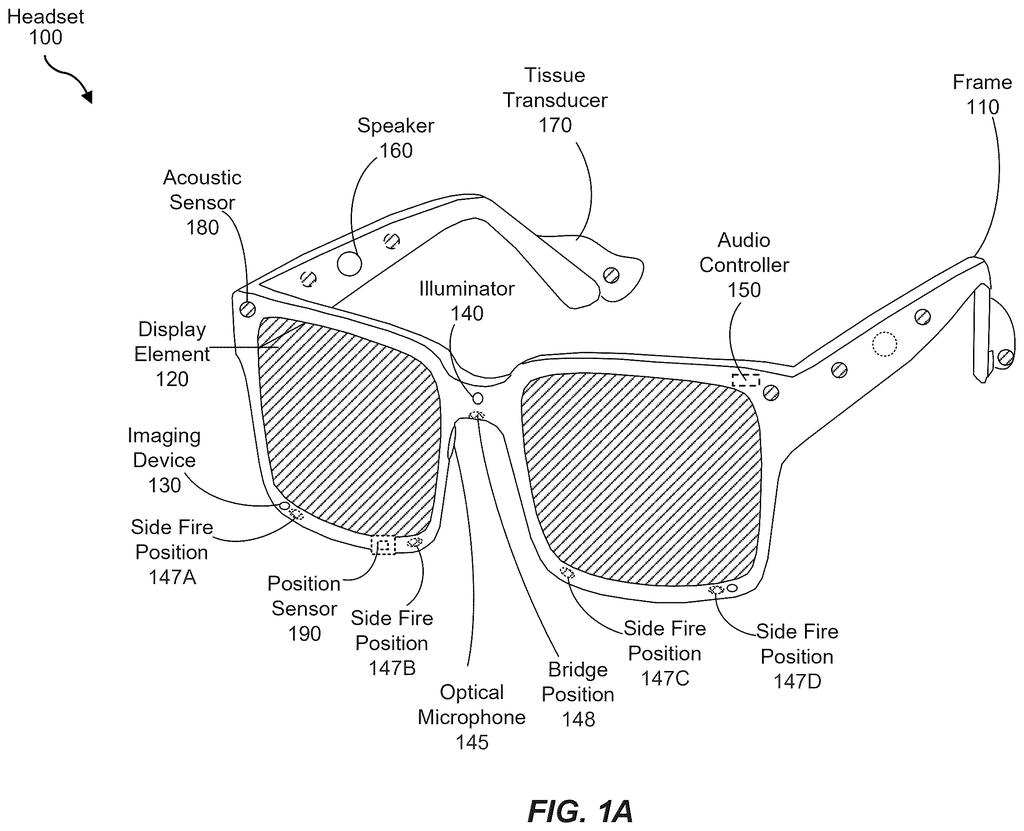
What Meta's laser-on-your-nose microphone does
Imagine you're at a loud restaurant, talking to your smart glasses while a dozen other conversations roar around you. Ordinary microphones hear all of it at once, so your glasses can't reliably tell when you are the one speaking.
Meta's filing describes a workaround. A tiny laser in the nose pad of your glasses shines a beam of light onto the skin of your nose. When you talk, your skin trembles by a sliver of the width of a hair, and the light bouncing back shifts slightly. By comparing that returning light with a copy of the original beam, the glasses can read those tremors and turn them into sound.
Because it reads your skin rather than the room's air, the filing says it picks up much less background noise. That makes it far easier to tell when you're talking, clean up your voice, or cancel out the din around you.
a light source configured to emit light, the light including a reference beam and a sensing beam, the light source configured to illuminate skin of a user with the sensing beam, the sensing beam being directed to a location on the skin, wherein vibrations of the skin are caused by sounds in a local area …
Translation: The glasses shine a laser beam onto the wearer's face to track how speech makes their skin vibrate.
How the laser beam turns skin shake into sound
The core claim is an audio system with an optical microphone. A light source emits light that is split into a reference beam and a sensing beam. The sensing beam is aimed at a spot on the user's skin, where sounds in the room make the skin vibrate. Some of that light reflects back and mixes with the reference beam at a detector. This setup is called interferometry (comparing two light waves, because the way they overlap reveals extremely small changes in distance). An audio controller then turns the mixed signal into sound.
The claims list several ways to build it:
- A self-mixing interferometer, where the reflected light feeds back into the laser itself
- A Michelson interferometer or a laser Doppler vibrometer, two other standard ways of measuring tiny motion with light
- Placement in the nose pad or the frame, with a second sensor aimed at a different spot on the face
- A chip-based light path with a grating coupler, plus a damping layer so the headset's own shaking doesn't interfere
The description says skin moves about 50 nanometers when you whisper and up to 1.5 microns when you yell. Skin also dulls high pitches (above roughly 2 kHz), so the controller can rebuild them using machine learning trained on recordings from regular microphones. The system can also pair with a normal microphone array to calibrate and sharpen the result.
A separate independent claim swaps the skin for a thin, reflective membrane that vibrates with sound.
A portion of the sensing beam is reflected by the skin and mixed with the reference beam to generate a mixed signal. The detector is configured to detect the mixed signal corresponding to interference between the reference beam and the reflected sensing beam.
Translation: Sensors measure the bouncing laser light to detect tiny skin movements and turn them into sound.
Why a nose-pad microphone matters for loud rooms
The practical payoff is simple: voice features that keep working in loud places. If your glasses can tell when you're speaking, they can boost your voice, cancel the noise around you, and act on spoken commands with fewer mistakes. The filing even describes sending your cleaned-up voice to another person's device in a crowd, such as at a football game.
The patent is a continuation of an application filed in November 2021, so the idea has been in Meta's pipeline for a while. It names eyewear and headsets as the main homes, and also mentions necklaces and watches. The description says users could opt in or out of recording and sharing, which matters for a sensor pointed at your face. As with any patent application, nothing here says a product is coming.
Meta's 73rd filing in our smart glasses watchlist since May adds to earlier applications like one reading pulse through sweat and one slimming glasses by tilting images.
The problem is real. Anyone who has shouted a voice command at a phone in a loud bar knows that voice features fail exactly when you need them most. Ordinary microphones can't separate your voice from the crowd's.
Meta's answer is to listen to your face. That is a heavy fix for a narrow problem, because it adds a laser, a detector and chip-level optics to glasses that already have tight limits on space and power. The filing helps its own case by giving the sensor several jobs: spotting your voice, cancelling noise, reading facial expressions and noticing when the glasses slip.
Whether it ships is another matter. The filing gives no figures on power use, cost or comfort, and a patent application shows an idea, not a plan. Still, aiming at the one moment voice features break is a sensible target.
Get our take in your Top Stories
Liked this breakdown? Add Patentlyze as a preferred source on Google, and our plain-English take shows up more often in your Top Stories the next time Meta patent news breaks.
There are more where this came from
We read every patent application Big Tech publishes and send you the ones worth knowing. Plain English, free, every week.
The drawings
9 drawing sheets from US 2026/0323225 A1 · click any drawing to enlarge


Show the other 1 sheets

Want this weekly breakdown for a company we don't cover? Patentlyze Pro →
Be the first to weigh in