
Apple Files Patent for Correcting Room Scans So Virtual Characters Sit on Your Couch
Scan your living room with a headset and the digital copy often comes out a bit wrong, so a virtual character ends up sitting on empty air beside your real couch. Apple's patent has the device check its own work and nudge the copy into place.
What Apple's room-scan correction actually does
When a headset scans your living room, the 3D model it builds is often a little off. A wall comes out too short, the TV too big, the couch a few inches from where it really sits. Apple's filing says that matters, because a virtual character placed on the couch model may end up sitting on empty space.
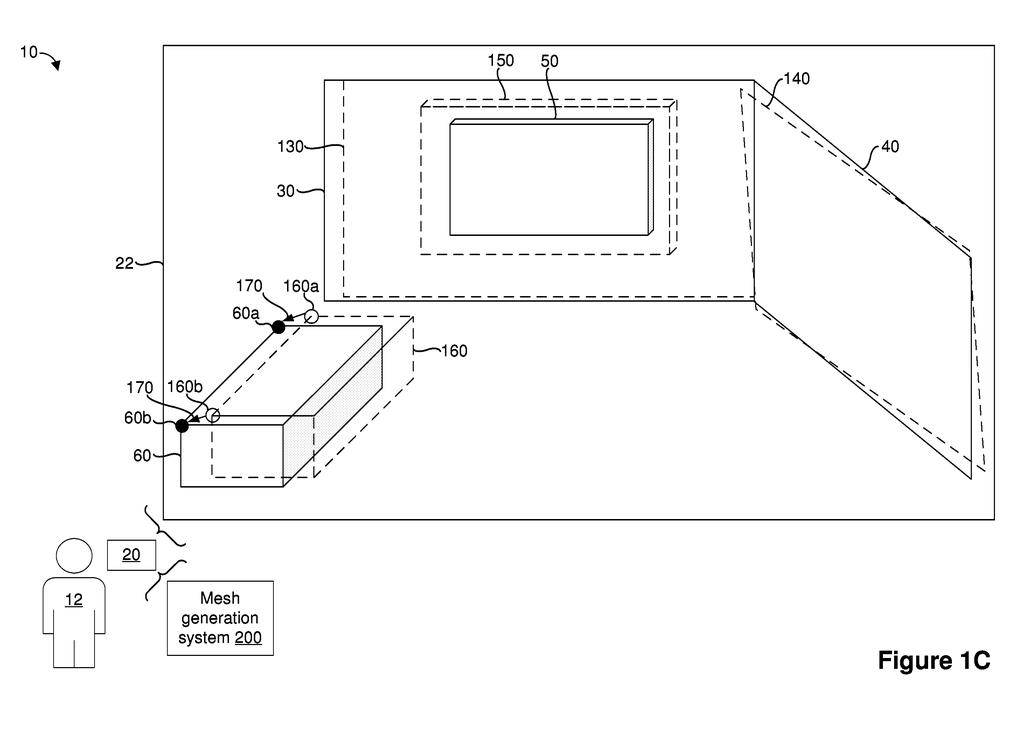
The patent has the device check its own work. It finds real landmarks like corners, furniture and architectural features, then compares them with the matching spots in its 3D model. Where the two disagree, it stretches, shifts or rotates that piece until it lines up with the real thing.
The leftover error can also serve as a clue. If the model is off because a sensor has drifted or gotten noisy, the device can recalibrate that sensor so future scans start out closer to the truth.
… determining whether the mesh is aligned with the physical environment based on a comparison between the plurality of mesh elements and the respective physical points in the physical environment; …
Translation: The system checks if its 3D digital map matches the actual layout of the real room.
How the headset checks corners, couches, walls
The patent covers a device with a display that obtains a mesh (a 3D model of a space built from many small connected pieces, called mesh elements). Each element stands for a real point, such as a wall, a corner or a piece of furniture. The device decides whether the mesh is aligned with the room by comparing those elements with the real points they represent, then modifies the misaligned portion to produce a corrected mesh.
The filing describes several ways to run that check:
- Do the coordinates of a mesh element match the real point when the mesh is overlaid on the room (for example, a virtual corner against a physical corner)?
- Does the distance between two mesh elements match the real distance between the points they represent?
- Does an element face the same way as the real object, such as a painting on a wall?
Fixes come in three types: scaling (stretching or compressing a piece), moving it, or rotating it. The description says the device can repeat corrections until the number of misalignments drops below a threshold, and can fill any holes the changes open up using smoothing techniques (math that blends a surface so gaps disappear). It also checks whether the room itself changed: small changes get adjusted for, while big ones trigger a brand-new mesh.
The mesh can come from LIDAR (a laser-based depth sensor), cameras, microphones that pick up sound reflections, matching two camera views, or the user drawing it by hand and letting the system refine it.
Why virtual objects need a better-fitting room
If you use a headset that blends virtual objects into your real room, the experience depends on small details: a virtual character that sits on your actual couch, a screen that hangs on your actual wall. A scan that is a few inches off breaks that illusion fast. The filing also names navigation guidance as a use, where an inaccurate model could point you the wrong way.
The patent describes a head-mountable device with a display that shows your surroundings, so it fits the spatial computing hardware Apple already sells. Correcting a scan after the fact, and using the errors to retune sensors, could mean better object placement with less rescanning. It is a patent application, so it says nothing about what will ship.
Apple's 87th filing we've tracked in our AR glasses work watchlist since May builds on the bigger keyboard idea and the room scan fix.
Every fix here has a cost. The device has to decide what counts as the truth, and it treats its own reading of real corners, couches and walls as the standard. If that reading is wrong, the correction can pull a decent scan further from the room.
The filing also asks for extra work: comparing point after point, adjusting pieces, and patching any gaps the stretching leaves behind. That means processing time and battery drain on a headset that has little of either to spare. The filing's answer is thresholds, so small errors get fixed and large changes in the room trigger a fresh scan.
That trade reads as worth it. A virtual character sitting on empty air breaks the illusion at a glance, and a quick correction pass is a small price for a couch that behaves like a couch.
Get our take in your Top Stories
Liked this breakdown? Add Patentlyze as a preferred source on Google, and our plain-English take shows up more often in your Top Stories the next time Apple patent news breaks.
There are more where this came from
We read every patent application Big Tech publishes and send you the ones worth knowing. Plain English, free, every week.
The drawings
13 drawing sheets from US 2026/0320951 A1 · click any drawing to enlarge


Show the other 5 sheets


Want this weekly breakdown for a company we don't cover? Patentlyze Pro →
Be the first to weigh in