
Sony Files Patent for Cars That Realign Their Own Cameras and Laser Sensors
Hit a pothole or bump a mirror, and the cameras and laser sensors on a self-driving car can drift out of alignment without anyone noticing. Sony's patent application has the car check itself against a stored 3D map of the street and fix the error on the spot.
What Sony's self-checking car sensors actually do
Imagine you've owned a car with driver-assist features for two years. A car wash, a few potholes and a minor parking bump later, its front camera is tilted a hair away from where it started. You'd never see it, but the car's idea of where things are is now slightly wrong.
Sony's patent application describes a way for the car to catch that on its own. As you drive, the car checks where it is, pulls up a stored 3D map of that spot, and looks for fixed objects like signs and buildings. It compares where those objects should appear with where the sensors actually see them.
If the two don't match, the car works out how far the sensors have shifted and updates its settings. No special equipment or trip to a calibration bay is required, and it can happen while you're moving.
… deviation determination unit that determines a deviation between a plurality of sensors on a basis of a 3D map and sensing results of the plurality of sensors …
Translation: This part checks how far off the vehicle's sensors are by comparing their view to a 3D map.
How the car tests camera and LiDAR against a map
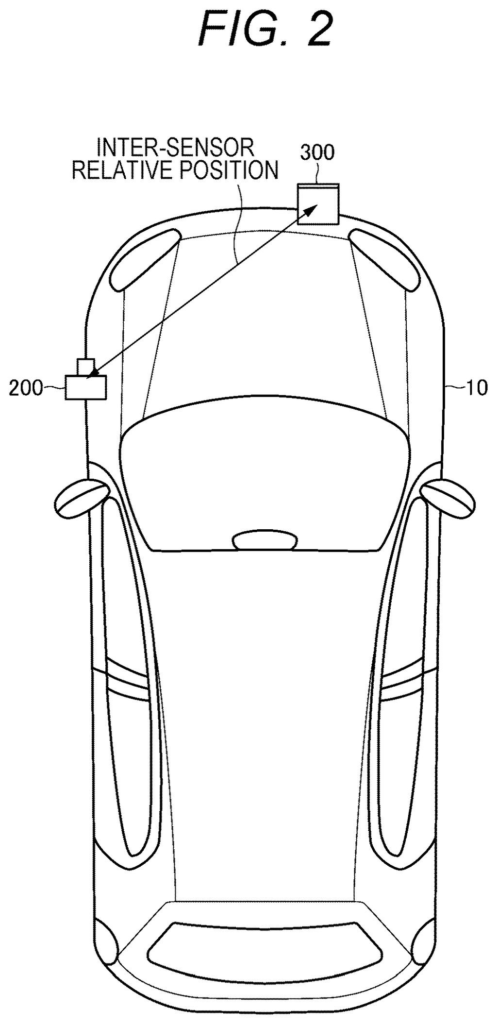
The system links a camera and a LiDAR (a sensor that bounces laser pulses off objects to measure distance, producing a 3D point cloud, meaning a cloud of dots that outlines the surroundings). The car's GPS and compass tell it where it is and which way it's facing. It then pulls a matching pre-made 3D map from storage. Each map holds a point cloud plus a list of landmarks, such as signs or buildings that don't move.
For the camera, the system finds the landmarks in the live image. It works out where the camera must be relative to the map using a standard geometry technique called perspective-n-point (a way to calculate a camera's position from known points in 3D and where they show up in a 2D picture). It then projects the map's landmarks onto the image and measures the gap. If the gap is over a threshold, for example one pixel, the camera has shifted.
For the LiDAR, it lines up the live point cloud with the map's point cloud using iterative closest point (a method that repeatedly nudges two sets of dots until they overlap) and measures the leftover error.
- It combines the two positions to get the camera-to-LiDAR relationship.
- It tests whether the landmarks still land in the right spot in the camera image.
- If not, it saves the new relationship as the calibration.
The filing also describes keeping maps in the cloud, using several readings and taking the median, and nudging drivers toward a nearby spot with good landmarks when calibration is overdue.
… calibration processing unit that performs calibration of the sensors on the basis of a determination result of the deviation determination unit …
Translation: This part automatically adjusts the sensors to fix whatever misalignment was just found.
What this means for self-driving car upkeep
Driver-assist systems depend on the camera and the laser sensor agreeing on where things are. If they drift apart, a car might think a pedestrian is a few inches from where they really are. Catching that drift automatically could mean fewer service visits and fewer quiet errors in the features you rely on.
The filing says this avoids the expensive 3D measuring equipment and dedicated calibration spots that other methods need, and it can work while the car is moving. It also applies beyond cars: the description lists drones, robots, ships and farm machines as possible uses. Like most patent applications, this one shows an idea, not a product.
Sony's 31st filing we've tracked since July in the self-driving sensing race adds to a run that includes its backing-off laser and cars that project road messages.
Most people will never think about sensor alignment, and that is the point. When it fails, the car's driver-assist features get a bit worse in ways you can't see, and you find out only when something goes wrong. A car that notices the drift and corrects it as you drive removes a maintenance chore you didn't know you had.
The approach is sensible because it uses things already on the road, like signs and buildings, so there are no special targets and no trip to a shop. The catch is that it only works where a good 3D map exists, so how useful you'd find it depends on how much of your daily route is covered.
The feature you'd notice most is the optional nudge that tells you when calibration is overdue and points you to a nearby spot where it can happen. That is a practical touch, and it's the sort of small thing that makes driver-assist feel dependable.
Get our take in your Top Stories
Liked this breakdown? Add Patentlyze as a preferred source on Google, and our plain-English take shows up more often in your Top Stories the next time Sony patent news breaks.
There are more where this came from
We read every patent application Big Tech publishes and send you the ones worth knowing. Plain English, free, every week.
The drawings
20 drawing sheets from US 2026/0320833 A1 · click any drawing to enlarge


Show the other 12 sheets


Want this weekly breakdown for a company we don't cover? Patentlyze Pro →
Be the first to weigh in