
Nvidia Patents a Light-Projection System to Keep Driver Gaze Cameras Accurate
Getting a car's interior camera to reliably know where a driver is looking is harder than it sounds, and Nvidia just filed a patent for a clever way to automate the tedious calibration process that makes it possible.
How Nvidia trains a car's camera to follow your eyes
Ever tried to explain to someone exactly where you're pointing, only to have them look at the wrong spot? Teaching a car's cabin camera to track a driver's eyes has exactly that problem, and on a much larger scale.
Car safety systems that watch whether you're looking at the road, drifting off, or staring at your phone depend on cameras calibrated to a very precise understanding of the cabin's geometry. Right now, getting that calibration right typically means a laborious manual setup. Nvidia's patent describes a smarter approach: project a small dot of light onto any surface inside the cabin, have a test driver look at it, and let the system automatically record exactly where the dot landed in 3D space. Do that dozens or hundreds of times across the whole interior, and you've built a rich, accurate set of labeled training examples without a human having to measure and log each one by hand.
The practical payoff is that eye-tracking systems inside vehicles could be trained and recalibrated faster and more accurately, which matters every time a new car model, dashboard shape, or seating configuration enters the picture.
cause a sequence of gaze targets to be projected over an interior surface of an ego-machine; determine, for each gaze target of the sequence of gaze targets, a position in a three-dimensional (3D) space corresponding to a location of a projection of a respective gaze target; …
Translation: The system shines lights inside the vehicle and calculates their exact physical coordinates.
How the projected dot becomes labeled training data
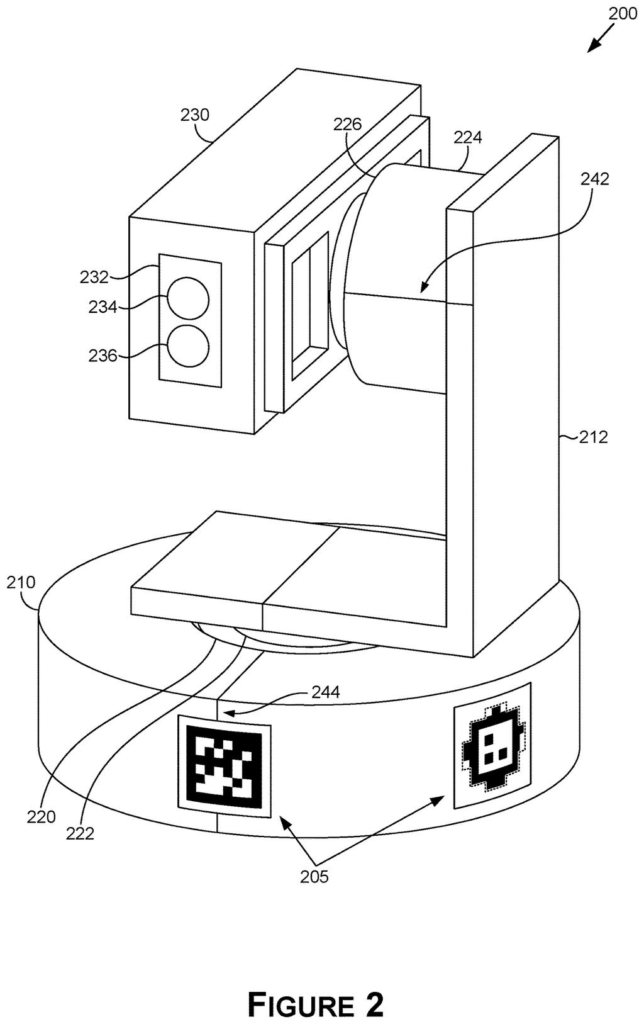
The patent describes a calibration rig designed to work inside a vehicle cabin. A projector mounted at a known fixed position fires a beam of light that lands as a visible dot on whatever interior surface it hits, whether that's a curved dashboard, a narrow door panel, or an irregular headliner.
Because the projector's position is known precisely, the system can calculate the 3D coordinates (the exact location in space, not just a flat 2D image position) of wherever the dot lands. A camera then captures images of a test occupant looking at each projected dot in sequence. Those images are automatically tagged with the corresponding 3D coordinates, producing what engineers call ground truth data, meaning labeled examples where the system knows with confidence exactly what the camera was seeing and where the occupant's eyes were directed.
Those labeled images then feed into training an in-cabin monitoring model (the AI that will later watch real drivers). The patent also describes using this same projection-and-capture loop to adjust the camera's own calibration parameters, correcting for things like slight shifts in mounting position or lens distortion.
- A gaze-target projector sweeps a sequence of dot positions across the cabin interior.
- The system computes the 3D position of each projected dot automatically.
- A camera captures the test occupant's face and eyes while they look at each dot.
- Each image is labeled with the dot's 3D coordinates, creating training and calibration data.
Because a beam of light may be used to produce the projected gaze target, the projected gaze target may be displayed at a projection point on the surface of the cabin interior, even if the surface at the projection point is curved, small, or an irregular shape.
Translation: Light can be projected onto any bumpy or curved interior surface to serve as a target.
What this means for driver-attention safety systems
Driver monitoring is becoming a legal requirement in many markets, including the European Union's new General Safety Regulation, which mandates attention-detection systems in new vehicles. The accuracy of those systems depends directly on how well the cabin cameras are calibrated. A camera that doesn't know the precise geometry of this specific car's interior will make more errors about whether you are watching the road.
Nvidia keeps filing on in-cabin sensing and autonomous-vehicle perception, and this patent fits squarely into that work. Automating the calibration data-collection step reduces a significant cost and time burden for automakers, potentially making better-tuned driver monitoring available across a wider range of vehicle models rather than only premium ones where manual setup budgets are generous.
Nvidia's 78th filing we've tracked since May in our self-driving sensing race follows work like tighter boxes around objects and 3D intersection mapping.
The projector and camera this method depends on already exist in vehicle testing facilities. What the patent adds is a structured way to use that equipment to automatically teach driver-monitoring software where a person is looking, by shining a light at a known spot inside a car and recording what the cameras see.
That means this is a factory-floor and testing-workflow idea before it is anything a driver would notice. An automaker would wire it into their evaluation process, not retrofit it into a finished vehicle.
For a company selling the software that powers driver-monitoring systems, owning the method that makes those systems accurate is a quiet but durable advantage. Calibration tools rarely make headlines, but they are often where long supplier contracts get decided.
There are more where this came from
We read every patent application Big Tech publishes and send you the ones worth knowing. Plain English, free, every week.
The drawings
17 drawing sheets from US 2026/0301433 A1 · click any drawing to enlarge


Want this weekly breakdown for a company we don't cover? Patentlyze Pro →
Be the first to weigh in