
Samsung Files Patent for a Screen That Shows Flat and 3D Images at Once
Samsung describes a phone-style screen that shows flat and 3D images side by side, using a lens layer that never needs electricity to switch.
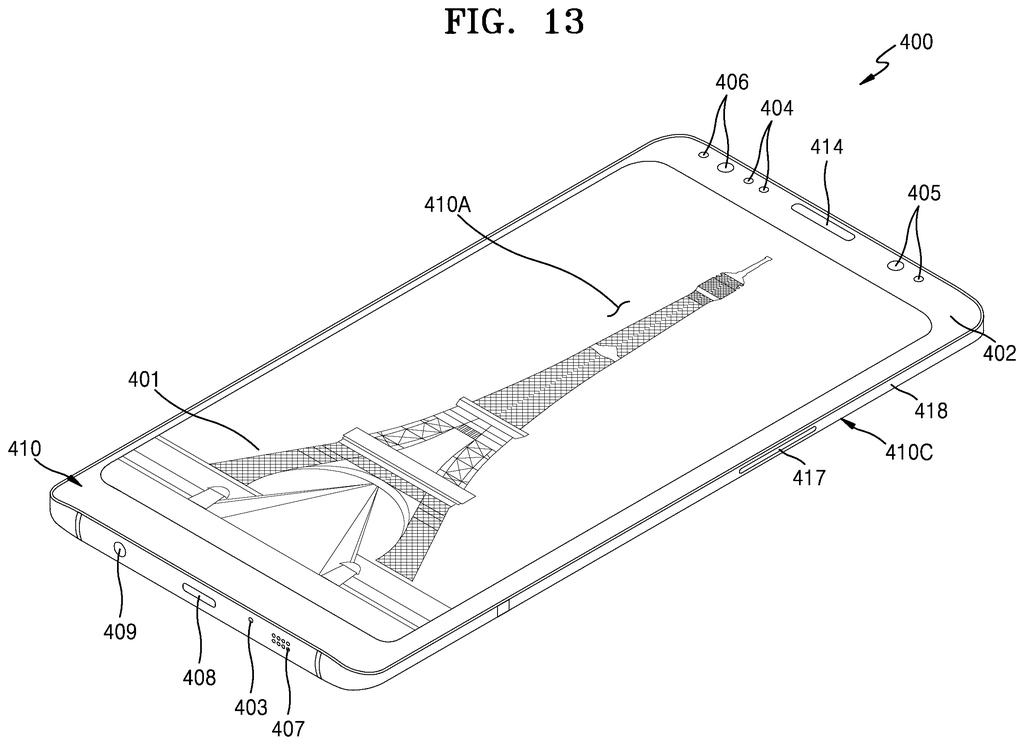
What Samsung's half-flat, half-3D screen does
Imagine scrolling through an online store on your phone. The page text stays crisp and flat while a pair of sneakers pops out in 3D in the middle of the screen, no glasses required. That is the scenario this Samsung patent application is built around.
The trick is to split the screen into two sets of pixels that never overlap, such as alternating lines. One set shows normal flat images. The other set shows a 3D image. Over the first set sits a clear layer that lets light pass straight through. Over the second sits a lens layer that sends slightly different views to your left and right eyes, which is what creates the sense of depth.
Because both layers are passive, meaning they need no electricity to switch, the phone only has to turn the right pixels on or off. The catch is that each mode uses half the pixels, so sharpness drops, though the filing says you would hardly notice on a high-resolution screen.
… a first region configured to display a 2D image and a second region configured to display a 3D image; an image controller configured to independently turn on and off the first region and the second region; …
Translation: The screen splits into separate areas that can show flat or three-dimensional views at the exact same time.
How the lens layer bends light only for 3D
The patent application describes a screen split into two kinds of regions that never overlap: one set of pixels for flat (2D) images and another for 3D images. A controller (the chip that feeds the screen its picture) can turn each region on or off independently. The screen can show all 2D, all 3D, or both at once. The regions can be alternating lines, columns, diagonal bands, groups of pixels, or even random.
On top sits an optical device with two parts. A transmission unit lets light pass straight through over the 2D region. A separation unit splits light into viewing zones (a separate view for each eye) over the 3D region. Both are passive, meaning no electricity runs through them. The separation unit could also be a gradient index lens, a holographic optical element, or a microlens array.
The main example works through light polarization (the direction light waves oscillate):
- A patterned retarder has clear strips over the 2D lines and half-wave plates (which flip the light's polarization) over the 3D lines.
- A lenticular lens array (rows of tiny half-cylinder lenses) is paired with a liquid crystal version shaped to fit it, forming one flat plate.
- Light from the 2D lines keeps its polarization, so both lenses bend it equally and the pair acts like plain glass.
- Light from the 3D lines gets flipped, so the liquid crystal lens bends it differently and the views split apart.
Tilting the lenses at an angle, or arranging the regions randomly, is described as a way to cut moiré (ripple-like interference patterns). Claim 12 also covers a device with this display plus a speaker, a sensor and a camera.
The transmission unit and the separation unit are configured as passive type components. The first region and the second region do not overlap.
Translation: The parts handling each view operate independently without crossing over into each other's space.
What this means for glasses-free 3D on phones
If this ever made it into a device, you could get glasses-free 3D that doesn't cost battery life every time the screen changes modes. The filing points to phones, tablets, smartwatches, VR and AR glasses, and even TVs and monitors. Because the optical layer is flat, it also stays out of the way when you touch the screen, and the filing says it avoids the electrical noise that switching layers can create.
The trade-off is sharpness. Each mode uses about half of the screen's pixels, which the filing argues you won't notice on a high-resolution display. Samsung also describes a mixed view, with a flat background and a 3D subject in the center, so depth shows up where you want it and sharp flat content stays sharp.
Samsung's 117th filing we've tracked since May in our Samsung display technology watchlist follows one sealing rollable screen lubricant and one on chip-cooling channels with another look at how the company builds screens.
The problem here is real but small. Layers that flip between 2D and 3D with electricity use power and, per the filing, can add electrical noise and complicate touch. On a phone those are annoying costs, though nobody loses a day over them.
Samsung's fix matches that size. A layer that never needs power is a simple answer, and it keeps the screen flat so your finger still glides over it.
The price is half the pixels for each mode. That is a steep tax on a phone screen, so the idea only pays off if people actually want depth in their apps. Until then it reads as tidy engineering waiting for a reason to exist.
Get our take in your Top Stories
Liked this breakdown? Add Patentlyze as a preferred source on Google, and our plain-English take shows up more often in your Top Stories the next time Samsung patent news breaks.
There are more where this came from
We read every patent application Big Tech publishes and send you the ones worth knowing. Plain English, free, every week.
The drawings
17 drawing sheets from US 2026/0322989 A1 · click any drawing to enlarge


Show the other 9 sheets


Want this weekly breakdown for a company we don't cover? Patentlyze Pro →
Be the first to weigh in