
A New Qualcomm Patent Uses Building Walls as Mirrors to Pinpoint Objects
Qualcomm's patent describes finding an object by listening for two echoes of the same signal: one straight off the object, and one that bounced off a nearby wall first.
What Qualcomm's bounce-based object locating does
Every time a radio signal hits a person or a parked car and bounces back, the echo carries a clue about where that thing is. A single echo tells a device roughly how far away something is, but it leaves a lot of guesswork.
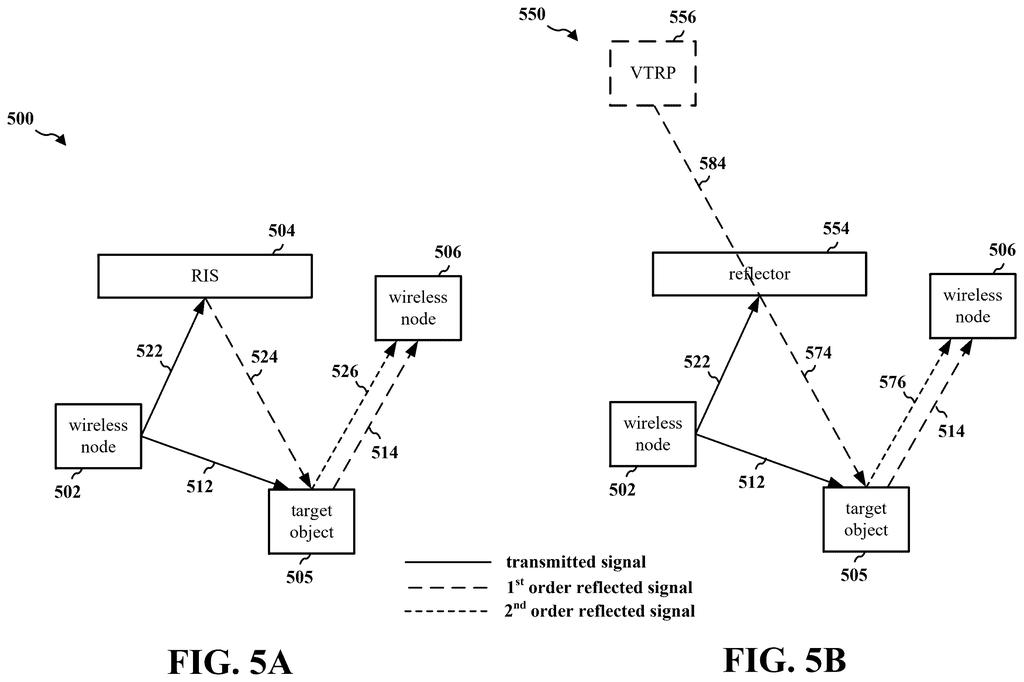
Qualcomm's patent adds a second echo. The device also aims part of its signal at a nearby reflector, such as the glass front of a building or a special panel whose reflections can be steered electronically. The reflector bounces the signal onto the object, and the object sends that second echo back.
Because the two echoes arrive at different times and from different angles, the receiver can compare them and get a better fix on the object's location. The catch is that it has to know which echo is which, so the sender shares a plan ahead of time describing what was sent and where the reflector sits.
… receive a first reflected sensing signal from the first wireless device via a target object; receive a second reflected sensing signal from a reflective object via the target object; and calculate a location of the target object …
Translation: The device figures out where an object is by catching both a direct echo and a bounce off a wall.
How the receiver tells direct echoes from bounced ones
The patent describes a sensing setup built on cellular radio. A first wireless device (a phone or a base station) sends out a set of test signals. Some go straight to the target object. Others go to a reflective object, which bounces them onto the target.
The reflector can be a reconfigurable intelligent surface (RIS, a panel whose tiny elements can be electronically tuned to steer a reflected beam) or a fixed surface such as a glass facade. The filing treats a fixed reflector as a virtual transmission reception point (VTRP, a stand-in transmitter placed where the reflection appears to come from).
The device that catches the echoes can be the sender itself (monostatic) or a second device (bistatic). Claim 1 covers that second device. It receives:
- A sensing signal configuration, the plan describing the test signals;
- A first echo, bounced straight off the target;
- A second echo, which went to the reflector, then the target, then back.
It then calculates the target's location from all three.
To keep echoes apart, the plan can give each path its own radio resources, its own time slot, or its own watermark (a tag added to the signal). It can also tell the receiver to group paths into clusters and report one representative path, using settings such as a delay threshold or an angle-of-arrival threshold (the direction the signal came from).
The reflective object may reflect at least one of the set of sensing signals to the target object based on the sensing signal configuration.
Translation: Surrounding walls or objects act as mirrors to bounce wireless signals toward the target.
Why wall-bounced signals could matter for 5G networks
For you, the practical angle is coverage. A network that senses objects from one direct echo can struggle in awkward spots. Adding bounced paths off existing walls or inexpensive panels gives it extra views of the same object without needing more towers. The filing also says a reflective panel can cost less and use less energy than a relay that retransmits a signal.
The filing is written around 5G networks, and nothing in it names a product. If sensing like this ever reaches real networks, it would come through the carriers and phone makers that adopt it, so any effect on your own phone would be indirect.
Qualcomm's latest telecom filing adds to its work on store tags that map radio signals and home internet boxes that aim their own antennas.
Claim 1 is wide. It asks for a device that receives a plan for the test signals, catches one echo straight off the object, catches a second echo that detoured through a reflective object, and then works out where the object is. Nothing in that wording requires a special smart panel, a particular radio standard, or even a phone.
The specifics sit in the narrower claims underneath: the panel type, the watermark tags, the beam shapes. All three independent claims describe the receiving side only. If granted, the broad version would cover any receiver that combines a direct echo and a bounced echo using a shared plan, which is a lot of ground for wireless positioning work.
The idea itself is simple to follow: check a position against a second route. Qualcomm is staking out that compare step, and whether the wording survives review is for the examiner to decide.
Get our take in your Top Stories
Liked this breakdown? Add Patentlyze as a preferred source on Google, and our plain-English take shows up more often in your Top Stories the next time Qualcomm patent news breaks.
There are more where this came from
We read every patent application Big Tech publishes and send you the ones worth knowing. Plain English, free, every week.
The drawings
18 drawing sheets from US 2026/0319082 A1 · click any drawing to enlarge


Show the other 10 sheets


Want this weekly breakdown for a company we don't cover? Patentlyze Pro →
Be the first to weigh in