
Nvidia's New Patent Lets Regular Video Show How Far Away Objects Are
Knowing how far away things are in a video is something cameras can't do on their own. Nvidia has patented a method that figures out depth by analyzing multiple frames of ordinary video and fusing two different depth estimates into a single, more accurate result.
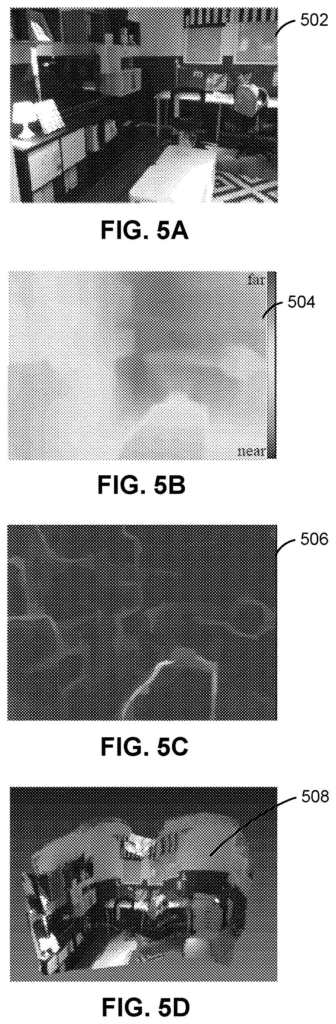
How Nvidia reads depth from video without a depth camera
Every time a self-driving car, a robot, or a visual effects pipeline tries to understand a scene, it needs to know how far away each object is. Depth cameras can measure that directly, but they're expensive and not always available. Regular video gives you pixels, not distances.
Nvidia's approach takes a video clip and works out the depth of each frame by running two separate processes. One looks at the current frame alongside the frame that came just before it, using motion between the two to infer distance. The other process looks at the current frame alone. Then the system combines both estimates into a final depth map that's more complete than either one alone.
The result is a three-dimensional picture of the scene built entirely from standard video, no special depth sensor required. That kind of capability is useful anywhere you need to understand space from footage you already have.
… performing one or more operations to combine the first intermediate depth map and the second intermediate depth map to generate the first depth map.
Translation: It merges two different depth estimates from video frames to create a final depth map.
How the two intermediate depth maps get merged into one
The patent describes a pipeline for generating a depth map (a frame-by-frame picture of how far each pixel is from the camera) from video frames, without relying on dedicated depth sensors like LiDAR or structured-light cameras.
The core method runs two parallel processes on each target frame:
- Temporal depth estimation: the system analyzes the current frame together with the immediately preceding frame. Motion between the two frames (called optical flow) lets the model infer how far objects are, because nearby things move more across frames than distant ones.
- Single-frame depth estimation: the system also estimates depth from the current frame in isolation, using learned visual cues like perspective, shading, and object size.
The two intermediate depth maps are then combined (the patent leaves the exact fusion method flexible) into one final depth map. Each method covers the other's weak spots: the temporal method struggles when there's little motion, while the single-frame method can miss fine detail that motion clues would reveal.
The first independent claim in the filing takes this further, describing a 3D Gaussian Mixture Model (GMM), essentially a mathematical representation of the scene as a collection of soft, overlapping 3D blobs. An expectation-maximization loop (an algorithm that alternates between assigning points to blobs and reshaping those blobs to fit better) refines the 3D model iteratively, producing a structured geometric description of the scene rather than just a per-pixel depth grid.
What this means for 3D scene reconstruction at scale
For fields like robotics, autonomous vehicles, and film production, accurate depth from ordinary cameras is a long-standing practical problem. Systems that require specialized depth sensors add cost and complexity. A method that extracts reliable depth from standard video could make 3D scene understanding far more accessible, particularly in situations where you're working from archival or consumer footage that was never shot with depth sensors in mind.
Nvidia's run of 3D scene reconstruction filings points to a consistent investment in the infrastructure needed to train and deploy spatial AI systems. Whether that means better simulation data, more capable robot perception, or tools for content creators, a reliable video-to-depth pipeline sits at the foundation of all of it.
Nvidia's 80th filing we've tracked since May in the self-driving sensing race follows work like fixing wide-angle distortion and keeping gaze cameras accurate.
Getting this from patent to product requires no new physical hardware at all. The method runs on existing graphics chips as software, which means the main remaining work is training the model well and plugging it into a pipeline that already exists.
The clever part of the approach is a cleanup stage that converts a rough, noisy depth estimate into a tidy geometric model before handing it off to whatever needs it next. That matters because raw depth data from video is usually too messy to use directly in applications like visual effects or robotics.
If Nvidia chose to ship something based on this, the shortest path would be a software update to tools developers already use, making better depth maps available without asking anyone to buy new equipment.
There are more where this came from
We read every patent application Big Tech publishes and send you the ones worth knowing. Plain English, free, every week.
The drawings
7 drawing sheets from US 2026/0301203 A1 · click any drawing to enlarge


Want this weekly breakdown for a company we don't cover? Patentlyze Pro →
Be the first to weigh in