
Samsung Files Patent for Hidden Markers That Label Sections of a Giant Video Wall
Samsung's patent application tackles an odd problem with giant video walls: once they get big enough, even a technician can lose track of which section is which.
What Samsung's hidden video-wall markers do
Today, when one part of a giant video wall acts up, finding the exact panel is a chore. The filing itself says that as these walls grow, it gets harder to tell where one section ends and the next begins.
Samsung's idea is to give one patch of the screen a slightly different flashing schedule from the rest. The tiny lights in a screen switch on and off many times per frame to make brightness, and this patent changes how often or when that happens in the chosen area. Your eyes can't tell the difference, so the picture looks the same.
A camera set up the right way can tell. It spots the odd patch, and a phone or tablet can then outline it on its own screen. A technician finds the right spot while the wall keeps playing its normal content.
… a plurality of timing processors configured to control a plurality of driver integrated circuits (ICs) included in the plurality of display devices to perform pulse width modulation (PWM) driving on pixels …
Translation: Multiple processors manage the tiny chips that light up the screen pixels.
How a camera spots a panel's flash schedule
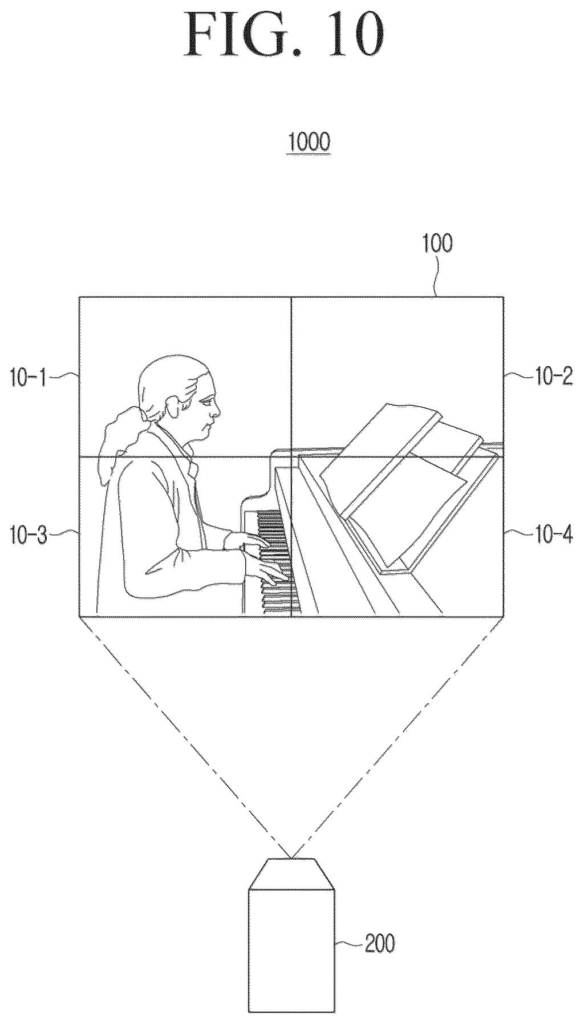
A modular display, like a video wall, is built from many smaller display devices tiled together. Each has its own timing processor (a chip that tells the screen when to draw each picture), and those processors control driver ICs (small chips that feed power to groups of pixels). The filing describes micro LEDs, tiny lights that make their own light, as the pixels.
Brightness comes from pulse width modulation, or PWM (how long a light stays on in short bursts). Each frame is split into sub-frame intervals, which are those short bursts. At 60 Hz a frame lasts about 16.7 milliseconds, and with 32 bursts the screen refreshes at 1,920 Hz.
The patent changes that schedule for just one region. The filing describes these options:
- More bursts (48, or 2,880 Hz), each one shortened so the pixel gets the same current and looks equally bright.
- Fewer bursts (16, or 960 Hz), each one lengthened to match.
- The same number of bursts, but bunched into the front or rear part of the frame instead of spread across it.
Viewers can't see the change. A camera whose shutter speed is set to match can count the flashes, or one with a shutter angle set to catch only the front or rear of each frame can see which pixels stay dark. The device then draws a border, highlight or arrow around that region. A person can pick the region from a control PC.
Why this matters for giant video wall repairs
If you've looked at a video wall or a large digital sign, you've seen many panels acting as one picture. When one section needs a repair or a color change, someone has to find it first. This patent lets a technician mark a region invisibly and pick it out with a camera, without turning the display off.
The filing says the goal is easier installation and maintenance while the screen keeps showing its normal content. That makes it a tool for the people who set up and service these screens, and most viewers would never notice it. The filing describes micro LED panels, but the claims don't limit the idea to them.
Samsung's 118th filing we've tracked in our display technology work since May builds on earlier applications like one on flat and 3D screens and one on rollable screen lubricant sealing.
Claim 1 is wide. It asks for several display devices, several timing processors, and one rule: some pixels must run on a different flashing schedule than others. The claim never mentions cameras, installers or finding panels.
That purpose shows up only in dependent claim 9 and its twin, claim 18. Claims 2 through 8 narrow the idea to more or fewer flashes, or flashes bunched at the front or back of the frame. If granted, claim 1 on its own would cover any multi-panel display where one region's flash timing differs from another's, whatever the reason.
The idea behind it is a modest maintenance trick for big screens, and a useful one. The claim wrapped around it is much wider than the trick.
Get our take in your Top Stories
Liked this breakdown? Add Patentlyze as a preferred source on Google, and our plain-English take shows up more often in your Top Stories the next time Samsung patent news breaks.
There are more where this came from
We read every patent application Big Tech publishes and send you the ones worth knowing. Plain English, free, every week.
The drawings
17 drawing sheets from US 2026/0321195 A1 · click any drawing to enlarge


Show the other 9 sheets


Want this weekly breakdown for a company we don't cover? Patentlyze Pro →
Be the first to weigh in