
Samsung Files Patent for a Headset That Fades Real Objects Into Your VR World
Samsung's patent application describes a headset that, when you look at or touch a real object, slowly eases a live view of it into your virtual world. It avoids ripping you out of the scene or cutting to a full camera feed.
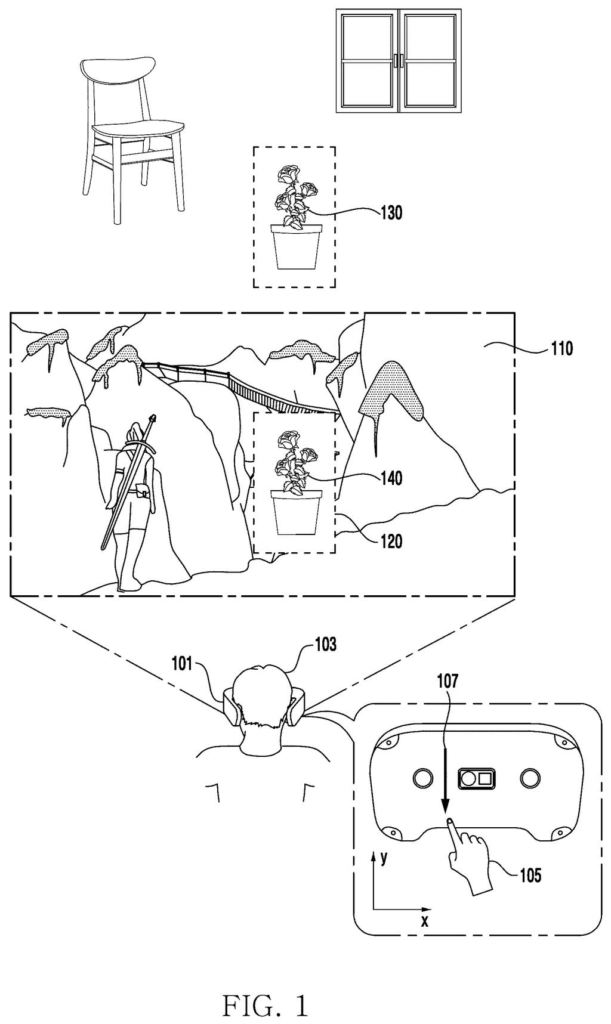
What Samsung's VR headset does with real objects
You're deep inside a virtual world and your real keyboard is sitting on the desk somewhere in front of you. Getting to it normally means lifting the headset or switching your whole view over to the room.
Samsung's patent application describes a gentler option. The headset's outward-facing camera spots a real object and shows it layered over your virtual scene. When you interact with it, the way it looks changes gradually from one visual style to another, rather than snapping from one view to the next.
The filing also describes making the patch of virtual world behind the object more see-through, so the real thing shows up clearly. In some versions your gaze counts as the input, and only objects within a set distance qualify.
… gradually change a visual effect used for displaying the visual object from the first visual effect to a second visual effect …
Translation: It slowly alters how real objects look as they appear inside your virtual world.
How the headset fades a real object into VR
Claim 1 covers a head-worn device with a camera and a display. It shows you a virtual environment, then uses the camera image to identify a real object nearby. Once it finds one, it displays that object so it looks overlapped with part of the virtual scene, using a first visual effect (a particular style of rendering the object; the dependent claims lean on transparency).
Then you act on the object. The claim says only 'a user input with respect to the visual object,' and the device gradually changes the effect to a second one. Dependent claims add detail:
- The part of the virtual scene behind the object becomes more transparent, and the object starts to appear as that change begins.
- The rest of the virtual scene keeps its original transparency.
- A second camera can track your gaze, and looking at the object can count as the input.
- The object is shown only when it is closer than a set distance to the headset.
The description adds a hardware version built around a dial on the headset. While you keep turning it, the virtual area shrinks and a camera-view area grows, while virtual objects such as app icons keep their size. It also describes swipes on the headset's outer surface, plus blurring or fading at the boundary so the two views blend.
What this means for wearing VR at your desk
If you've worn a VR headset, you know the awkward moment of needing something real: a keyboard, a coffee mug, a person who just walked up. This patent application aims to make that moment less jarring, with the real object easing into view while the rest of your virtual space stays put. That could matter for working in VR at a desk, where you switch between virtual screens and physical tools.
The patent examiner's first review rejected the claims as filed, which is routine at this stage and usually followed by amendments, so the final wording may end up narrower. The filing is a continuation of earlier applications that trace back to Korean filings from 2023, and it shows how much mixed-reality design comes down to handing you between the real and virtual worlds.
Samsung's 66th filing we've tracked since May in our AR glasses race watchlist builds on the location-based app picker and the drift-correcting holographic lens.
Claim 1 covers any headset that uses a camera to spot a real object, accepts some action on that object, and then changes how the scene looks in a gradual way. It says nothing about what the action must be, what the object must be, or what the visual change must look like. That is an unusually wide net.
In practice, a claim that broad could block a large share of mixed-reality headsets from doing almost anything interactive with real-world objects, as long as the response animates smoothly rather than snapping instantly. The single word "gradually" is the only hard boundary in the claim.
The transparency changes, gaze as the input and the distance limit sit in the dependent claims, and the dial-turning version from the abstract is not in claim 1 at all. The examiner has already rejected the claims once, so whether that range survives is the real question, because what is written now reaches far beyond Samsung's particular design.
Get our take in your Top Stories
Liked this breakdown? Add Patentlyze as a preferred source on Google, and our plain-English take shows up more often in your Top Stories the next time Samsung patent news breaks.
There are more where this came from
We read every patent application Big Tech publishes and send you the ones worth knowing. Plain English, free, every week.
The drawings
49 drawing sheets from US 2026/0320945 A1 · click any drawing to enlarge


Show the other 41 sheets


Want this weekly breakdown for a company we don't cover? Patentlyze Pro →
Be the first to weigh in