
Samsung Files Patent for Holographic Glasses That Stay Sharp When Parts Drift Out of Line
Samsung's holographic glasses depend on two tiny layers lining up almost perfectly, and heat or a bump can spoil that. This patent application designs the picture so it survives the drift.
What Samsung's drift-proof hologram glasses do
A man puts on holographic glasses after they spent a hot afternoon in a car. The glasses got warm and knocked around, and two tiny layers inside have slid a hair out of line. The 3D picture now looks blurry.
That small drift is the problem Samsung is going after. Inside, a panel shapes the light and a thin frosted-glass-like layer called a mask spreads it out, so the image is visible from a wider area. The two have to line up precisely, and heat or impacts can nudge them apart.
Samsung's answer is to plan for the slip. Instead of showing one picture, the glasses flash several slightly different versions in about 1/60 of a second, too fast for you to tell apart. Your eye blends them into one image that holds up even when the parts have shifted.
obtain a plurality of holograms by performing training based on a target hologram image and one or more alignment errors between the spatial light modulator and the mask …
Translation: The system learns how to fix image distortion by factoring in mechanical misalignments.
How Samsung trains holograms for misaligned parts
The hardware has three main parts: a light source (a laser or LED), a spatial light modulator (a panel that shows a pattern, called a hologram, that bends light into a 3D image), and a mask, a thin layer of irregular pixels only about 1 to 4 micrometers wide. The mask scatters light like frosted glass, which widens the field of view and the area where your eye can catch the image.
The weak spot is alignment. A hologram is normally calculated assuming the panel and mask sit in exact positions, and heat, temperature changes or an impact can move them. The patent fixes this by computing the patterns with that drift in mind:
- Start with a set of rough holograms and use a simulator to predict the image for each possible misalignment, measured in pixels along several axes and rotations.
- Add the predicted images together, since the eye will blend them, and measure the error against the target image.
- Adjust the holograms with gradient descent (a repeated nudge toward lower error) until the error stops falling.
Small misalignments get more weight because they are more likely, using a bell-curve distribution. The number of holograms depends on the panel's refresh rate, all shown within about 1/60 of a second. Another claim covers a neural network trained to produce these holograms directly, and the simulator can also account for mask thickness errors from manufacturing.
Why sturdier holograms matter for AR glasses
If you ever wear holographic glasses, the practical win is a picture that holds up in real life: a warm room, a hot car, a drop on the floor. The filing's test images show that as the misalignment grows, its results pull further ahead of a method that assumes perfect alignment.
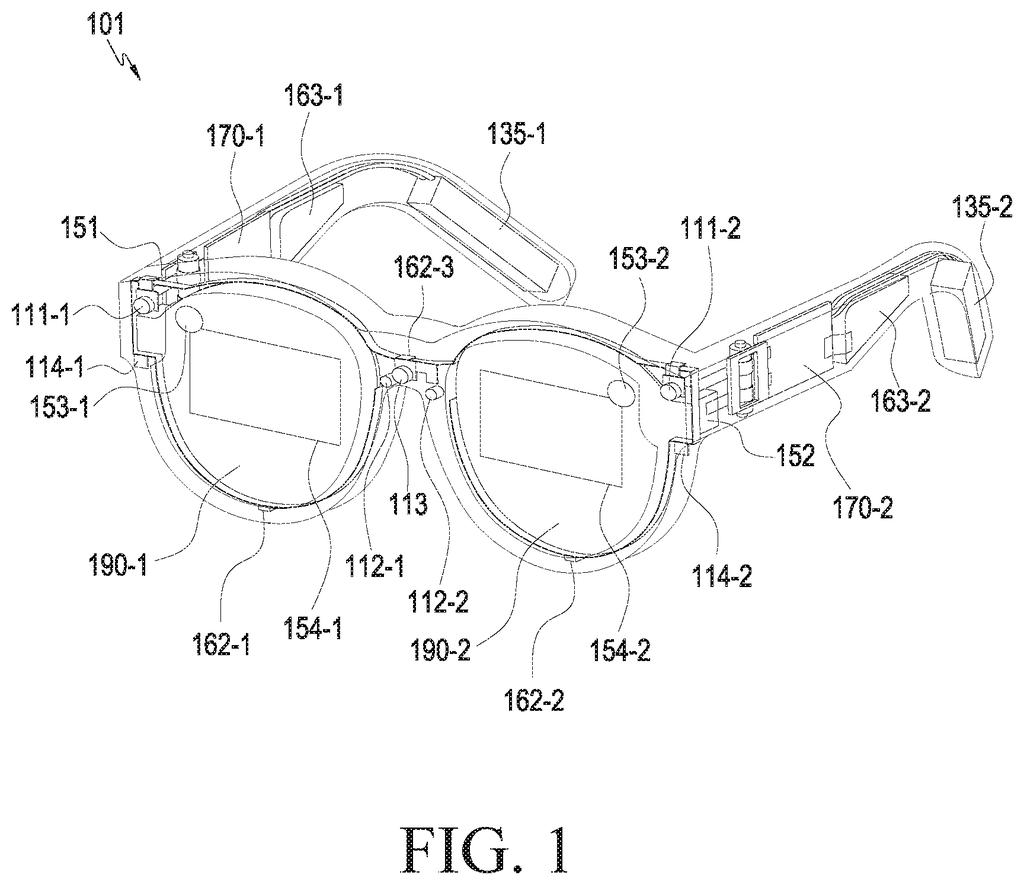
The filing describes a head-mounted AR or VR display but names no product, and it gives no figures for brightness or battery use. Treat it as a design for making an exotic, finicky display tolerate everyday wear, which is a hurdle any holographic headset has to clear.
Samsung's 64th filing we've tracked in the AR glasses race since May adds to a run that includes a fit-and-vision dial and a video clarity fix.
The price of this design is a hologram tuned for the average case. Because the glasses show several blended images instead of one perfect one, nothing improves when the parts are perfectly lined up. Samsung's own comparison shows substantially no difference at zero misalignment, so all of the gain appears only after something has slipped.
The second cost is speed. The panel has to flash several patterns inside about 1/60 of a second, so the number of images is capped by how fast the panel refreshes. The filing says nothing about brightness or battery drain, and finding the best patterns is a repeated calculation, which is why it also offers a trained AI shortcut.
Still, the trade reads as worth it. Someone wearing glasses all day will value a picture that survives a bump more than a slightly more demanding panel, and the filing's test images improve most at 5 and 10 pixels of drift.
Get our take in your Top Stories
Liked this breakdown? Add Patentlyze as a preferred source on Google, and our plain-English take shows up more often in your Top Stories the next time Samsung patent news breaks.
There are more where this came from
We read every patent application Big Tech publishes and send you the ones worth knowing. Plain English, free, every week.
The drawings
17 drawing sheets from US 2026/0322963 A1 · click any drawing to enlarge


Show the other 9 sheets


Want this weekly breakdown for a company we don't cover? Patentlyze Pro →
Be the first to weigh in