
Samsung Files Patent for Keeping a Motion Photo's New Cover Shot Sharp
Pick a better cover shot for your motion photo and the replacement comes from a lower-quality video clip. Samsung's patent describes how to dress that frame up so it matches the original photo.
What Samsung's motion photo cover swap does
Every time you snap a motion photo, your phone saves one sharp, full-quality still plus a short video clip of the moments around it. The still is the cover you see in your gallery.
Say your cover caught a friend mid-blink, so you scroll through the clip and pick a better moment. Under the usual approach, the filing explains, the frame you pick comes from the video side, which is saved at lower quality: 2 megapixels in the filing's example, against 12 for the original. It can look duller and softer, and any edits you add start from that weaker frame.
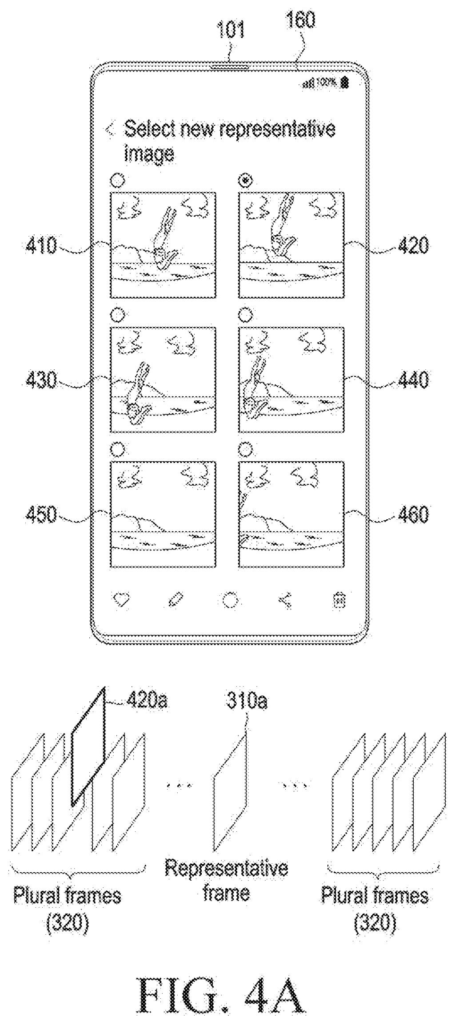
Samsung's patent copies the original cover's qualities onto the frame you choose: its size, its brightness range and its color. It also remembers where in the clip your pick sits, so later edits can start from the original frame without a second saved copy.
… receive a user input for selecting a first frame from among the plurality of frames included in the motion image, identify an image attribute of the first representative image and apply the image attribute to the first frame, based on the user input …
Translation: The user picks a new video frame to act as the cover photo, and the phone copies the original image style over to it.
How the chosen frame inherits HDR and color
A motion image here is a still photo (the "first representative image," for example 12 megapixels with HDR) plus a video file of frames around it (for example 2 megapixels, standard dynamic range). When you select a different frame as the new cover, the device identifies the attributes of the old cover, applies them to the chosen frame, and displays the result as the "second representative image."
The filing lists several attributes it can carry over:
- Brightness range (HDR): HDR, or high dynamic range, means a wider spread between the darkest and brightest parts of a picture. The device builds a gain map (an extra layer of data describing how bright each area should be) from the chosen frame.
- Color: if the original uses wide-gamut P3 color (a richer palette than standard sRGB), the frame's colors are converted to P3.
- Resolution: the frame is scaled up to match the original, such as 12 megapixels, and the gain map is scaled by the same ratio.
- Metadata: EXIF data (camera settings), color space information and an ICC profile (instructions for displaying colors correctly).
For editing, the filing describes non-destructive editing, meaning the original is kept so you can change your edits later. Instead of storing the chosen frame as a separate full-quality copy, the device stores only a timestamp (the filing's example is 0.3 seconds). It then pulls that frame from the video clip, which sits in hidden storage you can't browse, and reapplies the original attributes.
Why a timestamp beats saving a second copy
If you swap the cover of a motion photo, you would expect the new one to look as good as the old one, and you would expect your edits to behave the same way. The patent aims at exactly that: a replacement cover that keeps the original's brightness, color and size, so a filter or crop doesn't land on a washed-out starting point.
There is a storage angle too. Saving a timestamp in place of a second full-quality image means your edit history takes up less room on the phone, which adds up across a large gallery of motion photos. The filing only describes the idea and says nothing about when, or whether, it would reach a phone.
Samsung's 150th filing we've tracked in our camera sensor work since May adds to earlier applications like one on autofocus in bright light and one rating video frame detail.
Claim 1 is short and wide. It covers a device with a camera and touch screen that records a motion image, lets you pick a different frame as the cover, copies over the "image attribute" of the old cover, and displays the result. The claim never says which attributes, so HDR brightness, color and resolution appear only in the dependent claims.
If granted, that breadth would reach any phone gallery that carries the old cover's quality over to a newly chosen frame, however it does the carrying. The memory-saving timestamp trick shows up only in claims 5 and 6, so claim 1 does not depend on it.
The problem is easy to picture and the fix is sensible housekeeping for motion photos. Most people would never notice it working, and the best version of this feature is one you never think about.
Get our take in your Top Stories
Liked this breakdown? Add Patentlyze as a preferred source on Google, and our plain-English take shows up more often in your Top Stories the next time Samsung patent news breaks.
There are more where this came from
We read every patent application Big Tech publishes and send you the ones worth knowing. Plain English, free, every week.
The drawings
13 drawing sheets from US 2026/0320877 A1 · click any drawing to enlarge


Show the other 5 sheets


Want this weekly breakdown for a company we don't cover? Patentlyze Pro →
Be the first to weigh in