
Samsung
Samsung · Camera · Filed Apr 3, 2026 · USPTO published Oct 8, 2026 · Oct 8 release
Samsung Patents a Camera Sensor That Fixes Motion Blur by Counting Individual Light Particles
Samsung describes a camera sensor that takes a burst of tiny snapshots, lines each one up with the moving subject, and stacks them into one sharp frame. It also takes more snapshots only when things move fast.
- Publication number
- US 2026/0313265 A1(US20260313265A1)
- Applicant
- Samsung Electronics Co., Ltd.
- Filed · Published
- Apr 3, 2026 · Oct 8, 2026
- Inventors
- Takashi KUSAKARI, Toshinori OTAKA
- Status when we published
- Waiting for an examiner
- Document
- 20 claims
- US classification
- 348/294
What Samsung's motion-blur sensor actually does
Imagine photographing a kid sprinting across a dim backyard at dusk. Your camera faces a dilemma. Keep the shutter open long enough to gather light and the kid turns into a smear. Snap fast and the picture comes out dark and grainy.
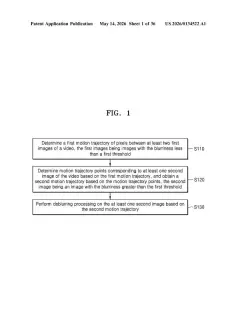
Samsung's patent describes a sensor that sidesteps that dilemma. Instead of one long exposure, it takes a rapid string of tiny snapshots, each built by counting individual particles of light (called photons). Then it checks how every spot in the picture moved between snapshots, nudges each one back into line, and stacks them into a single sharp photo.
It also adjusts on the fly. When something in the scene is moving fast, the sensor takes more snapshots. When the scene is calm, it takes fewer and saves power.
… an in-pixel counter configured to count the pulse signal; an intermediate image generator configured to generate a plurality of intermediate images by accumulating, over a plurality of unit exposure times, values counted by the in-pixel counter …
Translation: A tiny digital counter inside every pixel tracks individual light particles over multiple brief exposures.
How the sensor lines up its sub-images
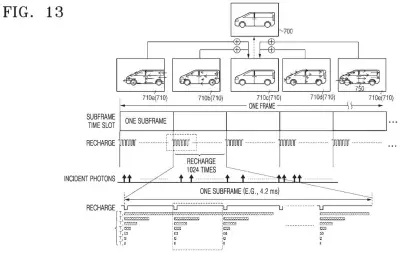
Each pixel contains an avalanche photodiode, a light detector so sensitive that a single photon (one particle of light) triggers a measurable pulse. The pixel is recharged once per short unit exposure time (the filing gives 4 microseconds as an example), and a gating circuit checks the detector at several moments inside that window. A small counter built into the pixel tallies the results, so each pixel records roughly how bright its spot is.
Counts from many of these windows (the example uses 1,024 per snapshot) are added together into subframes, which are short snapshots. In the example, four subframes make up one 16.7 millisecond frame. One subframe is picked as the reference. For every other subframe, the chip computes a difference vector for each pixel, meaning an arrow showing which direction and how far that spot moved (the filing mentions a standard technique called optical flow for this). Each subframe is shifted along its arrows to match the reference, and then all are added into one frame.
The claims and description also cover several add-ons:
- Raising the snapshot rate when the arrows are long (fast motion) and lowering it when they are short.
- Calculating arrows only inside a region of interest, such as the area around a person, and giving that region a different snapshot rate than the background.
- Skipping very dark pixels, because arrows computed from them are unreliable.
… calculate, by using one of the plurality of intermediate images generated in a time series as a reference intermediate image, a difference vector for each pixel with respect to the reference intermediate image for each of at least one non-reference intermediate image other than the reference intermediate image …
Translation: The sensor compares sequential mini images to track how objects moved across the frame.
What this means for blurry low-light photos
If you have ever taken a blurry photo of a pet or a passing car at night, this is the situation the filing targets. According to the filing, the correction works whatever the speed of the subject, and the sensor saves effort by slowing its snapshot rate when nothing is moving. The description even includes a night-time example frame, plus a section on ignoring dark pixels whose motion can't be trusted.
The filing names no product, so there is no particular phone or camera to point to. Sensors like this count single photons, which is a different design from ordinary camera sensors, and the filing contrasts the two. Whether any of this reaches something you can buy is unknown.
Samsung's 146th filing we've tracked in our camera sensor push since May builds on work like the nanostructure lens and cross-camera color consistency.
Source: US 2026/0313265 A1 at the USPTO (PDF). Full patent text and figures are in the official publication.
Get our take in your Top Stories
Liked this breakdown? Add Patentlyze as a preferred source on Google, and our plain-English take shows up more often in your Top Stories the next time Samsung patent news breaks.
Add Patentlyze on Google
One click.
There are more where this came from
We read the new patents from Big Tech, carmakers and more and send you the ones worth knowing. Plain English, free, every week.
The drawings · 29 sheets
29 drawing sheets from US 2026/0313265 A1 · click any drawing to enlarge


Show the other 21 sheets


More from Samsung
All 1,662 Samsung patents →
More in Camera
All 278 Camera patents →
Samsung
Samsung Patents Per-Zone Portrait Blur That Treats Foreground and Background Differently
Samsung
Samsung Patents a Camera Sensor Built With Air Gaps Between Color Filters
Samsung
Samsung Patents an Image Sensor That Traps Air Between Its Color Filters
Samsung
No comments yet