
Samsung Files Patent to Sharpen the Dark Backdrop Behind Images in AR Glasses
AR glasses have a sunlight problem: floating images look pale against a bright background. Samsung's fix is to darken a patch behind the image, then correct for the fact that your eye can't focus on that patch.
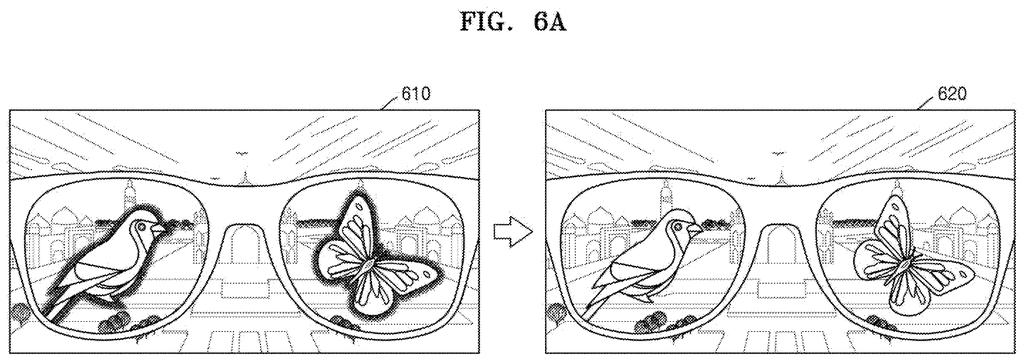
What Samsung's AR glasses dimming layer does
Today's AR glasses have a sunlight problem. A floating image looks pale and see-through against a bright background. The usual fix is a darkening layer behind the image, but that layer sits so close to your eye that you can't focus on it, so its edges look fuzzy.
Samsung's patent application tries to clear up the fuzz without making the glasses bigger. Moving the layer farther from your eye would work, but it would bulk up the frames. Instead, the glasses work out how your eye smears the dark patch, then pre-adjust the layer to cancel that smear.
The dark patch is built from zones that are darker or lighter, tuned until the edge looks crisp. In theory, you get a bright, colorful image you can read outdoors.
determine a position, a size, and a shape of an occlusion mask based on a virtual image to be displayed; determine an amount of light to be blocked by the occlusion mask based on surrounding brightness; …
Translation: The glasses figure out how big the shadow needs to be and where to put it based on ambient light.
How the panel is tuned zone by zone
The glasses start with the virtual image they plan to show. They shape a dark patch (the occlusion mask) on a see-through electroactive panel to match the image's position, size and outline. How dark the patch gets depends on the brightness of your surroundings, so a sunny street gets a stronger shade than a dim room.
Because the panel sits so close to your eye, the eye can't focus on it, and the patch edge smears. Optical engineers describe that smear with a point spread function (PSF), a map of how a single point of light spreads out. The glasses use it to find the blur width, extend the mask by that width, and run an inverse convolution (math that works backward from a blurry result to the input that would cancel it) to get the panel settings.
The panel is then split into zones:
- An outer zone that blocks light fully
- An inner zone that lets light through
- Edge elements whose transparency is nudged one at a time
The system scores the predicted result against an ideal no-blur mask using an error function (a number showing how far off it is). It keeps changing the zones until the score drops below a set limit. A second pass can even out uneven brightness in the center of the patch.
Why sunlit AR glasses images could look cleaner
If this works, you could look at a colorful floating image on AR glasses outdoors on a bright day without a smudgy dark halo around it. Washed-out images in bright light are the exact problem the filing names, and it aims straight at it.
The fix lives in how a dimming panel is driven, which could suit slim frames, since moving the panel away from your eye would make the device bigger. The filing also mentions VR and mixed-reality headsets and helmets, so the idea could stretch across headset styles. As with any patent application, nothing here says Samsung will ship it.
Samsung's 67th filing we've tracked since May in the AR glasses race adds to a run that includes one fading real objects into VR and one reading your location for apps.
Claim 1 is short and wide. It asks for a dimming panel, a processor and four steps: size the dark patch to match the floating image, pick how much light to hold back based on outside brightness, map that patch to what the eye sees, and vary how clear each zone of the panel is to cut the blur.
Look at what the claim leaves out. The blur math (the inverse convolution, a way of pre-correcting for the smear) and the repeat-until-sharp loop show up only in later claims, and so does the word "glasses." If granted as written, claim 1 would reach any device with a dimming panel that tunes zones to reduce blur, a much bigger net than the detailed math suggests.
Patent offices often ask for narrower wording on claims this wide, so the final version could look different. The target itself is sensible: a readable image in daylight.
Get our take in your Top Stories
Liked this breakdown? Add Patentlyze as a preferred source on Google, and our plain-English take shows up more often in your Top Stories the next time Samsung patent news breaks.
There are more where this came from
We read every patent application Big Tech publishes and send you the ones worth knowing. Plain English, free, every week.
The drawings
7 drawing sheets from US 2026/0320759 A1 · click any drawing to enlarge


Want this weekly breakdown for a company we don't cover? Patentlyze Pro →
Be the first to weigh in