
Sony Patents a Display That Projects Images Directly Onto the Eye for Sharper Focus
Sony has filed a patent for a display that skips the screen entirely and paints images directly onto your retina, using multiple laser beams at different angles to sharpen the picture and widen the zone where everything stays in focus.
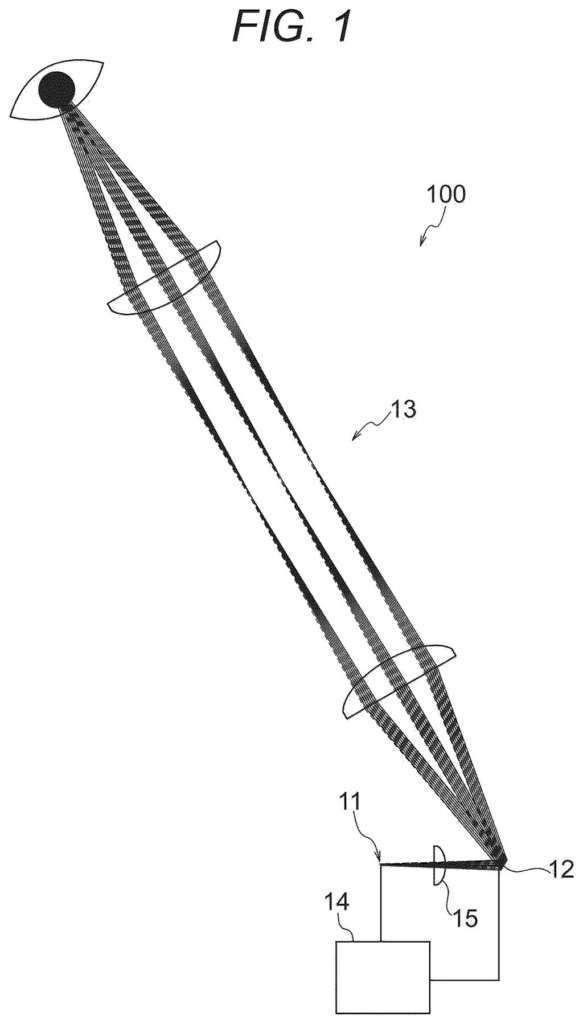
What Sony's multi-beam retinal display actually does
You're wearing an AR headset and trying to read text floating in the air, but the moment you shift your eyes slightly, the image blurs. That's a known weakness of retinal projection displays, which draw images by scanning light directly onto the back of your eye.
Sony's patent addresses this with a clever approach: instead of using a single laser beam, the device fires multiple beams simultaneously, each spread at a slightly different angle. A scanning unit sweeps all of them across the retina in sync, and an optical relay system stitches the result into one coherent image.
The idea is that different divergence angles cover different focus distances, so the device can keep images sharp whether you're looking at something close-up or far away, without forcing you to hold your gaze at one fixed depth. It's a hardware-level fix for a problem that has made retinal displays tricky to use in practice.
… a relay optical system that relays the light beams scanned by the scanning unit to form an image on a retina of an observer and allows the observer to visually recognize the image …
Translation: A system of lenses shines light right onto the user's eye so they can see the picture.
How different beam angles build one sharper retinal image
A retinal projection display, sometimes called a retinal scanning display, skips a traditional screen and instead steers a laser beam back and forth across the retina to draw an image pixel by pixel. The challenge is that the beam must arrive at the right focus depth or the image looks blurry, and the usable focus range (called the "free focus range") on these systems has historically been narrow.
Sony's approach uses multiple light source units, each emitting a beam with a different divergence angle (divergence angle is how much a beam spreads out as it travels; a wider angle means the light fans out more, which shifts where it naturally comes to focus). By combining beams that spread at different rates, the system can cover a wider range of focal depths at once.
A scanning unit sweeps all beams across the field of view in coordination. A relay optical system then takes those scanned beams and directs them so they converge correctly on the observer's retina, forming a single fused image. A control unit manages each light source independently, which means it can adjust brightness, timing, and which sources are active to tune both resolution and focus coverage.
- Multiple light sources, each with a distinct divergence angle
- A shared scanning unit that sweeps all beams together
- An optical relay that focuses the combined result onto the retina
- A control unit that drives each source independently
The purpose of the present invention is to achieve both expansion of a free focus range and improvement in image resolution.
Translation: The new design aims to make pictures sharper while letting users focus at different distances.
What this means for AR headset image quality
Retinal displays have long promised a display surface with effectively unlimited resolution, because the image is drawn at the resolution limit of the human eye rather than the pixel count of a panel. The problem has been keeping that image sharp across the range of depths a person naturally looks at. Sony's multi-beam approach attacks both problems at once: more beams, spread at different angles, can collectively cover more focal depths while also contributing to a denser, sharper image.
For AR and mixed-reality headsets, this matters a lot. One of the main complaints about current headsets is the "vergence-accommodation conflict," where your eyes converge on a virtual object at one distance but the display forces them to focus at another. A wider free-focus range reduces that mismatch, which in turn reduces eye strain during long sessions. If this system works as described, it could make extended AR use noticeably more comfortable for you.
Sony's 30th filing we've tracked since July in the AR glasses race builds on one that makes objects go transparent and one that scans your room, showing how far this work has come.
Claim 1 is broad. It covers any image display device that combines multiple light sources with different divergence angles, a scanning unit, a relay optical system, and a control unit. There is no limitation on what kind of light sources, how many there are, what the relay optics look like, or how the control unit decides which sources to activate. That breadth means if the claim survives examination, it could cover a wide class of retinal scanning designs that use the divergence-angle trick, not just Sony's specific implementation.
In practice, the question examiners will ask is whether combining light sources with different divergence angles in a scanning retinal display was already obvious from prior art. Retinal scanning displays have been in research literature for decades, and beam-shaping techniques are well documented. The claim's strength depends entirely on whether that specific combination in this context is genuinely new.
For readers watching the AR headset space, the filing signals that Sony is still investing in retinal display architecture at the optics level, rather than just improving panel-based approaches. Whether or not this particular claim grants broadly, the direction is clear.
There are more where this came from
We read every patent application Big Tech publishes and send you the ones worth knowing. Plain English, free, every week.
The drawings
10 drawing sheets from US 2026/0287897 A1 · click any drawing to enlarge


Want this weekly breakdown for a company we don't cover? Patentlyze Pro →
Be the first to weigh in