
Google Patents AR Glasses That Show Two Separate Images at Once
Most AR glasses show one small window of digital content floating in front of you. Google is working on a way to show two separate image zones at the same time, without needing a bigger or more complicated lens.
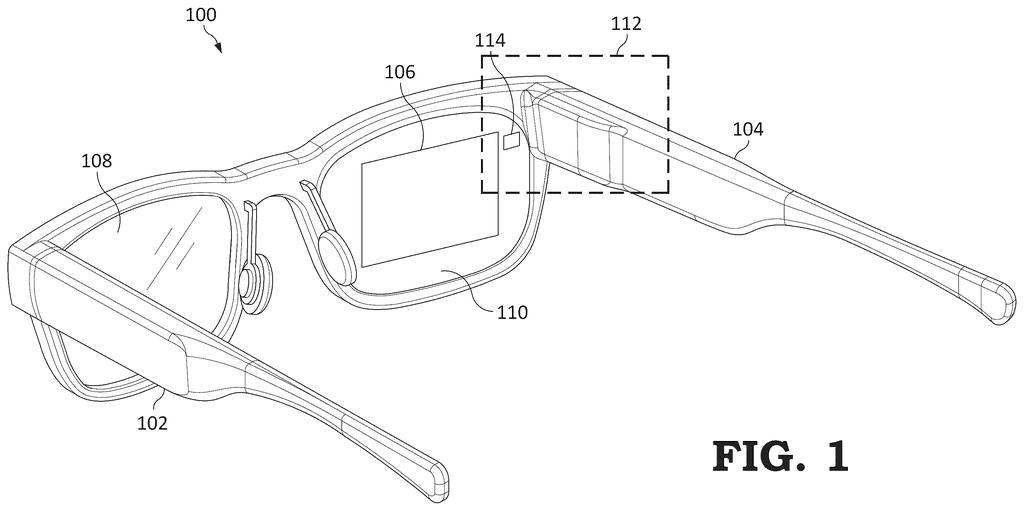
What Google's split-view AR glasses actually do
Imagine you're wearing AR glasses and you want a navigation arrow in the top corner of your vision while a message notification sits in your lower view, each in its own space, not overlapping. That's the kind of split-image experience this patent is pointing toward.
Right now, most AR glasses pipe everything through a single display into one relatively small window in your field of vision. Google's patent describes a system with two separate screens built into the glasses, each feeding light into the same lens at different angles. Each screen gets its own zone in your view, so the two images land in different spots.
The trick is that the lens (called a waveguide) handles both images without needing to be physically larger. One display might show content in one color, the other in a different color, and the waveguide routes each to its own spot in your vision. The result is a wider, more flexible display area inside a compact frame.
… a first display to emit display light comprising a first color to enter a waveguide system at a first set of input angles corresponding to a first field of view; and a second display displaced from the first display to emit display light comprising a second color to enter the waveguide system at a second set of input angles corresponding to a second field of view …
Translation: Two separate screens send different colors of light into the lenses at unique angles to create two distinct images.
How two displays feed one waveguide at different angles
The core idea here is separating a near-eye display into two distinct visual zones, called fields of view (FOV), using two independent screens rather than one.
In a standard AR waveguide setup, a single display emits light that enters the waveguide (a thin, transparent lens that acts like a light highway, bouncing light from the screen to your eye) at a fixed set of angles. Those angles correspond to one central window of digital content. Google's system adds a second display positioned at a different physical location. That second display sends light into the same waveguide at a different set of angles, which the waveguide then routes to a different spot in the user's visual field.
Key components in the claim:
- A primary display emitting one color, aimed at the waveguide at one set of input angles
- A secondary display emitting a second color, aimed at the same waveguide at a different set of angles
- A single waveguide that separately routes each display's light to its own output zone in front of the eye
Because the two zones are spatially separated (one might sit in the upper visual field, one lower, for example), the user sees two non-overlapping image regions without the lens itself needing to grow. The use of different colors per display also gives the system a way to keep the two light paths distinct inside the waveguide.
A waveguide system of an eyewear display device guides display light from a primary display to a primary field of view (FOV) and guides display light from a secondary display to a secondary FOV that is displaced from the primary FOV.
Translation: The glasses use a special optical system to steer light from two different screens into separate areas of the user's vision.
What a wider AR view means for wearable displays
Expanding the usable display area in AR glasses without making the hardware bulkier is one of the hardest problems in the field. Today's AR waveguides can only show content in a relatively narrow window, which is why AR glasses still feel limited compared to what you might imagine from science fiction. A system that tiles two separate display zones together could effectively double the area where digital content can appear, without requiring a larger or thicker lens.
For you as a user, that could mean glanceable information in one part of your vision (a map, a message count) while interactive content sits in another, all inside glasses that still look and feel like normal eyewear. Google's interest in AR display optics shows up across multiple waveguide-related filings, and this one tackles a constraint that has held back practical AR headsets for years.
Google's 45th filing we've tracked since May on our smart glasses display work follows one fixing 3D depth order and one brightening AR edge to edge.
Getting two separate image zones into a pair of glasses requires two physical screens, a precisely engineered light-guiding layer, and alignment optics that all have to fit inside a frame light enough to wear for hours. The document describes an optical concept, not a production design, so the gap between this idea and something a factory can build is substantial.
The clever trick here is using the angle of incoming light to place images in different spots in your vision without making the lenses any larger. But clever optics on paper still need hardware that does not yet exist in a finished, wearable form.
The shortest path to a real product almost certainly runs through workplace or industrial headsets first, where buyers tolerate bulk and expense that no consumer would accept. For anyone tracking where this technology actually lands, that is the honest timeline this document supports.
There are more where this came from
We read every patent application Big Tech publishes and send you the ones worth knowing. Plain English, free, every week.
The drawings
9 drawing sheets from US 2026/0299299 A1 · click any drawing to enlarge


Want this weekly breakdown for a company we don't cover? Patentlyze Pro →
Be the first to weigh in