
Samsung Files Patent for One Photo-Processing Model That Fits Every Phone Camera Sensor
Phone cameras use several different sensor layouts, and the AI that finishes your photo is usually trained to understand only one. Samsung's filing describes a single system that recognizes the layout on its own and handles all of them.
What Samsung's one-model camera patent does
Ever wondered how your phone turns what its sensor sees into a full-color photo? Each tiny dot on the sensor sits under a red, green or blue filter, so it records only one color. Software has to guess the other two for every dot. That guessing game is called demosaicing.
The catch is that camera sensors come in several dot layouts, with names like Bayer, Tetra, Nona and HexaDeca. AI tools that do the guessing are usually trained for just one layout, so a phone with different cameras may need a separate tool for each.
Samsung's filing describes a single system instead. It first works out which layout a photo came from, then sends it through a matching front end, and everything after that is shared. The filing says this saves storage space on the device while keeping image quality comparable or better.
… identifying, for each CFA image, a CFA-specific encoder from an encoder pool based on the determined CFA type; encoding each CFA image using the identified CFA-specific encoder to generate a latent embedding corresponding to each CFA image; …
Translation: The system picks a specialized encoder from a shared pool to match the specific sensor pattern of each photo.
How the system spots which sensor took the shot
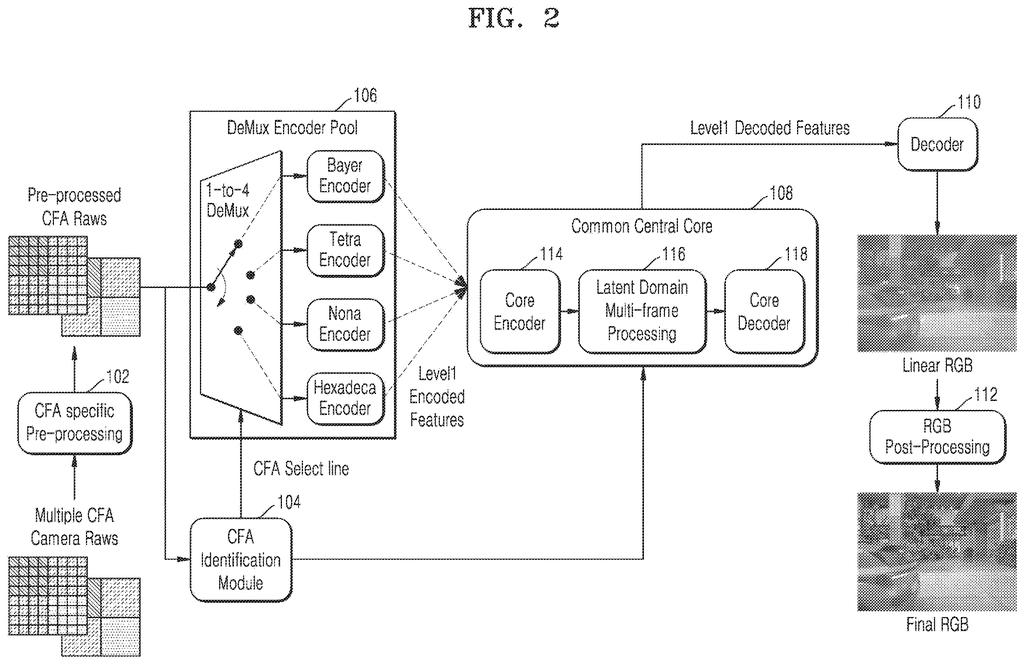
The process starts with pre-processing: cleanup steps such as black level correction, lens shading correction, white balance and bad-pixel fixes. Then a CFA identification module (CFA stands for color filter array, the dot layout) works out which layout produced the image. It runs a Fourier transform (a math tool that turns an image into a map of its repeating patterns), takes the horizontal and vertical middle slices of that map, and averages them into a compact signature. That signature is matched against stored reference signatures for known layouts.
Next, a switch (the filing calls it a DeMux) sends the image to the matching CFA-specific encoder in a pool: Bayer, Tetra, Nona or HexaDeca. Each is a lightweight neural network that converts the image into a latent embedding, a compressed internal description in a format shared by all layouts.
A central core then does the shared work. For a single photo, it refines the features. For a burst of photos, it builds two maps: a saturation map that flags under-exposed and over-exposed areas, and a motion map that tracks movement between frames. Both act as weights, so the blend favors well-exposed, aligned areas.
A final decoder produces a linear RGB image (full color, before finishing touches). Post-processing then applies tone mapping, color correction and sharpening. The filing says a new layout can be added by training a new encoder and adding its signature.
… processing the latent embedding of each CFA image using the common central core to generate core latent embeddings, and generating a linear red, green, blue (RGB) image by decoding the core latent embeddings using a decoder.
Translation: A shared central processor standardizes the data before turning it into a normal color photograph.
Why this matters for Samsung's phone cameras
For you, the payoff would be a phone camera that treats every sensor the same way, with less storage taken up by image-processing software. The filing says one shared model avoids keeping a separate model for each camera, while keeping image quality comparable or better than standalone ones. It also covers burst shots, such as HDR (combining several exposures), and the description says it can merge photos taken with different sensor layouts or resolutions.
For Samsung, it simplifies the engineering. Training, storing and maintaining one model per sensor layout adds up, and this design lets new layouts join by adding a small encoder. The description says it can run on a phone's AI chip or graphics chip for real-time use. It is a patent application, so nothing here says it will ship in any phone.
Samsung's 153rd filing we've tracked since May sits alongside the photographer insertion idea and distance sensing while cropping in our growing camera sensor push watchlist.
Claim 1 is wider than the headline detail suggests. It calls for six steps: take in raw sensor data, detect the layout, pick a matching front end from a pool, convert the image into a shared internal format, run it through a common core, and decode it into a full-color image. It never says how the layout gets detected, which layouts count, or that several photos must be combined.
Those specifics sit in later claims: the frequency-signature method in claims 2 through 4, and the blending of multiple exposures in claims 6 through 9. If granted, the opening claim would reach any phone pipeline built on detect, route, share and decode, however the detection works.
The flip side is that claim 1 calls for every one of those steps. A single model trained on all layouts at once, with no detector and no per-layout front ends, would not match its wording. Overall it is a well-fenced engineering choice that matters to Samsung's camera team and will likely go unnoticed by anyone holding the phone.
Get our take in your Top Stories
Liked this breakdown? Add Patentlyze as a preferred source on Google, and our plain-English take shows up more often in your Top Stories the next time Samsung patent news breaks.
There are more where this came from
We read every patent application Big Tech publishes and send you the ones worth knowing. Plain English, free, every week.
The drawings
6 drawing sheets from US 2026/0320737 A1 · click any drawing to enlarge


Want this weekly breakdown for a company we don't cover? Patentlyze Pro →
Be the first to weigh in