
Samsung Files Patent for a Robot Convoy That Plans Routes Around Its Slowest, Widest Follower
Samsung's latest filing teaches a lead robot to check whether the robots trailing behind it will actually fit through the hallway before it picks a route.
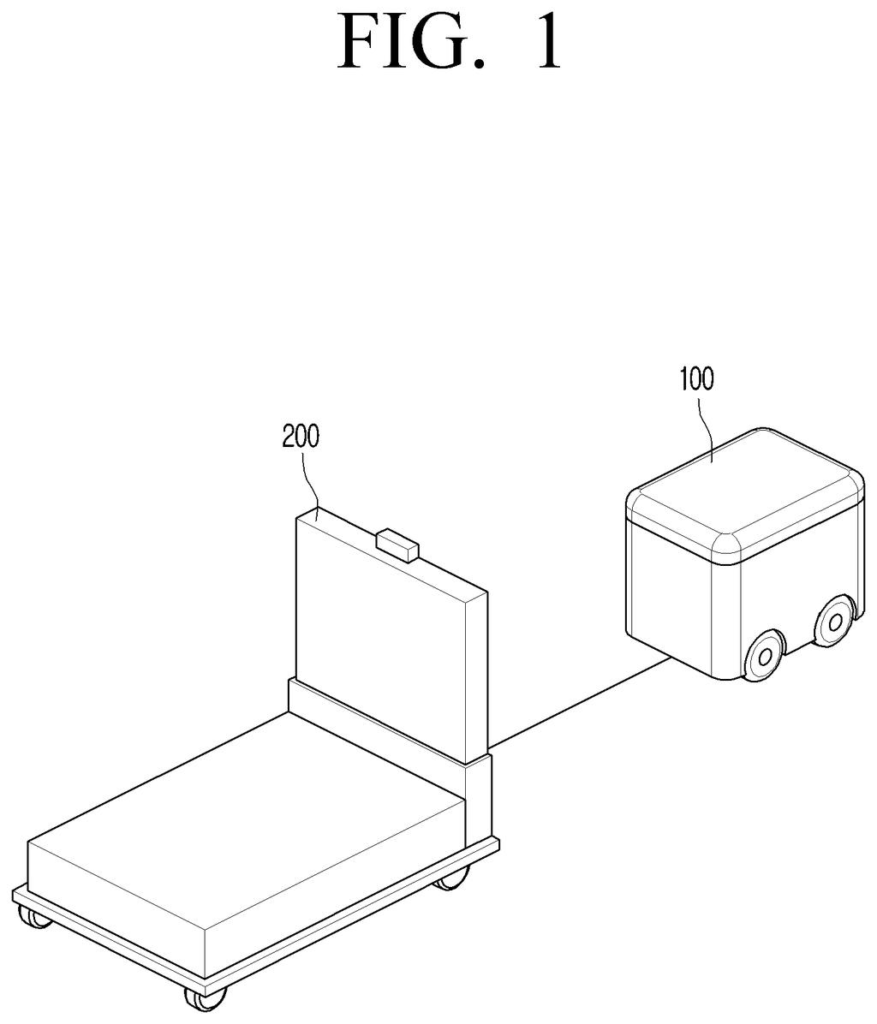
What Samsung's robot convoy patent does
Right now, when a line of robots hauls a big load together through a hotel or factory, the followers mostly trace whatever path the lead robot picked. The leader doesn't stop to ask how wide the others are, how slowly they move, or how wide a turn they need. A trailing robot can end up scraping a wall or clipping an obstacle.
Samsung's patent has the lead robot gather those details first. Each follower's size, top speed and turning radius gets stored, and the leader then picks a route the whole line can get through. If one follower is too wide for a narrow alley, the route goes around it.
The followers can be physically hitched to the leader, or they can simply trail a marker on its back. Either way, the leader treats the group like one long robot and keeps rechecking as the line shifts.
based on obtaining, through the interface, characteristic information of at least one external robot configured to travel by following the robot, store the characteristic information of the at least one external robot in the memory …
Translation: The lead robot gathers and saves details about the following robots trailing behind it.
How the lead robot sizes up its followers
The patent describes a lead robot with wheels (a driver), memory holding a map of the space, a communication interface, and a processor. When another robot is set to follow it, the leader receives that robot's characteristic information. That means appearance details (shape, size, whether it carries a marker) and travel details (top speed, turning radius, drive type). The details can come from the follower itself over a wireless link, or a person can type them in on a touch screen.
The leader then sets a path the whole group can pass through in order. The filing gives concrete examples:
- Width: the leader compares each robot's width to the alley widths on the map and rejects any route that is too narrow for one of them.
- Turning: it uses the larger turning radius in the group. If the follower needs 3 m and the leader only 1 m, every curve must be at least 3 m.
- Speed: it uses the slower top speed. With 2 m/s and 4 m/s robots, the group moves at 2 m/s, which can rule out a longer route when there is a 30 second deadline.
For hitched robots, the connector has sensors that read the angle and distance between them. The leader combines everything into a virtual shape, one imaginary robot that stands in for the whole train. For unhitched robots, the follower's camera spots a marker on the leader, which reveals where the follower sits. The shape is rebuilt on a timer (every three seconds in one example) and the route is redone if it no longer fits.
… based on at least one of the characteristic information of the robot, the map data, and the characteristic information of the at least one external robot, set a path through which the robot and the at least one external robot can sequentially pass within the space …
Translation: The travel route is planned using the space layout and the specific traits of every robot in the group.
What this means for hotel and factory robots
If you've seen robots carry luggage in a hotel or move parts in a factory, you know a line of them is a handy way to move a lot at once. The risk is a follower that clips a corner and tips its load. This patent aims at that failure by making the leader responsible for the size and turning limits of everything behind it.
The filing also covers followers that are not physically connected, and says the method could arrive as a software update to existing robots. That points to mixed fleets, where robots of different sizes and speeds share a job. The description names hotels, airports and factories as places where heavy loads move, so the payoff would be fewer bumped walls and dropped cargo.
Samsung's 52nd filing we've tracked since May in our home robot patents builds on ideas like phone-taught robot vacuums and photo-based AI mapping.
Claim 1 covers any lead robot that collects a follower robot's details and uses them to plan a shared route. The claim allows that path to rest on the leader's own specs, the map, or the follower's specs, or any mix of the three, which means almost any coordinated robot pair would fall inside it.
That breadth matters because it does not require a camera, a physical link, or any specific sensor. A manufacturer building a simple warehouse convoy system, where one robot radios its dimensions to another and the pair rolls down a corridor together, could land squarely in this claim's territory.
The more specific engineering, the visual markers, the angle checks, the timed recalibrations, lives in the later claims. Those are the parts that describe a real product. Claim 1 is the wide net cast first, and if it holds up under review, it gives Samsung a stake in the ground before any of those details even come into play.
Get our take in your Top Stories
Liked this breakdown? Add Patentlyze as a preferred source on Google, and our plain-English take shows up more often in your Top Stories the next time Samsung patent news breaks.
There are more where this came from
We read every patent application Big Tech publishes and send you the ones worth knowing. Plain English, free, every week.
The drawings
10 drawing sheets from US 2026/0319510 A1 · click any drawing to enlarge


Show the other 2 sheets


Want this weekly breakdown for a company we don't cover? Patentlyze Pro →
Be the first to weigh in