
Samsung Files Patent for a Magnetic Chip Part That Flips Digital Coins Faster
Most computer chips are built to be perfectly predictable. Samsung's filing describes a chip part that is random on purpose, plus a trick to make it flip faster.
What Samsung's coin-flipping magnet actually is
You hit shuffle on a playlist and the order feels a little too tidy. That's because most computers don't produce true randomness. They follow rules, so their "random" is a very good imitation. Samsung's patent application describes a tiny magnetic chip part that is actually unpredictable, because heat makes it flip between two states by itself, like a coin spinning in the air.
The catch is speed. A coin that flips slowly is not much use to a chip that needs lots of random decisions quickly. Samsung's fix is a thin cap of a heavy metal, such as iridium or osmium, laid on top of the magnetic layer. The cap nudges the magnet so it flips noticeably faster, and the filing says this works without an outside magnet or extra circuitry.
The company says this suits brain-style computing, where chips weigh odds instead of following strict yes-or-no rules, and also hardware that generates random numbers.
a first free layer, wherein the first free layer includes a ferromagnetic material; and a first capping layer disposed on the first free layer, wherein the first capping layer includes an in-plane anisotropy inducing material.
Translation: The chip uses a magnetic layer paired with a special coating to control how the data spins.
How a thin metal cap speeds up the flipping
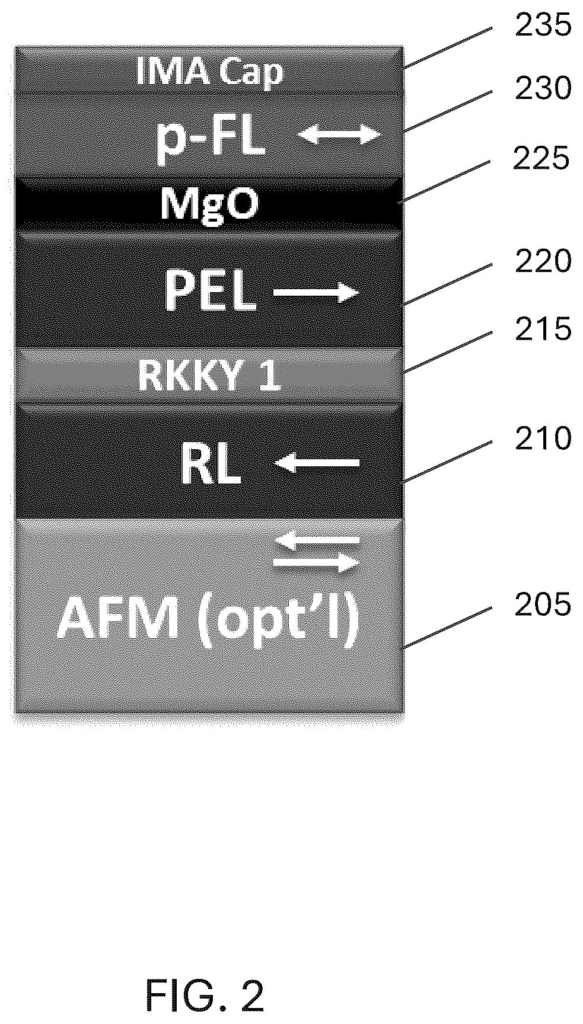
The core is a magnetic tunnel junction (MTJ), a sandwich of magnetic layers around an ultra-thin insulator that electrons can tunnel through. One layer, the reference layer, has a fixed magnetic direction. The other, the free layer (often CoFeB, a cobalt-iron-boron alloy), can point either way, and heat alone makes it flip. That random flipping makes it a p-bit, a probabilistic bit that is sometimes 0 and sometimes 1.
The independent claims center on a capping layer placed on the free layer and made of a material that induces in-plane anisotropy (a preference for the magnet to lie flat along the layer instead of pointing up or down). The filing names iridium, osmium, tellurium and thallium, whose strong interaction at the boundary with the magnet sets that flat preference. When the magnet wobbles out of the flat, a stronger pull drags it back, which raises the wobble rate (the precession frequency) and so the flip rate. The filing's simulations show faster, less correlated flipping as the effect gets stronger.
The filing also describes variations:
- Several free layers separated by insertion layers of the same materials (one independent claim covers a method of building this).
- A second cap, such as scandium nitride or aluminum nitride, that protects the first and adds strain.
- Two free layers coupled through a spacer, plus doping to increase damping (how fast the magnet settles after a nudge).
Why Samsung wants chips that embrace randomness
For you, this is mostly about what could sit inside future chips. Random numbers underpin things like encryption, and the filing's background says probabilistic hardware can handle pattern recognition and decision-making with less energy. A part that flips faster produces more random bits per second from the same tiny device.
The filing also describes an electronic device, such as a phone, whose non-volatile memory (storage that keeps data with the power off) uses these magnetic cells. That fits Samsung's existing chip business. Nothing here says a product is coming. It is a materials recipe for one component.
Samsung's 179th filing in our chip patents we cover since May joins earlier work like one on keeping AI chips busy and one on inconsistent processors.
This sits far from a shippable feature. It is a recipe for a single component, and the filing leans on computer simulations instead of measurements from a built chip. The first hurdle is proving that a real device flips as fast as the model says.
Some of the road looks short. The stack uses familiar parts like a magnesium oxide barrier and cobalt-iron-boron layers, and the caps are deposited with standard thin-film techniques such as sputtering. The open question is the metals: putting iridium, osmium, tellurium or thallium onto a production line is a manufacturing question the filing does not answer.
Expect no phone feature from this. The nearest realistic landing is inside a chip, as random-number hardware or a building block for brain-style processors, long before you would ever notice it.
Get our take in your Top Stories
Liked this breakdown? Add Patentlyze as a preferred source on Google, and our plain-English take shows up more often in your Top Stories the next time Samsung patent news breaks.
There are more where this came from
We read every patent application Big Tech publishes and send you the ones worth knowing. Plain English, free, every week.
The drawings
8 drawing sheets from US 2026/0334088 A1 · click any drawing to enlarge


Want this weekly breakdown for a company we don't cover? Patentlyze Pro →
Be the first to weigh in