
Samsung Files Patent to Fix Computer Processors That Come Out Slightly Different Every Time
Quantum chips are built from tiny parts that are supposed to be identical but never quite are. Samsung's patent says part of the fix may be the length of one edge.
What Samsung's quantum chip patent changes
Building a quantum computer chip means making many tiny parts that are supposed to behave the same way. In practice, parts made the same way still come out a little different. That matters because each part hums at a particular frequency, and small mismatches can throw off how accurately the chip works.
Samsung's filing points at a surprising culprit: shape. Each part has a spot where two thin metal strips overlap, and the filing says the ratio between the lengths of two edges of that overlap changes how consistent the part's electrical resistance is from copy to copy.
In the company's comparison of 32 parts of each shape, the ones with the longer step edge varied less. So the idea is to choose the shape up front, so every part on the chip lands closer to the same target.
… a ratio of the first length to the second length corresponds to a resistance dispersion of the Josephson junction …
Translation: Comparing those two lengths tells you how much electrical resistance will vary.
How edge lengths set a quantum part's spread
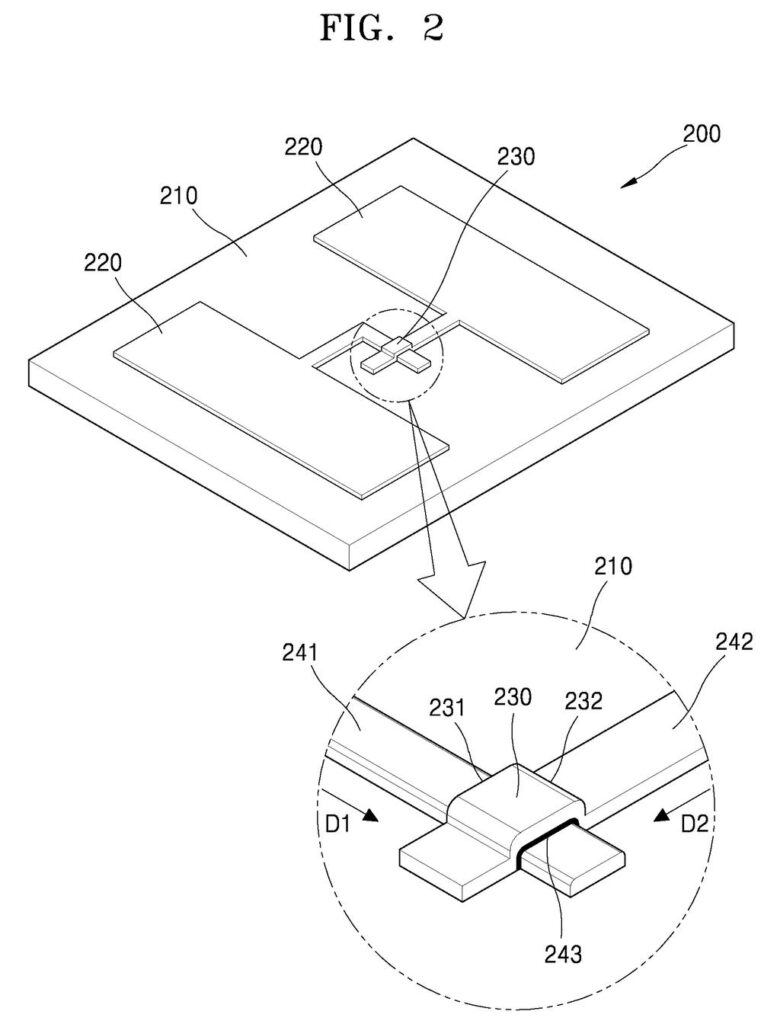
Each quantum device pairs a Josephson junction (two thin superconducting strips that overlap, with a very thin oxide layer between them) with capacitor pads (small plates that store charge). Together they form a resonance circuit, an electrical loop that vibrates at one particular frequency. The filing says that frequency affects how accurate quantum operations are.
The upper strip climbs over the lower one and back down onto the chip. The junction therefore has a top edge (the crossing along the top) and step edges (where the strip climbs up and down). The claims tie the ratio of those two lengths to resistance dispersion, meaning how much measured resistance varies across junctions built the same way.
In the filing's comparison, 32 junctions of each of two shapes had the same overlap area. The group with step edges longer than the top edge varied less. The filing says earlier research assumed resistance tracked overlap area alone.
The filing also describes a design routine:
- Look up the overlap area that matches a target resistance.
- Look up the edge ratio that matches a target spread.
- Set both edge lengths to fit.
The claims cover the hardware: one device, or a chip of many devices sharing one ratio.
Why matching quantum parts matters for accuracy
A quantum computer is only as dependable as its individual parts. This filing goes after one source of mismatch, the spread in electrical resistance between parts, which feeds into how closely each part hits its target frequency. The filing says tighter frequencies mean better accuracy for quantum operations and for how devices link up with each other.
For Samsung, the pitch is manufacturing control: pick a shape at the design stage and get more consistent chips out of the factory. The filing even says a resistance shift caused by the shape can be corrected by changing the thickness of the oxide layer. Nothing in it describes a product you could buy.
Samsung's 177th filing in our Chip coverage since May follows one on failure-predicting memory and one on slimmer phone cameras in the applications we've tracked.
The distance from this filing to something shippable is short, because it changes a drawing and little else. It describes the same superconducting materials, the same oxide layer and the same chip-printing process a quantum chip already uses, with one dimension chosen differently.
The road has limits. The evidence is one comparison of 32 parts against 32 parts, and the filing says the narrowest strip is capped by what the factory's printing process can produce. A working quantum computer also has to exist around the part first, and nothing here says how close Samsung is to one.
Verdict: a modest manufacturing refinement that customers will never see, and one a chip designer could fold into a layout without new equipment. If it shows up at all, it will show up as parts that land closer to their target frequency.
Get our take in your Top Stories
Liked this breakdown? Add Patentlyze as a preferred source on Google, and our plain-English take shows up more often in your Top Stories the next time Samsung patent news breaks.
There are more where this came from
We read every patent application Big Tech publishes and send you the ones worth knowing. Plain English, free, every week.
The drawings
9 drawing sheets from US 2026/0324298 A1 · click any drawing to enlarge


Show the other 1 sheets

Want this weekly breakdown for a company we don't cover? Patentlyze Pro →
Be the first to weigh in