
OpenAI Files Patent for a Live Progress Feed of What Its AI Is Thinking
Ask an AI to solve a maze from a photo and it can think for nearly two minutes. OpenAI's patent application is about what appears on your screen during that wait.
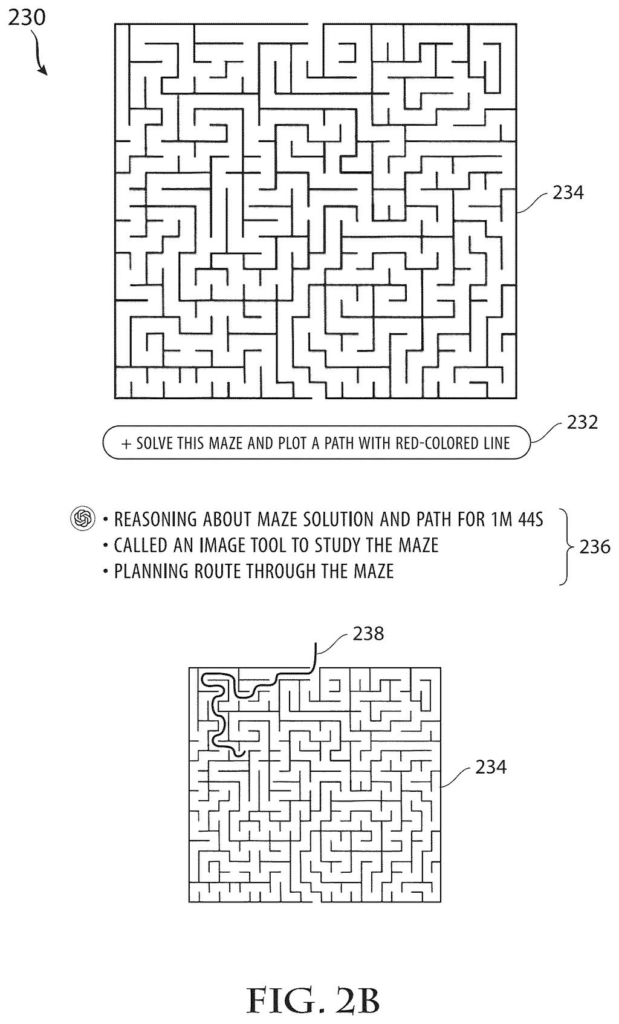
What OpenAI's reasoning progress feed shows
You upload a photo of a maze and ask an AI to solve it. Then your screen sits there for nearly two minutes while the model thinks, searches the web, and runs code behind the scenes. Is it working? Is it stuck? You have no idea.
OpenAI's patent application describes a back end built to fix that. As the AI thinks, its raw notes pile up in a hidden area. A second AI model reads those notes in batches and writes a short title and summary for each step, something like "Planning a route through the maze." Answers from tools, such as a web search or an image edit, get lined up so everything shows up in the right order.
The raw notes stay private. You only see the cleaned-up version, as it happens.
… buffering the reasoning tokens; determining when to release the reasoning tokens and the tool-call responses to a summarization model to provide released tool-call responses and a subset of released reasoning tokens; …
Translation: It holds back the AI's internal thoughts and tool results until the right moment to summarize them.
How the hidden notes become step summaries
The system starts by turning your input (a typed prompt plus any attached image, audio or video) into tokens, the small chunks of text and data an AI model reads. A reasoning model then produces its own running notes, called reasoning tokens, and decides when to call tools, such as a web search, a code runner or an image editor.
That creates two streams. Tool answers go into an ordered queue so they appear in the right sequence. The reasoning notes are held in a buffer and handed to a separate summarization model only when a threshold is met. The filing gives examples: release after about 50 new tokens, or after about one second, whichever comes first. Chunk sizes can also grow, for instance from 150 tokens at first to 300 or more later.
The summarization model then writes a step summary, and the claims add several options:
- A title and short description for each step, formatted so an app can display it.
- Visibility flags marking which pieces can be shown and which are protected intermediate reasoning.
- A recap message at the end of each turn.
- Earlier summaries fed into later ones so the story stays consistent.
The result goes out through an API (a way for other software to plug in) or into the conversation window. The raw reasoning lives in an analysis channel that, in some versions, is thrown away after the turn.
By coordinating asynchronous tool-call execution, reasoning token buffering, and incremental summarization, the method improves latency management and enables structured, context-aware summaries for multimodal reasoning outputs.
Translation: Managing background tasks and hidden thoughts helps the system generate organized summaries faster.
Why watching an AI think could build trust
If you have waited on an AI that is searching, coding and editing a picture all at once, you know the dead air. This design aims to keep you informed with short, ordered updates while the model's raw thoughts stay out of view. Developers who use the API could get the same structured summaries to show in their own apps.
For OpenAI, it also draws a line between what the model works through and what it chooses to show. The filing says that separation protects 'secret sauce' reasoning and gives the company control over how much of the thinking users see. Whether that satisfies people who want full transparency is a separate question, and the patent leaves it to settings the company controls.
OpenAI's second AI recommendation patent we've tracked since October follows one on short user profiles.
Waiting on a machine with no feedback is one of the oldest frustrations in computing, and it has real costs. People abandon sessions, assume something broke, and lose confidence in the tool itself. As AI systems take on longer and more complex jobs, that silent stretch grows from uncomfortable to untenable.
A status feed that updates at least once a second gives people something real to read while the work happens. That small change addresses a problem that compounds over time: every unexplained pause is a small withdrawal from whatever trust the user brought to the session.
Some of what a model reasons through privately is not appropriate to show a user, and routing those raw notes away from the display without discarding them entirely is a practical solution to a problem most people never see but everyone would recognize. The approach is proportionate to the problem it targets.
Get our take in your Top Stories
Liked this breakdown? Add Patentlyze as a preferred source on Google, and our plain-English take shows up more often in your Top Stories the next time OpenAI patent news breaks.
There are more where this came from
We read every patent application Big Tech publishes and send you the ones worth knowing. Plain English, free, every week.
The drawings
12 drawing sheets from US 2026/0330193 A1 · click any drawing to enlarge


Show the other 4 sheets


Want this weekly breakdown for a company we don't cover? Patentlyze Pro →
Be the first to weigh in