
Google Files Patent for Keeping Ad-Targeting AI Accurate Without Starting Over
Every time a website guesses what you're into, an AI score gets turned into a yes or a no. Google's patent is about keeping that cutoff honest as people and trends change.
What Google's ad-prediction cutoff patent does
Ever wondered how a website decides you're a "travel person" when all it knows is the page you're on, your device and your rough location? An AI model makes a guess and hands back a score, something like "72% likely to be interested in travel." Somewhere along the line, a cutoff turns that score into a yes or a no.
This Google patent is about that cutoff. Over time, people's habits shift and the AI's scores drift out of step with reality. The usual fix is retraining the whole model, which is slow and costly. Google's filing leaves the model alone and instead re-sets the cutoff using fresh data, such as past ad logs and survey results.
The cutoff can be tuned to hit a target. If surveys say 30% of an audience likes a topic, the system can adjust until roughly 30% get labeled that way. It then checks the new cutoff against safety rules before using it to decide which ads and videos show up on your screen.
… applying the one or more calibration thresholds to the prediction scores generated by the machine learning model to generate calibrated prediction data comprising one or more predicted classifications …
Translation: Adjusting the AI's scoring system so it stays accurate without needing to be retrained from scratch.
How Google re-tunes its yes-or-no cutoffs
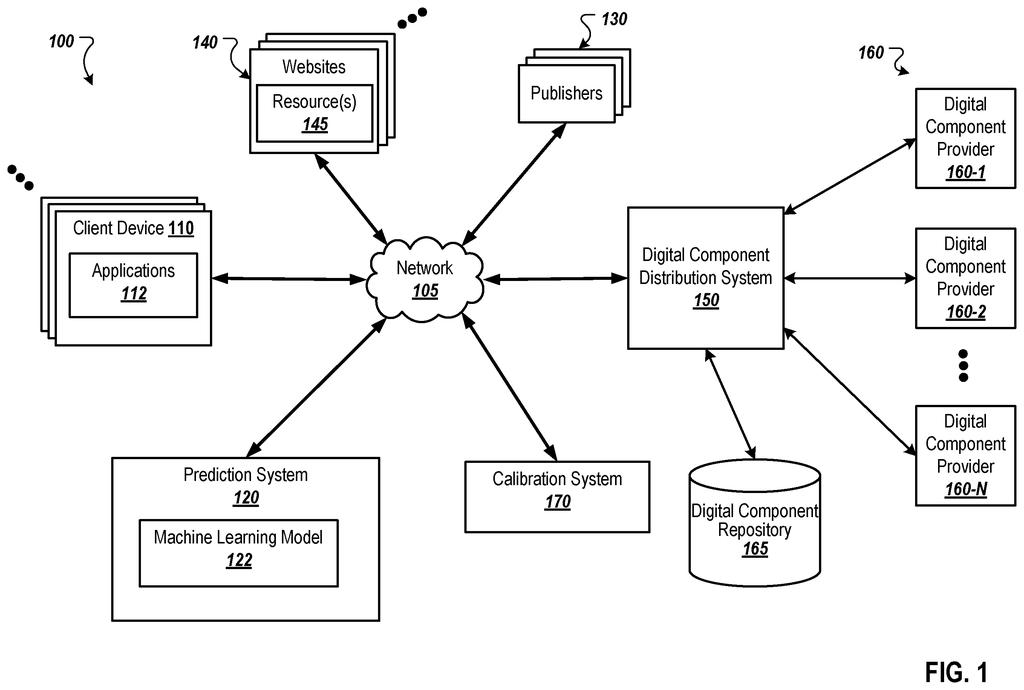
The patent describes a calibration system that sits between an AI model and the system that delivers content. The model produces prediction scores (numbers saying how likely a user is to be interested in a topic, or how likely a video is to suit an audience group). The calibration system turns each score into a yes-or-no label by comparing it to a threshold (a cutoff value), and the delivery system picks content based on those labels.
To set the thresholds, the system first builds a calibration dataset on request, using data that differs from the model's training data. Sources include ad logs and survey results, joined by shared keys such as an event ID and a user ID, which can be encrypted. It can also drop audience segments that have little relevance to an ad, and it can shrink stored numbers by rounding and packing them.
Then it searches for thresholds that meet goals. One goal is matching a known distribution (if surveys say 30% of an audience likes a topic, about 30% should be labeled that way). Another is quality, such as precision (how often a 'yes' is correct) and lift (how much better than random guessing). It can solve all goals at once (joint optimization) or one after another (piece-wise optimization), which the filing says takes less computing.
Finally, new thresholds are checked against validation rules, such as minimum and maximum values, and the whole process can repeat daily, weekly, monthly, or when survey data shifts.
The system performs one or more calibration processes to generate one or more calibration thresholds using the calibration dataset …
Translation: It creates a fresh set of guidelines based on recent data to keep the ad targeting aligned with reality.
Why ad AI needs upkeep without full retraining
If you've ever seen an ad that seemed oddly on target (or oddly off), the labels behind it come from a cutoff like this. Keeping those labels accurate means the ads and videos you get are more likely to fit what you care about, and content that doesn't fit doesn't need to be sent at all, which the filing says saves bandwidth.
For Google, the appeal is upkeep. The filing says retraining a large model each time the data shifts burns time and computing power, so adjusting the model's output on a schedule is cheaper. It also notes the approach works from the details in a single request, with no third-party cookies, which matters as browsers block them. Nothing in the patent says it is in use today.
Google's 22nd filing in the AI recommendation space we've tracked since May follows earlier applications like one hiding advertiser data and one masking your location.
Model drift is a costly, everyday headache for any company running prediction AI at Google's size. People's interests change, new trends appear, and a model trained last spring slowly gets worse. Retraining a big model each time costs real money and computing power, so a cheap fix for staleness has obvious value.
The answer here fits the size of that problem. Adjusting a cutoff with fresh survey and log data is a small, repeatable job that can run on a schedule, and the minimum and maximum checks guard against a bad update. It is plain maintenance engineering, and that is the right scale for a maintenance problem.
It also leaves a bigger question untouched: how well anyone can guess your interests from a few signals. A better cutoff keeps the guesses lined up with reality. Each result is still an estimate of you built from a handful of clues.
Get our take in your Top Stories
Liked this breakdown? Add Patentlyze as a preferred source on Google, and our plain-English take shows up more often in your Top Stories the next time Google patent news breaks.
There are more where this came from
We read every patent application Big Tech publishes and send you the ones worth knowing. Plain English, free, every week.
The drawings
4 drawing sheets from US 2026/0320429 A1 · click any drawing to enlarge


Want this weekly breakdown for a company we don't cover? Patentlyze Pro →
Be the first to weigh in